

Creatine Loading Phase Explained: Do You Need One?
You don’t need a creatine loading phase, but it gets you full muscle saturation in about a week instead of a month. Loading means taking 20–25 grams daily, split into four 5-gram servings, for five to seven days. Then you’ll drop to 3–5 grams daily. If you skip loading, you’ll reach saturation in three to four weeks. You might gain a water weight or feel bloated, so stick around to learn how to avoid it.
Key Takeaways
- A creatine loading phase means taking 20–25 grams daily, split into four or five doses, for 5–7 days to saturate muscles quickly.
- Loading is not essential, because 3–5 grams daily fully saturates muscles in about 3–6 weeks with similar long-term results.
- Loading mainly offers speed, so it suits athletes, or anyone needing results within 1–4 weeks, while recreational lifters and vegetarians can skip it.
- Loading can cause water retention of roughly 1–3 kg, plus bloating, loose stools, and stomach upset, especially with doses above 10 grams.
- To avoid discomfort, skip loading, keep servings at or below 5 grams, take creatine with food and water, and use micronized powder.
What Is a Creatine Loading Phase?
A creatine loading phase is a short burst of higher creatine intake that saturates your muscles’ creatine stores faster than a standard daily dose would. You typically use it at the start of supplementation, and it lasts 5 to 7 days.
The standard loading dose is 20 to 25 grams per day, or about 0.3 grams per kilogram of body weight. You don’t take it all at once. Instead, you split it into four or five servings, often 5 grams each, which improves tolerability.
Loading means 20 to 25 grams daily, about 0.3 grams per kilogram of body weight. Split it into four or five servings for better tolerability.
Creatine monohydrate is the form most loading protocols use. The goal is speed. Loading builds an energy reserve in your muscle tissue quickly, so you may notice benefits sooner than with gradual buildup. Creatine is derived from amino acids and helps boost ATP levels, the compound that fuels your muscles at a cellular level.
Loading isn’t permanent. Once you finish, you drop to a maintenance dose of 3 to 5 grams once daily to keep your stores elevated. It’s a short protocol, not a habit.
Do You Really Need to Load Creatine?
You don’t need a loading phase to get the full benefits of creatine.
A standard daily dose of 3 to 5 grams reaches the same muscle saturation as loading, just more slowly.
Loading gets you there in about 5 to 7 days, while skipping it takes roughly 4 to 6 weeks.
A 1996 study found that taking just 3 grams daily led to full saturation after 28 days.
Loading Is Optional
Although creatine loading gets a lot of attention, you don’t have to do it to make creatine work. A steady daily dose of 3–5 grams eventually saturates your muscles just as effectively.
The main difference is speed, not results. Loading simply gets you there faster, usually within a week, while skipping it means you’ll need about four weeks of consistent use to reach similar saturation.
Research summaries find no meaningful long-term difference between loading and steady maintenance dosing. If you take creatine consistently, you’ll still get its benefits without a loading phase.
Loading makes sense when you want quick results over a short period. If you’re supplementing for months or longer, steady dosing is generally enough. Some people also report mild, temporary gastrointestinal distress during loading, and avoiding a loading phase is one strategy that may help minimize it.
Loading is an optional shortcut, not a requirement.
Faster Saturation Timeline
Speed is where loading earns its reputation. When you take about 20 g/day, usually split into several smaller doses, your muscles reach saturation in 5–7 days.
One classic study found that six days of loading raised muscle total creatine by roughly 17–20%, from about 127 to 149 mmol/kg dry muscle. Most of that rise happens early, so you’ll see your biggest gains in the first few days before stores level off.
If you take 3–5 g/day instead, you’ll reach the same ceiling in about 28 days. That means loading gets you there three to four times faster. The steady approach is gentler on the gut, whereas loading may cause moderate GI discomfort.
Still, you won’t reach a higher creatine level. Loading only changes how fast you get there. If you need near-term training support, load; otherwise, you can wait.
How Long Does Creatine Take to Work Without Loading?
When you skip the loading phase, creatine takes about three to four weeks to fully saturate your muscles. You’ll take 3 to 5 g daily from day one, and the same dose maintains saturation afterward. Consistency matters more than timing, since daily intake keeps your muscle stores rising.
| Timeframe | What you’ll notice | Saturation |
|---|---|---|
| Weeks 1–2 | Subtle effects | Rising gradually |
| Week 2 | Possible early gains | Partial |
| Weeks 3–4 | Clearer strength and power gains | Full |
| After week 4 | Full benefit | Maintained |
Small improvements may begin around week two, but strength and power benefits generally lag behind the start of supplementation. Most people notice changes around week three or four, once intramuscular creatine climbs enough.
Skipping the load means you’ll wait about a month instead of about a week. The tradeoff is speed, not effectiveness: you’ll reach the same muscle saturation level eventually, without a rapid jump in your creatine intake. Research shows that loading and maintenance dosing produce identical final phosphocreatine concentrations, so skipping the load doesn’t reduce your long-term results.
Who Should Load Creatine, and Who Can Skip It?
Whether you should load comes down to one question: do you need results soon?
Loading is a speed choice, not a requirement, since maintenance dosing still reaches full saturation in several weeks.
You should consider loading if:
- You’re a strength, sprint, or repeat-effort athlete facing a meet or testing day within 1–4 weeks.
- You’re heading into surgery or a forced rest period and want rapid creatine support.
- You play a concussion-prone sport and want faster creatine elevation.
You can skip loading if you’re a recreational lifter, a beginner, or a long-term user.
Vegetarians and vegans can skip it too, unless a deadline is near. Start with 3–5 g/day, and you’ll build stores without the hassle.
Avoid loading if you’re prone to bloating, have a sensitive stomach, or can’t tolerate large oral doses.
Weight-class athletes cutting for weigh-ins and endurance athletes should skip it to avoid rapid water-weight gain.
How Do You Run a Creatine Loading Phase?
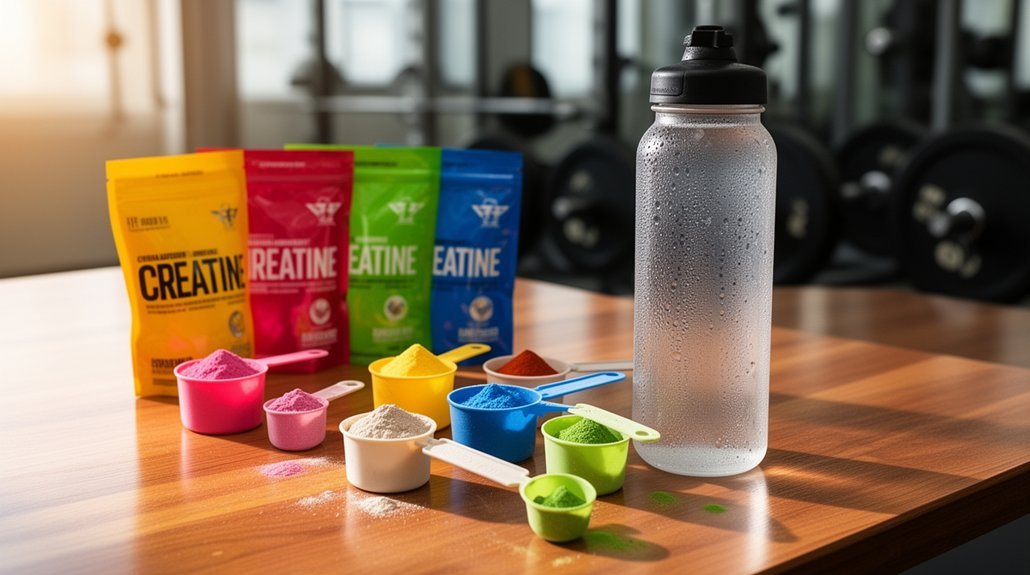
You’ll run a creatine loading phase by taking 20–25 grams daily for 5–7 days, split into 4–5 equal servings.
A common setup is 5 grams four times a day, which saturates your muscle creatine stores quickly.
If you’d rather scale the dose to your size, you can use about 0.3 g/kg of body weight per day instead.
Standard Loading Protocol
A standard creatine loading phase means taking 20–25 g of creatine monohydrate per day for 5–7 days, which saturates your muscles’ creatine stores faster than low-dose supplementing.
Don’t take it all at once. Split your total into 3–4 servings, since larger single doses can upset your stomach.
Try this example: 5 g four times daily for 5 days, spaced like this:
- Morning: take your first 5 g with breakfast.
- Midday and post-workout: take 5 g at each, keeping the doses separate.
- Evening: finish with your last 5 g, ideally alongside a meal or carbohydrate-containing drink.
Expect your body weight to rise by 1–3 kg, mostly from water retention, during loading.
Once loading ends, you’ll switch to a maintenance dose of 3–5 g per day.
Weight-Based Dosing Option
Two numbers drive weight-based loading: 0.3 g of creatine monohydrate per kilogram of body weight, per day, for 5 to 7 days.
If you weigh 70 kg, that’s about 21 g daily; at 80 kg, you’d take about 24 g. Larger bodies get larger doses, since the calculation scales directly with kilograms.
Split your daily amount into 3 or 4 servings, roughly 5 g each, and take them with meals. Smaller doses are easier on your stomach than one large serving, and they keep your intake even throughout the day.
Once loading ends, don’t keep the high dose. Drop to maintenance at 0.03 g/kg daily, about 2.1 g at 70 kg or 2.4 g at 80 kg.
Others suggest 3 to 5 g daily.
How Much Creatine Should You Take After Loading?
Once your loading phase ends, drop to a maintenance dose of 3–5 g per day. This keeps your muscle creatine stores elevated instead of raising them further. Your body uses creatine daily, so stores decline if you stop taking it.
After loading, drop to 3–5 g daily. This keeps your muscle creatine stores elevated, since your body uses creatine every day.
Pick the approach that fits you:
- Fixed dose: Take 3–5 g daily, which works for most people.
- Weight-based: Use 0.03 g/kg daily. If you weigh 80 kg, that’s about 2.4 g.
- Larger frame: If you’re heavier or carry more lean mass, aim for the upper end of the range.
Health Canada’s guidance lists 2–5 g per day as maintenance options after loading. Take your dose once daily, ideally with meals. Most people continue for several weeks to months, and long-term daily use is also acceptable.
If you skipped loading, you can use the same 3–5 g daily dose. You’ll reach saturation more slowly, usually in about 4 weeks.
What Does Loading Do to Strength and Weight?

Loading affects your weight faster than your strength, so don’t expect a big jump on the bar in the first week. A seven-day loading protocol of 0.3 g/kg/day didn’t improve maximal or explosive strength in strength-trained lifters. You may complete more reps and total work first, though, before your one-rep max moves.
Over time, the strength benefits are real but modest. Paired with resistance training, creatine adds about 4.43 kg to upper-body strength and 11.35 kg to lower-body strength versus placebo. Loading mainly saturates your muscles faster, so those changes can show up earlier.
Expect the scale to move. Body mass typically rises by about 0.86 kg overall, and it often climbs during loading. That gain mostly reflects extra water inside your muscle cells, not fat.
Fat mass and body-fat percentage usually stay flat, while lean mass increases with training. Loading adds scale weight faster than visible muscle.
Can Loading Cause Bloating, and How Do You Avoid It?
Yes, loading can cause bloating, and it’s the phase when people report it most. When you take 20–25 g daily for 5–7 days, creatine pulls water into your muscles, and unabsorbed creatine can draw water into your gut. You might notice a fuller feeling, loose stools, or stomach discomfort. Single servings above 10 g are the biggest culprits. The effect is usually temporary, and it isn’t a sign of harm.
You can avoid it easily:
- Skip loading and take 3–5 g daily from the start.
- Split your doses so each serving stays at or below 5 g.
- Take creatine with food and plenty of water, and choose micronized powder so it dissolves fully.
If you’ve already started loading and feel uncomfortable, reduce your dose immediately. Symptoms usually resolve quickly.
Since loading is optional, you lose nothing by choosing the gentler, simpler route, especially if your digestion is sensitive.
Frequently Asked Questions
Should I Take Creatine With Food, or Can I Take It on an Empty Stomach?
You don’t need food for creatine to work, so you can take it on an empty stomach. Your body absorbs it well either way.
Still, you’ll get slightly better muscle uptake if you pair it with carbs or protein, especially during loading. If you’ve got a sensitive stomach, take it with a meal and split larger doses.
Otherwise, don’t stress about timing; you’ll benefit most from taking it every day.
Does the Type of Creatine, Like Monohydrate or HCL, Change Loading?
Not really. The type mainly changes how you’d typically dose, not what your muscles can hold.
Monohydrate has the strongest evidence for loading, so you can take 20 g daily for five to seven days if you want faster saturation. You don’t have to, though; 3–5 g daily gets you there in about four weeks.
HCl brands say you don’t need loading, but you won’t find proof it beats monohydrate.
What Should I Do if I Miss a Dose During Loading?
Take your next scheduled dose at the usual time and keep going. You don’t need to restart the loading phase, and you shouldn’t double up, since that can upset your stomach.
One missed dose only delays saturation by about a day. If you missed a substantial amount, you can add one extra loading day to make up the total.
Consistent intake across the week matters more than perfect daily timing.
Do I Need to Cycle off Creatine After a Loading Phase?
No, you don’t need to cycle off creatine after a loading phase. Research doesn’t support mandatory breaks, and healthy adults tolerate long-term use well.
Once you’ve finished loading, you can drop to 3–5 grams daily and keep going. If you stop, your muscle stores will gradually fall over several weeks, so you’ll lose the benefits you’ve built.
Cycling off simply doesn’t improve how your body responds to creatine later on.
Is It Safe to Take Creatine With Caffeine or Other Supplements?
Yes, you can safely take creatine with caffeine and most other supplements if you’re healthy.
Research doesn’t show a dangerous interaction, though caffeine might blunt some of creatine’s performance benefits.
You’ll mostly risk stomach upset, and late-day caffeine can wreck your sleep.
Drink plenty of water.
Check labels on stimulant-heavy pre-workouts, and talk with your doctor if you’ve got kidney problems, Parkinson’s disease, or take medications that affect your kidneys.
Conclusion
You don’t need a creatine loading phase to get results. Loading simply saturates your muscles faster, usually within a week, while a steady 3–5 grams daily gets you there in about a month. If you’re impatient or preparing for a competition, you can load. If you’ve got a sensitive stomach or you’re not in a rush, skip it. Either way, consistency matters most, so pick the approach you’ll actually stick with.