

How Much Creatine Should You Take Per Day?
You need just 3 to 5 grams of creatine monohydrate daily. That’s enough for most adults, and consistency matters more than timing. If you’re smaller, 2 to 3 grams can work. Larger athletes might need 5 to 10 grams. You don’t have to load creatine, either. You’ll reach full muscle saturation within a few weeks by taking your steady daily dose. Keep going to find out how loading, body weight, and long-term safety factor in.
Key Takeaways
- Most adults should take 3 to 5 grams of creatine monohydrate daily, and consistent daily intake matters more than timing.
- Body weight guides dosing at about 0.03 g/kg per day, so smaller adults may need only 2 to 3 grams.
- Larger athletes may need 5 to 10 grams daily, though digestive issues become more common at doses above 10 grams.
- Loading with 20–25 grams daily for 5–7 days saturates muscles faster but isn’t required and may cause diarrhea or dizziness.
- People with kidney, liver, or diabetes concerns, or who are pregnant, breastfeeding, over 60, or taking NSAIDs, should consult a doctor first.
How Much Creatine Should You Take Per Day?
How much creatine do you actually need each day? For most adults, 3 to 5 grams of creatine monohydrate covers it.
Most adults only need 3 to 5 grams of creatine monohydrate daily, and there’s no need to cycle on and off.
That’s the standard maintenance dose, and you don’t need to cycle on and off.
If you’d rather scale to your size, use 0.03 g/kg per day. At 70 kg, that’s about 2.1 grams, though most sports guidelines still recommend 3 to 5 grams for practicality.
Some reviews cite 2 to 3 grams as enough for general health.
You might need more if you’re a larger athlete. Your body turns over roughly 2 to 4 grams of creatine daily, and that need rises with lean mass and training load.
Some sports medicine guidance suggests 5 to 10 grams per day for bigger bodies.
Timing matters less than consistency, so take your dose every single day. Taking far more than recommended offers no added benefit and may cause stress on kidneys without significant gains.
If you have kidney disease, talk with a doctor before you start supplementing.
Do You Really Need a Creatine Loading Phase?
You don’t need a loading phase to get the full benefits of creatine.
Loading, at 20–25 g a day for 5–7 days, saturates your muscles in about a week, while a 3–5 g daily dose gets you to the same place in three to six weeks.
Choosing the slower route also reduces the risk of side effects such as diarrhea, dizziness, and weight gain that can come with loading.
Loading Versus Steady Dosing
Although creatine loading gets plenty of attention, you don’t need it to see results. The difference comes down to speed, not the final outcome.
Loading means taking 20–25 g daily (or about 0.3 g/kg) for 5–7 days. Split it into four or five servings, such as 5 g four times a day.
You’ll saturate your muscles faster, and intramuscular stores can rise 20–40%. Expect a 1–3 kg gain in body mass, mostly water, not fat.
Steady dosing means taking 3–5 g daily. You’ll reach the same saturation, but it takes about four weeks. A 1996 study found that full saturation occurred after 28 days of taking just 3 g daily. This approach is simpler for most routines, and 3–5 g daily also maintains your levels afterward.
Choose loading if you need faster saturation. Otherwise, choose steady dosing and build up gradually.
Who Benefits From Loading
Three groups of people get the most from a creatine loading phase: athletes in high-intensity sports, lifters chasing early strength gains, and anyone working against a short deadline. Loading saturates your muscle creatine within about a week instead of several weeks.
Loading fits these situations best:
- Sprinters and power athletes: Repeated bursts rely on phosphocreatine recycling, so you’ll notice benefits sooner.
- Strength-focused lifters: You’ll reach saturation faster, which can speed early strength and power gains.
- Competitors and campers: A 5 to 7 day protocol delivers benefits before your event or training camp starts.
- Anyone prioritizing early progress: You’ll accept multiple daily servings for visible short-term training results.
Loading is optional. If you’re not in a hurry, steady daily dosing gets you similar end results. Skipping loading is possible because muscle creatine reaches saturation over approximately four weeks with just a maintenance dose of 3 to 5 grams per day.
What Is the Best Creatine Dose Without Loading?
If you’re skipping the loading phase, you’ll want to take 3–5 g of creatine monohydrate daily, and 5 g is a practical default for most adults.
At that dose, your muscles typically reach full saturation in about four weeks, which is slower than loading but ends in a similar place. Research also shows that creatine supplementation elevates creatine levels in both resting and exercised muscle (Harris et al., 1992).
Your body size matters too, so if you’d rather tailor your intake, you can aim for roughly 0.03 g per kilogram of body weight.
Standard 3–5 G Daily Dose
A daily dose of 3–5 g is the standard answer when you want to take creatine without loading.
You skip the faster loading phase and rely on consistent daily intake, so you’ll reach similar muscle saturation with enough time.
Here’s how to apply it:
- Choose creatine monohydrate, the best-studied form for this range.
- Take 5 g daily as your simple default; it works for most adults.
- Drop to 3 g if you prefer the low end of the accepted range.
- Adjust for body size if you’re heavier; larger athletes may need 5–10 g daily.
Your goal is maintaining elevated muscle creatine stores.
Lower daily doses have improved muscle mass, performance, and recovery versus placebo, and they’re practical for long-term use and for simpler routines.
Time to Full Saturation
Skipping the loading phase means you’ll wait longer for full muscle saturation, but you’ll still get there. Taking 3–5 g of creatine monohydrate daily typically saturates your muscles in about 3 to 4 weeks. Research shows 3 g per day produces similar increases in muscle creatine over roughly 28 days.
| Approach | Daily Dose | Time to Saturation |
|---|---|---|
| Loading | 20 g | 5–7 days |
| No loading | 3 g | About 28 days |
| No loading | 3–5 g | 3–4 weeks |
| No loading | 3–5 g | 21–28 days |
The tradeoff is speed, not results. Your final saturation level matches what loading achieves. Expect about a month, not a few days.
Once you’re saturated, keep taking your daily dose to maintain elevated muscle creatine levels. Skipping loading costs time but keeps things simple.
Adjusting Dose by Body Weight
Your body weight determines the most precise no-loading creatine dose, and the standard formula is 0.03 g/kg/day of creatine monohydrate.
You’ll take it once daily, starting at maintenance from day one. Use these weight-based targets:
- 45 kg: about 1.4 g/day
- 60 kg: about 1.8 g/day
- 70 kg: about 2.1 g/day, which you can round to 2–3 g/day
- 80 kg: about 2.4 g/day, often rounded to 2.5–3 g/day
If you weigh 100 kg or more, you’ll need about 3.0 g/day or more.
Smaller adults usually land near 2–3 g/day, while larger adults land closer to 3–5 g/day. This scaling keeps smaller users from taking unnecessary excess and keeps larger users from underdosing.
If you’d rather skip the math, a flat 3–5 g/day fits most adults.
How Do You Load Creatine Step by Step?
Loading creatine takes five simple steps, and you can finish the whole phase in about a week. First, choose a loading period of 5 to 7 days. Second, set your daily total at 20 to 25 grams, or use about 0.3 g per kg of body mass. Third, split that total into four or five servings. Fourth, take each serving with a meal or snack, since food makes the routine easier to tolerate. Fifth, you’ll switch to a maintenance dose once loading ends.
| Phase | Daily Dose |
|---|---|
| Loading (5–7 days) | 20–25 g, split into 4–5 servings |
| Maintenance | 3–5 g once daily |
A common pattern is 5 g four times daily, spaced about every 4 hours. Mix each serving with water, and drink plenty of fluid daily, because loading can increase your fluid needs. Consistency matters more than exact timing. Carbohydrate-containing meals may also help absorption during the loading phase.
How Much Creatine per Kilogram of Body Weight?
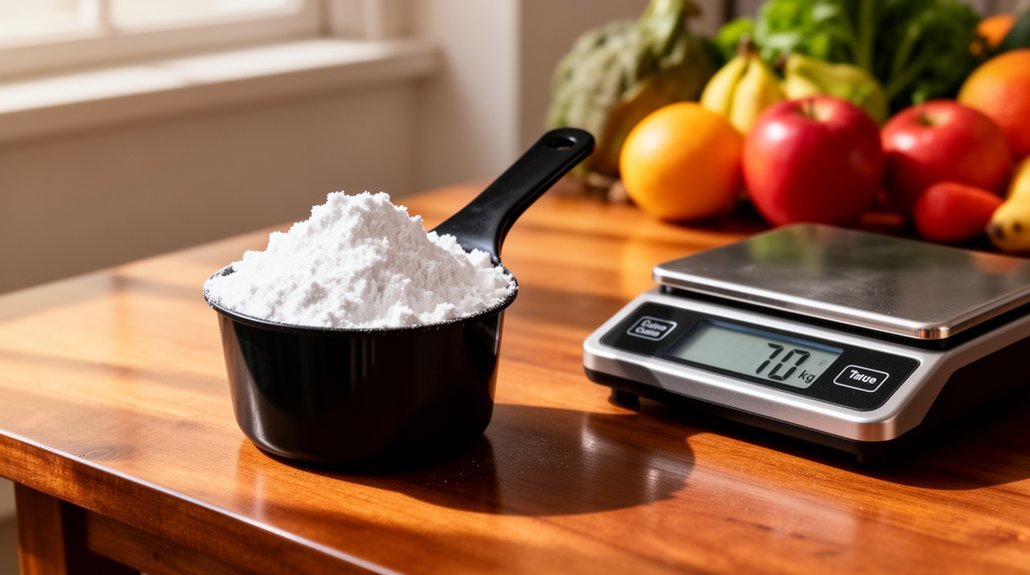
If a flat dose doesn’t fit your size, you can calculate your creatine by body weight instead. Weight-based dosing scales more precisely than a fixed amount, and multiple sports nutrition sources agree on the same two numbers.
- Loading: Take 0.3 g/kg/day, split into 3–4 doses, for 5–7 days.
- Maintenance: Take 0.03 g/kg/day once you’ve finished loading.
- 80 kg example: You’d take about 24 g/day to load and 2.4 g/day to maintain.
- 82 kg example: You’d take about 25 g/day to load and 2.5 g/day to maintain.
Compare your result with the common 3–5 g/day range. If you’re a larger adult, you may need more than 3 g/day to hit your target. If you’re smaller, you may need less than 5 g.
You can also skip loading and take 3–5 g/day, though your muscles will take about four weeks to saturate. Loading raises muscle creatine faster than maintenance-only use.
Does Age or Training Change Your Creatine Dose?

Why does the same 3–5 g/day range keep showing up whether you’re a beginner or a seasoned lifter? Because training status changes how much you benefit, not how much you need to saturate your muscles.
Creatine works best when you pair it with resistance training, so you’ll see clearer performance gains with a training stimulus. Whether you load (20 g/day for 5–7 days) or skip loading (3–6 g/day for 3–4 weeks), you’ll reach similar saturation.
Age matters more for how you calculate the dose. If you’re an adult, you’ll use the same fixed range. If you’re a teen or child, reviews favor weight-based dosing, such as 0.3 g/kg/day for 5–7 days, then 3–5 g/day.
Studies also used 0.1 g/kg/day, 0.05 g/kg/day, or fixed doses of 2–10 g/day, and adolescents tolerated them well.
Younger doesn’t automatically mean lower. Your body size, sport demands, and supervision should guide the dose.
Is Daily Creatine Use Safe Long Term?
Once you’ve settled on a dose, the next question is how long you can keep taking it. For healthy adults, daily creatine appears safe over the long term. Studies report no significant kidney harm from 5 days to 5 years of use, and creatine monohydrate ranks among the best-studied supplements.
Studies report no significant kidney harm from 5 days to 5 years of daily creatine use in healthy adults.
Here’s what matters most:
- Kidneys: Your GFR, proteinuria, and urea typically stay unchanged.
- Creatinine: Your serum creatinine may rise modestly because creatine breaks down into creatinine, but that doesn’t signal kidney injury.
- Dose: Safety evidence is strongest at 2–3 g daily for general health or 5 g for maintenance.
- Other risks: Reviews haven’t found convincing liver damage or increased cancer risk.
Higher short-term doses can raise urinary methylamine and formaldehyde, though harm hasn’t appeared.
If you have kidney disease, elevated kidney risk, or take medications affecting kidney function, talk with your doctor before starting.
Does Creatine Cause Bloating or Stomach Upset?
Creatine can cause bloating or stomach upset, but it doesn’t affect everyone, and your dose largely determines the risk. Early in supplementation, you might notice fluid retention that makes you feel bloated. Stomach upset is among the most common complaints, including cramping, nausea, belching, and loose stools.
Dose matters most. Single servings above 10 g cause digestive trouble more often, and loading phases of about 20 g daily raise your odds of symptoms. Doses of 2 to 5 g cause fewer complaints, and maintenance doses of 3 to 5 g are generally easier to tolerate.
You can reduce problems easily. Split your daily total into smaller servings, and avoid large single doses. Dissolve the powder fully, and take it with food if your stomach’s sensitive.
Choose plain creatine monohydrate without extra sweeteners or fillers, and watch for irritants like caffeine or sugar alcohols, which can make upset worse.
Who Should Talk to a Doctor Before Taking Creatine?
Some people should check with a doctor before they start creatine, even though it appears safe for most healthy adults.
You’ll want medical advice if any of these apply to you:
1. Kidney, liver, or diabetes concerns: Your kidneys process creatine, so existing kidney dysfunction calls for monitoring.
Creatine may also affect blood sugar, and liver disease warrants caution.
2. Pregnancy or breastfeeding: Safety data are limited, so you shouldn’t use creatine without medical advice.
3. Medications: Tell your doctor about every prescription, over-the-counter, vitamin, or herbal product you take.
NSAIDs deserve special mention because they can affect kidney function.
4. Age: Children and adolescents are often advised against creatine because safety data are limited, and adults over 60 benefit from guidance too.
If you’ve got several chronic conditions, a clinician review matters even more.
Don’t assume creatine suits every adult; a doctor can assess your specific risks and advise you accordingly.
Frequently Asked Questions
Does the Time of Day You Take Creatine Matter?
No, the time of day you take creatine doesn’t matter much. What counts is that you take it every day.
Studies show pre-workout and post-workout doses build similar muscle benefits, so you don’t need to stress over your schedule. On rest days, you can take it when convenient.
To remember it, pair it with a meal, since carbs or protein may boost absorption and make it easier on your stomach.
Can You Mix Creatine With Coffee or Caffeine?
Yes, you can mix creatine with coffee or caffeine. Healthy adults generally tolerate the combination well, and evidence doesn’t show coffee cancels creatine’s benefits.
You won’t likely get extra performance gains, though. If you notice stomach discomfort, space them apart or cut back on caffeine.
Stick with your usual 3–5 grams daily, and adjust your caffeine timing based on how you feel. Moderate caffeine works best for most people.
What Is the Best Type of Creatine to Buy?
Creatine monohydrate is the best type you can buy.
You’ll find it’s the most studied form, with the strongest evidence for strength, power, and muscle gain, plus a long safety record.
It’s usually cheaper than newer versions. Choose a plain powder with “creatine monohydrate” listed first, and look for third-party testing.
Don’t pay extra for HCl or other branded forms, since they haven’t proven better, unless monohydrate upsets your stomach.
Should You Take Creatine on Rest Days?
Yes, you should take creatine on rest days.
You’re keeping your muscle creatine stores saturated, not chasing an instant pre-workout boost, so consistency matters more than timing.
Stick with your 3 to 5 grams, and take it whenever you’ll remember, preferably with a meal.
If you skip rest days, you’ll slow your maintenance of those stores, especially after loading.
You don’t need a perfect routine; you need one you’ll follow.
What Happens if You Miss a Day of Creatine?
You won’t notice much if you miss a single day of creatine. Your muscles don’t lose their stored creatine quickly, since levels can take four to six weeks to return to baseline after you stop.
Just take your usual 3 to 5 grams at the next scheduled time, and don’t double up. If you’re loading, a missed dose might delay peak levels by about a day.
Repeated misses matter more.
Conclusion
Most people don’t need anything complicated. You’ll get reliable results with 3 to 5 grams of creatine monohydrate daily, and you can skip loading if you don’t mind waiting a few weeks. If you want faster saturation, you can load for a week, then drop to your maintenance dose. Stay consistent, drink plenty of water, and watch how your body responds. If you’ve got kidney concerns or take medication, check with your doctor first.