Creatine Benefits: What It Actually Does for Your Body
Creatine refills your muscles’ phosphocreatine reserve, so you’ll regenerate ATP faster during sprints, jumps, and heavy sets. That means you’ll squeeze out extra reps and build more strength and lean mass when you lift consistently. It may even speed your recovery and sharpen your memory. It won’t help much with endurance, though, and you’ll want to check your kidney health first if you’re unsure. Stick around, and you’ll uncover exactly who benefits most and why.
Key Takeaways
- Creatine raises muscle phosphocreatine by roughly 16.8%, helping regenerate ATP faster during short, high-intensity efforts lasting 30 seconds or less.
- Combined with resistance training, it produces greater strength gains than placebo, averaging 4.43 kg in the upper body and 11.35 kg in the lower body.
- It supports lean mass gains of 0.37 to 1.37 kg and may speed recovery by lowering creatine kinase, but only with consistent training.
- Cognitive benefits center on memory, with modest attention and processing-speed gains, especially in older adults, vegetarians, and people who are sleep-deprived.
- Creatine does not improve steady-state endurance or VO2 max, and water-retention weight gain may hinder endurance; 3-5 grams daily is considered safe for healthy adults.
How Creatine Powers Short, Intense Efforts
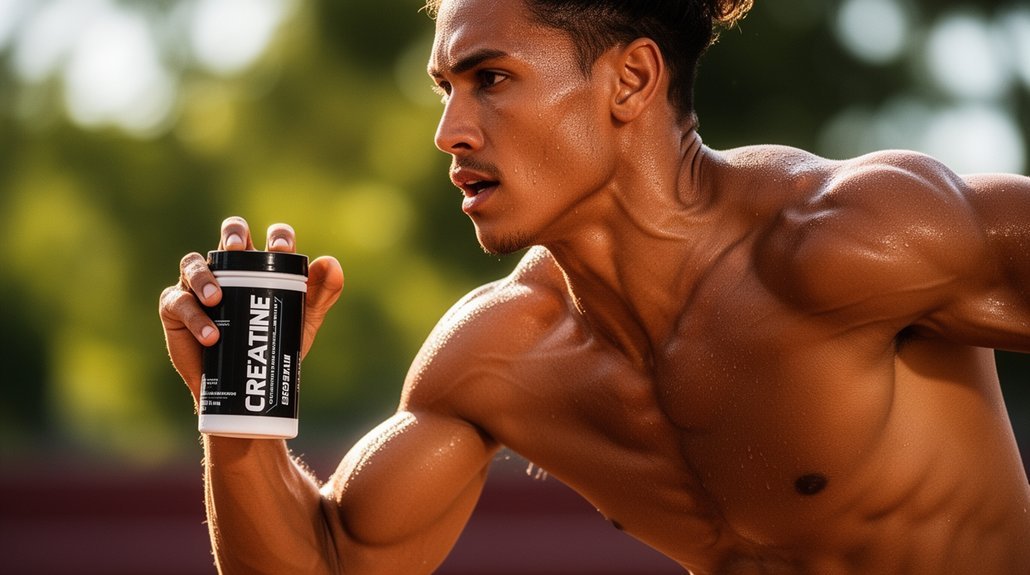
When you sprint, jump, or grind out a heavy set, your muscles burn through ATP faster than aerobic metabolism can replace it. Phosphocreatine, your fastest on-site energy reserve, fills that gap by resynthesizing ATP immediately. Creatine supplementation raises that reserve; one report showed muscle phosphocreatine rising about 16.8% from baseline after a short loading period. With more phosphocreatine available, you regenerate ATP faster between contractions and between efforts.
Creatine raises your phosphocreatine reserve, so you regenerate ATP faster between contractions and between efforts.
You’ll notice the clearest payoff in efforts lasting 30 seconds or less, when phosphocreatine dominates anaerobic ATP supply. Meta-analytic data show an effect size of 0.24 for these activities. One review found a 7.5% improvement with creatine versus 4.3% with placebo.
Repeated sprints benefit too: studies report higher peak and mean power, and triathletes improved anaerobic sprint-interval performance by 18%. During multiple bouts of high-intensity, short-duration activity, creatine groups improved by 4.9% while placebo groups declined by 2.0%.
Don’t expect a boost in long endurance pace, though. Creatine raises short-burst output intensity, not endurance capacity. Think explosive power.
Why Creatine Boosts High-Intensity Performance
Because creatine expands your phosphocreatine pool, your muscles have a larger, faster reserve to draw on when effort peaks. That matters most when you repeat brief, near-maximal efforts. Here’s how it plays out:
- Faster ATP resynthesis: Creatine helps you regenerate ATP quickly and rebuild phosphocreatine during rest between bouts.
- Steadier power: You’ll lose less output across repeated sprints, jumps, or heavy sets, especially with short rests.
- Delayed fatigue: Phosphocreatine depletion drives fatigue in short, intense work, so bigger stores postpone that limit and help you preserve force.
- Extra cellular support: Creatine may also improve hydrogen ion buffering and calcium handling, which supports faster force production.
Notice what creatine doesn’t do: it isn’t a stimulant. Its anti-fatigue effect comes from stronger phosphagen support, so you’ll see the biggest gains when rest is short and intensity stays high.
Over a full workout, that means you can sustain training quality longer. That performance benefit rests on the ATP-PCr system, in which phosphorylated creatine helps regenerate ATP.
How Much Strength Can Creatine Add?
How much stronger can creatine make you? Enough to notice, though you won’t transform overnight.
When you pair it with resistance training, one meta-analysis found adults under 50 gained 4.43 kg more upper-body strength and 11.35 kg more lower-body strength than placebo users. Other reviews report small to moderate effects, with Hedges g values between 0.31 and 0.6.
The gains vary by lift. Your bench or chest press might improve by about 1.43 kg, while your squat and leg press often show clearer benefits.
Your age, sex, and training history matter too. If you’re younger, male, or untrained, you’ll likely see larger, more consistent improvements.
If you’re older, you can still get stronger, but the effect tends to be smaller and more variable. Some analyses found no significant strength gains in females.
Creatine works best when you lift consistently. Treat it as a meaningful boost, not a shortcut.
Does Creatine Build Muscle and Lean Mass?

Yes, creatine helps you build muscle, but it works best when you pair it with resistance training.
It helps you train harder, and that extra work adds up to more lean mass than lifting alone, with meta-analyses showing average gains of roughly 0.37 to 1.37 kg depending on the population.
You won’t get the same payoff from supplementing alone, so treat creatine as an adjunct to your lifting rather than a replacement for it.
Creatine Plus Resistance Training
When you pair creatine with resistance training, you’ll generally gain more lean mass than you’d from lifting alone. The research points to four takeaways:
- Lean mass gains: Pooled analyses report roughly 1.1 to 1.4 kg more lean or fat-free mass with creatine.
- Muscle size: Trained lifters often see greater hypertrophy, especially in the upper limbs.
- Body composition: Your scale weight may rise about 0.9 kg, but fat mass typically doesn’t change meaningfully; that’s mostly lean tissue and water.
- Variable results: Age, training status, and study length matter, and some trials in healthy adults show no added benefit.
Expect a modest boost, not a dramatic transformation.
Creatine supports your training; it doesn’t replace it. A 12-week UNSW-led trial of 54 participants found that both the creatine and non-creatine groups gained an average of 2 kg of lean mass with resistance training. You’ll still need to train hard for it to count.
Greater Training Capacity
Creatine builds muscle mainly by helping you train harder, not by acting as a muscle builder on its own. It raises phosphocreatine availability, so you regenerate ATP faster during short, intense efforts.
Short-term loading can increase your muscle creatine stores by 20–40% and lift performance capacity by 5–10%. That means you can squeeze out more reps, sets, or sprints before fatigue hits.
Over time, that extra output gives your muscles a stronger growth stimulus. Reviews link creatine plus resistance training to about 1.1 kg more lean mass in adults. In young men, one meta-analysis found that creatine combined with resistance training increased fat-free mass by about 3.39 kg.
If you’re older, the gain averages about 1.4 kg in one meta-analysis, though a 2026 review found muscle mass changes uncertain and strength the clearest benefit.
Without training, you shouldn’t expect lean-mass gains from it.
Lean Mass Gains
Although creatine won’t build muscle on its own, it does help you gain more lean mass when you pair it with resistance training. It supports ATP generation in your muscles during intense workouts, which helps you perform more work in each session.
The research shows four key points:
- You’ll gain modestly: most reviews report roughly 2 pounds more lean mass than training alone.
- You need to lift: creatine alone hasn’t reliably increased lean mass, including in a two-year study of postmenopausal women.
- Some gain is water: creatine increases intracellular water, so lean mass readings may overstate actual muscle fiber growth.
- Results vary: age, training status, and measurement method shape your outcome, and one recent trial in healthy older adults found no added muscle benefit.
Treat creatine as a training booster, not an anabolic shortcut.
Lift consistently, and it’ll help you build more muscle.
Can Creatine Speed Up Recovery?

How quickly you bounce back from a brutal training session can decide how soon you’re ready for the next one, and creatine might give you an edge. The clearest benefit is lower muscle damage. Trials show lower creatine kinase levels versus placebo at 48, 72, and 96 hours after hard exercise, and force production returns faster.
Creatine may speed your recovery by lowering muscle damage, with reduced creatine kinase levels up to 96 hours after hard exercise.
You may also notice less soreness, possibly because creatine dampens the inflammatory response to muscle-damaging exercise. Don’t count on it, though. Some trials found no difference from placebo, and creatine doesn’t consistently reduce chronic inflammation markers like CRP and IL-6.
Glycogen recovery depends on timing. Creatine doesn’t speed it within the first six hours, but paired with a high-carbohydrate diet, it can boost glycogen storage over the following days, which matters when you train repeatedly.
Expect the benefits mainly after strenuous sessions, since results vary by exercise type, dose, and training status.
Who Benefits Most From Creatine?
If you’re a strength or power athlete, you’re in the group with the strongest evidence for creatine.
It supports repeated short bursts of high-intensity effort, like sprints and heavy lifts, and it delivers its biggest gains in strength, muscle mass, and performance when you pair it with resistance training.
If you’re an adult under 50 who trains consistently, you’re well positioned to take advantage of that combination.
Strength and Power Athletes
Creatine works best when your sport relies on short, maximal efforts, so strength and power athletes get the most out of it. If you lift, sprint, jump, or fight, you’ll likely notice these benefits:
- Higher maximal strength: You’ll often lift heavier, and your 1RM usually improves.
- More training volume: You’ll complete more work across repeated heavy sets.
- Greater power output: You’ll sprint faster, jump higher, and produce force more explosively.
- Quicker recovery between bouts: You’ll repeat explosive efforts more effectively.
Lean mass often increases too when you pair creatine with resistance training.
Team-sport athletes with repeated sprint demands and combat athletes also benefit during short, intense exchanges.
Adults Under 50
When you’re under 50 and follow a structured resistance-training program, you’ll see some of the clearest gains from creatine. Meta-analyses show that adding it to training improves upper-body strength by about 4.43 kg and lower-body strength by about 11.35 kg over 4–12 weeks.
You’ll notice the benefits through training adaptation, not casual use without exercise.
Your diet and lifestyle matter. If you’re vegetarian, you’ll likely respond more strongly because your baseline muscle creatine is lower.
If you’re sleep-deprived or under metabolic stress, you may notice more consistent improvements in fatigue, short-term memory, and reaction speed than rested peers do.
Cognitive effects vary. If you’re a healthy young adult, you’ll probably see mixed or limited changes, while illness or high cognitive demand can boost attention.
Does Creatine Sharpen Memory and Focus?
Memory is where creatine has the best evidence, and focus is where it gets murkier. A 2024 meta-analysis found a small memory improvement (SMD 0.31) with moderate certainty, plus slight gains in attention time and processing speed. Overall cognitive and executive function haven’t improved consistently, though.
You’ll likely notice the effect most in these situations:
- Older age: You may see memory and attention gains.
- Low dietary creatine: If you’re vegetarian, your memory may benefit more than meat-eaters’ would.
- Mental strain: Sleep deprivation or stress may amplify creatine’s payoff.
- Healthy young adulthood: Results stay inconclusive; one six-week dose-response study found no working memory, processing speed, or executive function improvement.
Why Creatine Won’t Help Endurance Much
Because steady-state aerobic exercise runs mostly on oxidative phosphorylation, you won’t get much from creatine if you’re training for distance events. Creatine fuels the ATP-phosphocreatine system, which powers short, intense efforts.
After roughly 150 seconds, your body leans on a pathway that doesn’t depend on creatine.
The research backs this up. Most studies show no meaningful change in VO2max, and time-trial performance usually doesn’t improve. A meta-analysis in trained athletes found a trivial, non-significant effect of -0.07 (p=0.47).
Body mass works against you, too. Creatine commonly adds water weight, and even a small gain can hurt running, cycling, or swimming efficiency, where economy matters most.
Creatine can help when your event includes repeated sprints, surges, or a finishing kick. Time to exhaustion may improve in high-intensity settings, but that rarely translates into faster race times.
Think of it as a tool for intermittent high-intensity bursts, not pure endurance.
Is Creatine Safe, and Who Should Check First?
Even if creatine suits your training, you’ll want to know it’s safe before you start. For healthy adults, creatine monohydrate has a strong safety record. Reviews haven’t found kidney damage at recommended doses, typically 3 to 5 grams daily.
Creatine can raise your blood creatinine without signaling kidney injury, so don’t panic over that number. Very high doses and long-term misuse cause most concern.
Creatine may raise your blood creatinine without signaling kidney injury, so a higher number alone isn’t cause for alarm.
Check with a clinician first if:
- You have kidney disease, since research there remains limited.
- You take medications that affect kidney function.
- You have diabetes or liver disease.
- You’re pregnant or breastfeeding.
Studies show healthy kidneys aren’t harmed. If your kidney status is unknown, ask for a kidney function assessment.
With existing kidney conditions, request non-creatinine markers, because creatinine can mislead. Expect some weight gain from water retention in muscle; that’s normal.
Consistent standard doses beat excessive amounts every time.
Frequently Asked Questions
What Is the Best Time of Day to Take Creatine?
The best time to take creatine is whenever you’ll remember it every day. Consistency matters more than the clock, because your muscles need repeated intake over days to weeks to build saturation.
On workout days, you’ll do well taking it within a couple hours before or right after training, since research doesn’t show a clear winner.
On rest days, you can take it with a meal to keep your routine.
Do I Need a Loading Phase When Starting Creatine?
No, you don’t need a loading phase. Taking 3–5 g daily saturates your muscles just as effectively; it takes about 3–4 weeks instead of 5–7 days.
Loading, usually 20–25 g daily split into smaller doses, gets you there faster, which helps if you’ve got a competition or training block coming up.
It can also cause 1–3 kg of water weight and stomach upset, so you’ll probably prefer the slower route.
Which Form of Creatine Is Best: Monohydrate or Others?
Creatine monohydrate is your best choice. You’ll find the most research supporting it, and no other form has convincingly beaten it for raising muscle creatine or improving performance.
Alternatives like hydrochloride may dissolve better, but that hasn’t produced better results, and ethyl ester actually performs worse.
You’ll also get the strongest long-term safety record, and you’ll pay the least, often just pennies per gram.
Stick with monohydrate for best value.
Should I Cycle on and off Creatine?
No, you don’t need to cycle creatine. Take 3-5 g daily, and you’ll keep your muscle stores saturated, which is what drives the benefit.
You won’t gain anything from periodic washouts, and healthy users haven’t shown negative effects from long-term use.
If you’re curious how you perform off it, you can briefly pause, but that’s just preference.
If you’ve got kidney issues or diabetes, talk with your doctor before starting.
Can Women Take Creatine, and Is Dosing Different?
Yes, you can take creatine, and you don’t need a different dose than men.
Aim for 3–5 grams of creatine monohydrate daily. You can load with 20 grams daily for 5–7 days, split into several servings, but it’s optional. Steady daily use works just as well over time.
If you’re pregnant, breastfeeding, or have kidney concerns, you’ll want to talk with your clinician before starting.
Conclusion
Creatine won’t transform you overnight, but it’s one of the most researched supplements you can take. You’ll likely notice better performance in short, intense efforts, modest strength gains, and possibly faster recovery. You might even get a small mental boost. Don’t expect endurance miracles, though. If you’re healthy, creatine’s generally safe, but you should check with your doctor first if you’ve got kidney concerns or take medications. Stay consistent, drink plenty of water, and let results build.