How Does Creatine Work? The Science Explained
Creatine helps your muscles recycle ATP, the fuel behind short, intense efforts. Your muscles store it as phosphocreatine, and creatine kinase hands a phosphate to ADP to rebuild ATP within seconds. Supplements raise your stores, so you’ll sprint and lift harder. It isn’t a stimulant like caffeine, and its effects build gradually. There’s more to uncover about how it enters your cells, how fast it works, and how you can get the most from it.
Key Takeaways
- Creatine is stored in muscle as phosphocreatine, and about 95% of the body’s creatine is held in muscle tissue.
- Creatine kinase transfers a phosphate from phosphocreatine to ADP, quickly regenerating ATP during the first 5–8 seconds of high-intensity effort.
- The SLC6A8 transporter pulls creatine from the blood into muscle cells using sodium and chloride gradients, and insulin can boost uptake.
- Supplementing raises muscle creatine stores, improving sprint performance by 1%–5% for single sprints and 5%–15% for repeated sprints.
- Combined with resistance training, creatine increases strength and lean mass, and it also supports recovery by reducing markers of muscle damage.
How Does Creatine Work to Recycle ATP?
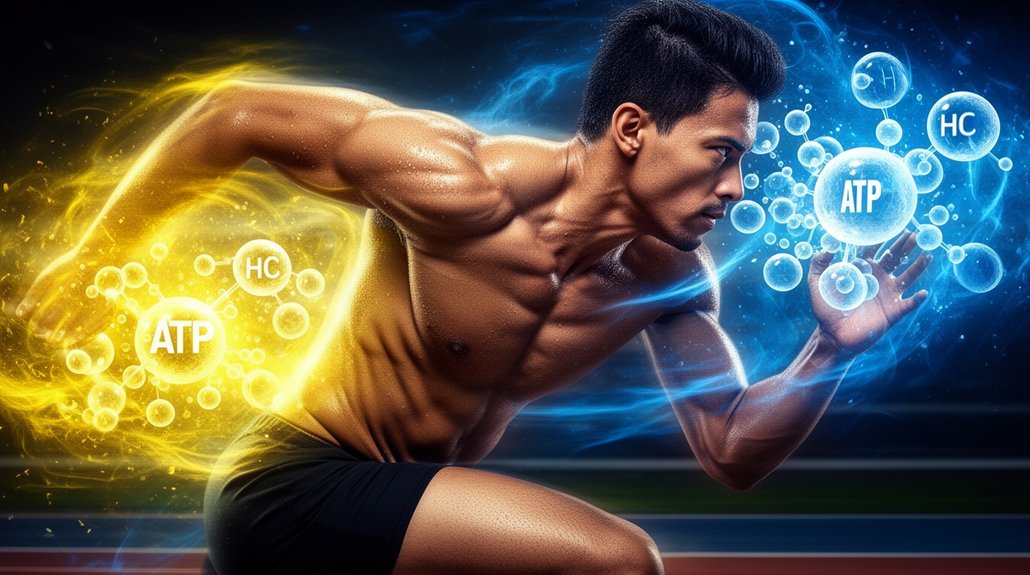
How does creatine keep your muscles powered when you sprint or lift something heavy? It recycles ATP through phosphocreatine (PCr), a high-energy phosphate reserve.
When you exert maximal effort, your cells burn ATP faster than oxidative metabolism can replace it. Creatine kinase (CK) solves that problem. It transfers a phosphate from PCr to ADP, reforming ATP. Because the reaction’s reversible, CK also recharges creatine into PCr using ATP your mitochondria produce.
This system carries most of the load during the first 5–8 seconds of all-out effort. It also works as a shuttle: mitochondrial CK builds PCr, PCr diffuses to where your muscle fibers use energy, and cytosolic CK regenerates ATP right there. Because about 95% of your body’s creatine sits in muscle cells, your muscle tissue is where this rapid energy exchange matters most.
Your resting muscle holds about 26 mmol/kg of PCr, and PCr can store up to 10 times the energy in your ATP pool. Supplementing raises your creatine stores, giving you more PCr for rapid ATP recycling.
How Does Creatine Get Into Muscle Cells?

Your muscle cells can’t make creatine, and it can’t slip through their membranes on its own, so they pull it in from your blood through a dedicated transporter called SLC6A8 (CRT1).
This transporter uses sodium and chloride gradients to move creatine against its concentration gradient, and once it’s inside, your cells convert it to phosphocreatine for quick ATP recycling.
SLC6A8 belongs to the solute carrier 6 family, specifically the neurotransmitter sodium symporters, which explains why its activity depends on sodium and chloride.
Because the transporter saturates, supplementing raises your muscle stores only until they fill, which is why loading gets less efficient over time.
Specific Creatine Transporter Role
Creatine can’t slip through your muscle cell membranes on its own, so it relies on a dedicated protein called SLC6A8 (also known as CRT1 or CreaT). This transporter sits on the sarcolemma and pulls creatine in against its concentration gradient. Like other cells, muscle cells depend on this sodium-chloride dependent transporter to bring creatine inside, where it can be phosphorylated to help regenerate ATP.
Picture the process:
- Creatine travels through your bloodstream to the muscle fiber’s surface.
- SLC6A8 grabs it like a doorman admitting only one guest.
- Two sodium ions and one chloride ion ride along as escorts.
- Your Na+/K+-ATPase pumps keep the sodium gradient steep, powering each entry.
- Creatine floods into the cell, ready for energy buffering.
Over 90% of cellular creatine uptake happens through this transporter, so it’s your muscle cells’ main gatekeeper.
If transporter function drops, creatine entry falls sharply, and muscle performance can suffer.
Conversion to Phosphocreatine Inside Cells
Once SLC6A8 pulls creatine inside, the real work begins. Creatine kinase, an enzyme in your muscle cells, transfers a phosphate group from ATP to creatine. This transphosphorylation forms phosphocreatine, the phosphorylated storage form of creatine. You don’t need a separate storage organelle; the creatine kinase system handles everything inside the cell.
The reaction runs both ways, so you can pull that phosphate back off when you need it.
| Step | Molecule | Result |
|---|---|---|
| Uptake | Creatine | Enters your cell |
| Conversion | Creatine and ATP | Phosphocreatine |
| Reversal | Phosphocreatine | Regenerated ATP |
In skeletal muscle, roughly 60% of your creatine exists as phosphocreatine and 40% stays free. Of the two forms, phosphocreatine is the pool you draw on first. Phosphocreatine then serves as your rapid, oxygen-free energy reserve during high-intensity effort. By enhancing ATP generation, this system supports the energy supply to your muscles during intense workouts.
Supplementation Boosts Muscle Stores
Supplemental creatine doesn’t reach your muscles directly. You absorb it into your blood first, and plasma levels typically peak about 60 minutes after you take creatine monohydrate.
Then the SLC6A8 transporter pulls it into muscle cells, using sodium and chloride gradients to move creatine against its concentration gradient.
Picture the process:
- Creatine enters your bloodstream and peaks near the 60-minute mark.
- SLC6A8 carriers on muscle membranes grab it from circulation.
- Sodium and chloride ions power the transport inside.
- Insulin from carbohydrates or protein boosts transporter activity.
- Exercise near your dose may speed uptake.
Your starting point matters. If you eat little meat or fish, your baseline stores run lower, so you’ll typically gain 20–40%.
If your stores already run high, expect just 10–20% gains.
Is Creatine a Stimulant Like Caffeine?
No, creatine isn’t a stimulant, and you won’t feel the alertness or jitters you’d get from caffeine.
Instead of acting on your central nervous system, it works as an energy buffer in your muscles, helping you regenerate ATP during short, intense efforts. Creatine is also not an anabolic steroid and does not increase testosterone levels.
Caffeine works differently, so it’s worth understanding how the two supplements don’t overlap.
Energy Buffer, Not Stimulant
Although creatine often shows up next to caffeine in pre-workout tubs, it doesn’t work like a stimulant. Instead, it acts as an energy buffer inside your cells, supporting ATP when demand spikes.
Picture what happens during a sprint or heavy set:
- Your muscles burn through limited ATP within seconds.
- Phosphocreatine hands a phosphate group to ADP.
- Creatine kinase speeds that transfer, restoring ATP almost instantly.
- Your ATP/ADP ratio stays steady, so energy stress stays low.
- Phosphate moves exactly where your cells need it most.
Supplementing raises your intramuscular phosphocreatine stores, so you can regenerate ATP faster through non-oxidative pathways.
You won’t feel an acute buzz or a faster heartbeat. Instead, you’ll notice the benefit during repeated sprints, heavy lifting, and other short, intense efforts.
How Caffeine Works Differently
Caffeine is the stimulant in your pre-workout, and it works through a completely different pathway than creatine. It blocks adenosine receptors, which raises alertness and wakefulness, and it acts on both your central nervous system and your muscles. You’ll feel it quickly, and performance doses typically run 2–6 mg/kg before exercise.
| Caffeine | Creatine |
|---|---|
| Stimulant | Not a stimulant |
| Blocks adenosine receptors | Supports cellular energy availability |
| Immediate stimulation | Gradual saturation |
| Can cause jitters | Unlikely to cause jitters |
Research shows no pharmacokinetic interactions between the two, so you can take them together. Some earlier studies suggested caffeine might blunt creatine loading, but newer findings report no major performance downsides. Some people experience digestive discomfort from the combination. Caffeine stimulates; creatine supports energy availability at the cellular level.
No Central Nervous Stimulation
Creatine isn’t a central nervous system stimulant, so you won’t get the buzz you’d expect from your morning coffee. Caffeine blocks adenosine receptors to activate your CNS. Creatine skips that pathway and regenerates ATP inside your cells instead.
When you take creatine, you’ll notice:
- No jitters or nervousness after your scoop.
- No sudden surge in perceived energy or alertness.
- Gradual performance gains as your muscles saturate with repeated use.
- No caffeine in pure creatine products.
- Possible brain energy support, not arousal.
Research suggests creatine may act as a neuromodulator in your brain. It may sit in synaptic vesicles and release during stimulation, facilitating neuronal firing.
That supports neuroprotection, metabolic resilience, and cognitive processing under stress, but it isn’t stimulant activity. Creatine fuels; caffeine stimulates.
Why Does Creatine Work for Sprints and Lifting?
When you sprint or lift something heavy, your muscles burn through ATP faster than your aerobic system can replace it. Creatine raises your intramuscular phosphocreatine, which rapidly regenerates ATP, so you preserve power when demand spikes. It doesn’t stimulate your nervous system; it simply recycles energy faster.
| Effort | Typical improvement |
|---|---|
| Single sprint | 1%–5% |
| Repeated sprints | 5%–15% |
Sprints under 30 seconds benefit most. Creatine also improves repeated-sprint performance because phosphocreatine replenishes more effectively during short recoveries, so you hold speed across later bursts.
Lifting follows the same logic. Heavy sets demand short, explosive ATP supply, so higher phosphocreatine helps you sustain force across repeated sets and heavy reps. Short-term use has increased maximal strength and power by about 5% to 15%, and it’s raised bench press volume and total work across sessions.
Longer, lower-intensity efforts typically show less consistent benefit, because they don’t depend on rapid, explosive ATP regeneration.
Does Creatine Work Better With Resistance Training?

Yes, you’ll get the clearest benefits when you pair creatine with resistance training rather than take it on its own. Meta-analyses show you’ll gain more upper- and lower-body strength than you’d from training alone.
- You’ll add about 4.43 kg to your upper-body strength and 11.35 kg to your lower-body strength if you’re under 50.
- You’ll gain roughly 1.37 kg of lean tissue, though muscle mass effects are smaller and less certain than strength gains.
- You’ll shed about 0.73 kg of body fat mass.
- You’ll push more weight on the chest press and leg press.
- If you’re older, you’ll still add about 1.4 kg of lean tissue.
Studies use 2 to 10 g daily, or 0.03 to 0.22 g/kg, for 4 to 12 weeks. Taking creatine only on training days has worked.
Women may see smaller or less consistent effects, so you’ll want structured training to maximize results.
Can Creatine Work as a Recovery Aid?
Strength and size gains aren’t the only reason you might take creatine, since it may also help you bounce back after hard sessions. The evidence is promising but mixed, so think of it as a possible recovery aid, not a guarantee.
Pooled analyses show lower creatine kinase, a muscle damage marker, at 48, 72, and 96 hours after exercise. Some trials also report less soreness after eccentric or exhaustive work, and faster restoration of force output.
Other controlled trials found no change in soreness, strength, or range of motion, even when creatine kinase improved. Inflammation results look inconsistent too.
You’ll likely notice the most benefit when training causes substantial muscle damage, such as eccentric loading or repeated intense sessions. Researchers have used short loading phases, like 20 g daily for six days or 0.3 g/kg daily for seven days.
Treat creatine as an adjunct, not a standalone fix.
How Long Does Creatine Take to Work?
Creatine works as soon as your muscles are saturated, and how quickly you get there depends on how you take it. Loading is the fastest route. Take about 20 g daily, split into four doses, for 5–7 days, then drop to 3–5 g daily. Skip loading, and you’ll still reach the same saturation, just later.
- Day 1: You start loading, and your muscles begin filling their creatine stores.
- Days 5–7: Your stores approach saturation, roughly 140–160 mmol/kg of dry muscle.
- Weeks 1–2: You notice better repeated high-intensity efforts in the gym.
- Weeks 2–4 without loading: Your 3–5 g daily scoops slowly build toward full stores.
- Week 4: Your muscles finally reach saturation, and benefits show up.
Several factors shift your personal timeline. Low starting stores, a diet light in creatine, genetics, and body mass all matter. Expect about a week with loading, or roughly a month without it.
Frequently Asked Questions
Is Creatine Safe for Long-Term Daily Use?
Yes, creatine’s generally safe for long-term daily use if you’re a healthy adult.
Research hasn’t found meaningful kidney harm at standard doses, and you’ll find the strongest evidence for creatine monohydrate at 3 to 5 grams daily.
You might notice temporary water retention or mild stomach upset.
Choose high-quality, well-tested products, and if you’ve got kidney disease or take kidney-affecting medications, talk with your clinician before you start taking it.
Which Form of Creatine Is Best: Monohydrate or Others?
Creatine monohydrate is your best choice. Researchers have studied it far more than any other form, and it’s the reference standard in sports nutrition.
You’ll absorb nearly all of it, and you’ll pay less for it. Alternative forms like ethyl ester, hydrochloride, and buffered creatine haven’t shown consistent advantage over it.
Marketers may promise better solubility, but you won’t get better results. Stick with monohydrate, and you’re choosing proven effectiveness.
Does Creatine Cause Water Retention or Weight Gain?
Yes, creatine can cause both, but it isn’t fat gain.
It pulls water into your muscle cells, so you’ll often notice a 1 to 3 kg jump during a 20 g/day loading week. Long-term, you’re likely to gain closer to 0.9 kg.
Not every study finds increased total body water, though, and your response depends on dose, training, and measurement.
You shouldn’t worry; that early scale bump is totally normal.
Do Women and Older Adults Benefit From Creatine?
Yes, you’ll likely benefit, especially when you pair creatine with resistance training.
If you’re a woman, you can improve strength and exercise performance, and if you’re postmenopausal, you may also support muscle, body composition, and possibly bone health.
If you’re over 60, you’ll typically gain more lean mass and strength than training alone provides.
Don’t expect much from 1 g daily, and skip it if you’re pregnant or breastfeeding.
Should Creatine Be Taken Before or After Workouts?
It doesn’t matter much, so you can take creatine before or after your workouts. Research shows you’ll get similar muscle and strength gains either way, as long as you’re taking it consistently every single day.
Some studies hint post-workout dosing gives you a slight edge for muscle mass, and it’s easy to pair with a meal or shake.
Pick whichever timing you’ll actually stick with, because consistency beats perfect timing.
Conclusion
Creatine works by helping your muscles regenerate ATP quickly, so you can push harder during short, intense efforts. It’s not a stimulant, and you won’t feel a buzz. Instead, you’ll notice gradual gains in strength, power, and recovery, especially when you pair it with resistance training. Stay consistent, and you’ll likely see results within a few weeks. If you’re looking for a well-researched supplement that supports your performance, creatine’s a smart choice.