Does Creatine Make You Gain Weight?
Yes, creatine can make you gain weight, but it’s mostly water, not fat. You’ll likely see a 1–3 kg jump in the first week, especially if you load with 20 grams a day. That’s because creatine pulls water into your muscle cells. Your weight typically levels off once your muscles are saturated. You won’t gain fat from it, and real muscle growth needs resistance training. Keep going, and you’ll see how to track your progress.
Key Takeaways
- Yes, creatine typically raises scale weight by 1–3 kg within the first week, especially during a loading phase of 20 g/day.
- Early weight gain comes mainly from water being pulled into muscle cells, not from fat.
- Weight gain usually levels off once muscles reach creatine saturation, and long-term use does not significantly change fat mass or body-fat percentage.
- Meaningful gains in lean mass, around 2.7–3.4 kg, occur mainly when creatine is combined with resistance training.
- Tracking measurements, progress photos, and workout performance helps distinguish temporary fluid shifts from real muscle growth.
Does Creatine Cause Weight Gain?
Yes, creatine can raise the number on your scale, but it’s not adding fat. Creatine contains no calories, so it can’t directly create body fat. Instead, it pulls water into your muscle cells, which raises your total body water. You’ll likely notice this shift early, especially if you take a loading dose.
Over time, your weight may reflect more than water. Creatine helps you train harder, and when you pair it with resistance training, you’re more likely to build muscle. Because skeletal muscle is denser than fat and water, the scale can climb without any increase in your waist circumference.
One meta-analysis found creatine increased fat-free mass by 1.39 kg and body mass by 0.89 kg, with no significant effect on fat mass or body fat percentage.
Keep in mind that early gains may not continue at the same rate once your muscle creatine stores are saturated. Treat the scale increase as normal and expected, not as unwanted fat gain.
Meanwhile, your body fat typically stays fundamentally unchanged.
How Much Weight Gain Should You Expect on Creatine?
Most people gain about 1–3 kg (roughly 2–6 lb) in the first week or two of creatine, especially if you use a loading phase of 20 g per day for 5–7 days.
If you skip loading, you’ll likely gain less because maintenance dosing raises weight more slowly.
Skipping the loading phase means slower weight gain, since maintenance dosing raises your weight more gradually over time.
Research supports a smaller long-term picture. A 2024 meta-analysis found an average increase of 0.86 kg over placebo, and a 2025 analysis of 61 trials reported 0.89 kg.
Individual results vary with your training status and supplementation schedule. In one study, responders gained between 0.4 and 1.9 kg.
Don’t expect fat gain. The 2025 analysis found fat-free mass rose 1.39 kg with no significant change in fat mass, so the scale mostly reflects lean mass and body water.
Your weight may rise before you notice visible muscle changes.
Over time, training adaptation drives changes. Most early gains stay within 1–2 kg.
Why Does Creatine Weight Gain Come From Water?
That early jump on the scale comes mostly from water, not fat or new muscle. Creatine is osmotically active, so when your muscles store more of it, they draw water in alongside it.
Here’s how it works:
- Sodium carries water in. Creatine enters your muscle through a sodium-dependent transporter, and water follows sodium to keep osmotic balance.
- Cells hold the fluid. Most of the extra water expands intracellular volume, so your muscles look fuller without adding fat.
- Loading amplifies it. One soccer-athlete trial found total body water rose 2.3 L and body weight rose 1.0 kg after just 7 days.
Don’t expect it to last, though. Some studies show no change in total body water over longer training periods, and results vary by sex, training status, and measurement method.
If you gain a kilo early on, you’re seeing fluid shifting into and around muscle, not fat.
Is Creatine Weight Gain Fat?
You’ve probably noticed the scale creeping up after starting creatine, and it’s natural to wonder if that’s fat.
It isn’t: creatine has no calories and your body doesn’t convert it into fat.
Instead, the added weight typically comes from water shifts and increased lean mass, which is what we’ll break down next.
Water Retention Explained
When you start creatine and the scale jumps within a few days, you’re almost certainly seeing water, not fat. Creatine builds up inside your muscle cells and pulls water in with it, which raises your intracellular fluid volume. Here’s what that looks like:
- Timing: You’ll notice the biggest jump during loading, within 3 to 7 days. Total body water rises about 0.86 L by day 3.
- Size: Expect roughly 1 to 3 kg early on. Your weight then plateaus after a few weeks.
- Location: The water sits inside your muscles, not under your skin, so your muscles look fuller while your body fat stays unchanged.
Creatine contains no calories, so it can’t add fat directly. Several clinical trials also show no fat mass change regardless of how long people supplement.
Skip loading, and you’ll likely see a smaller change.
Lean Mass, Not Fat
Creatine doesn’t add fat, so the extra weight on the scale comes from lean tissue and the water inside it. Pooled trial data back this up.
A 2025 meta-analysis found creatine raised fat-free mass by 1.39 kg without markedly changing fat mass. A 2024 review reported similar results: body mass rose 0.86 kg, fat-free mass rose 0.82 kg, and fat mass barely moved (0.05 kg, 95% CI −0.24 to 0.35).
Training strengthens the effect. A 2024 resistance-training meta-analysis found lean body mass increased 1.14 kg and body fat percentage fell 0.88%.
If you’re older, you may see a 0.55% greater drop in body fat percentage than with placebo. Expect the scale to rise typically under 1.5 kg, and that gain reflects muscle, not fat.
Does Creatine Loading Cause Faster Weight Gain?
Why does the scale jump so quickly when you load creatine? Loading, usually about 20 g daily for 5–7 days, saturates your muscles with creatine faster than maintenance-only dosing does. Your cells pull in water alongside it, so you’ll often see the scale rise within the first week.
- You’re gaining water, not fat. Creatine expands your total body water, and you’ll typically add 1–3 kg during loading. A 2017 trial showed the creatine group rising from 73.7 kg to 74.4 kg.
- Your results vary. Dose, training status, and baseline creatine stores shape how much you gain.
- The bump levels off. A 2024 meta-analysis found an average increase of 0.86 kg, so long-term changes run smaller than your initial jump.
Pooled data show no significant effects on fat mass or body-fat percentage.
When Does Creatine Weight Gain Level Off?
Your scale usually stops climbing within a few weeks, once your muscles reach creatine saturation. If you load, you’ll see the biggest jump in the first week, typically 1–3 kg, and then your weight steadies. If you skip loading and take 3–5 g daily, saturation builds more gradually, so expect about 3–4 weeks before you plateau.
After that, you’re in a steady-state phase. Your muscles keep some extra intracellular water as long as you take creatine, but you won’t gain much more from it. If your weight keeps rising, credit your training, nutrition, or new muscle rather than creatine’s water effect. And it isn’t fat, since creatine contains no calories.
Should you stop, your muscle creatine and its water drift back to baseline over 4–6 weeks. You might notice the scale dip gradually, depending on your previous dose, how long you used it, and your current training status.
Can Creatine Weight Gain Turn Into Muscle?
Some of the weight you gain on creatine can turn into muscle, but only if you’re lifting. A 2026 review in young men found significant gains in fat-free mass (+3.39 kg) and lean body mass (+2.70 kg) only when participants combined creatine with resistance training. Without training, you won’t see meaningful lean-mass benefits.
Keep three points in mind:
- Early gain is mostly water. Scale jumps in the first week or two don’t represent muscle growth. In a UNSW-led trial, the creatine group gained about 0.5 kg more lean mass before exercise began, which researchers attributed to potential fluid retention rather than actual muscle growth.
- Training drives the muscle. In one 2025 trial, both creatine and control groups gained about 2 kg of lean mass while lifting.
- Expect modest results. Meta-analyses show creatine plus lifting adds roughly 1.1 to 1.4 kg more lean tissue than lifting alone.
Creatine won’t build muscle by itself. Pair it with resistance training, and you’ll convert part of that scale gain into functional tissue rather than fat. Pooled trials show no significant fat gain.
Who Gains More Weight on Creatine?
Who gains more weight on creatine? You’ll likely see bigger scale changes if you fit certain profiles. Most of the early gain is water, not fat.
| Factor | Likely larger gain |
|---|---|
| Responder status | Bigger creatine uptake |
| Resistance training | Lean mass ~1.1 kg |
| Heavier, muscular build | Larger absolute scale change |
Responders gain more than nonresponders, often without extra fat. Nonresponders may already have high baseline creatine stores or lower uptake. If you eat little creatine, you’ll probably respond more, and fast-twitch dominance may help too.
Sex matters less than context. Some trials show women gaining about 0.5 kg more lean mass early, while older reviews favor men. Endurance training usually produces smaller, less consistent changes.
Loading typically adds 1–3 kg in a week; expect about 1–2 kg monthly with strength training. Because body size shapes percentages, the same 2 kg looks bigger on a lighter person than a heavier one.
How Can You Track Creatine Progress Beyond the Scale?
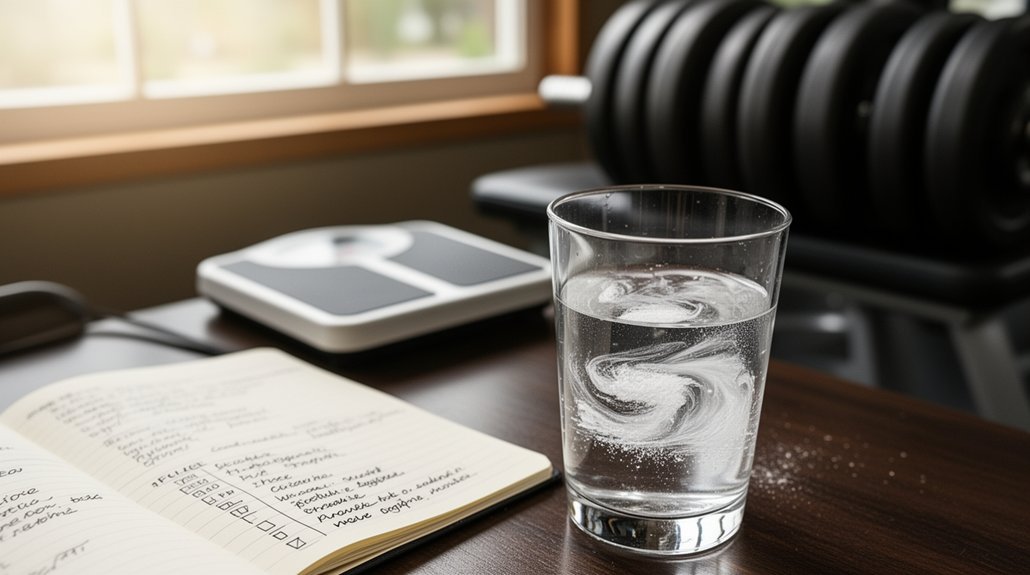
How can you tell if creatine is working when the scale mostly reflects water? Track performance, body composition, and recovery instead. Early weight gain often comes from water, so you’ll need better indicators.
Early creatine weight gain is mostly water, so judge results by strength, body composition, and recovery rather than the number on the scale.
- Strength and volume: Log weight, reps, and sets for your main lifts over 4–12 weeks. Look for extra reps at the same load, stronger final sets, or lower exertion ratings on a 1–10 scale.
- Body composition: Measure your waist and hips, and take progress photos in the same lighting, pose, and time of day. Weigh yourself each morning, and note fluid and sodium intake, so you can separate water shifts from real changes.
- Recovery: Record soreness duration, fatigue across repeated workouts, sleep, and appetite. If normal loads feel manageable sooner, creatine may be helping.
Watch muscle fullness in your shoulders, arms, thighs, and calves. These signals show whether creatine’s working, even when the scale’s misleading. A meta-analysis found that creatine users gain an average of 1.14 kg more lean mass than non-users.
Frequently Asked Questions
Will I Lose the Extra Weight if I Stop Taking Creatine?
Yes, you’ll likely lose it. Creatine mostly adds water inside your muscles, so when you stop, your stores decline over a few weeks and that extra fluid leaves.
You’ll typically drop about 1–5 pounds, often within the first one to two weeks. It isn’t fat loss, and you won’t lose real muscle if you keep training.
Your muscles might look less full, and your high-intensity performance may also dip briefly.
Does Creatine Cause Bloating or Stomach Discomfort?
It can, but you won’t necessarily experience it. Bloating and stomach discomfort show up most often during loading phases or when you take large single servings, like 10 g at once.
Studies at recommended doses show little difference from placebo. You can cut your risk by splitting doses into smaller servings, taking creatine with food, staying hydrated, and choosing micronized powder.
Loading can make you retain water, which feels puffy.
Is Creatine Safe for Women Who Want to Avoid Weight Gain?
Yes, creatine’s generally safe for healthy women who don’t want to gain body fat.
Reviews haven’t linked recommended doses to meaningful weight gain, and any scale change usually reflects temporary water in your muscles, not fat.
You’ll tolerate a smaller daily dose better than a loading protocol, so skip loading.
Don’t add extra calories unnecessarily.
If you’ve got kidney disease, you’re pregnant, or you’re breastfeeding, talk with your doctor first.
What Time of Day Should I Take Creatine?
You can take creatine at any time of day, because consistency matters more than the clock.
If you’d like a small potential edge, take it near your workout, though the evidence is mixed. Morning and evening doses work similarly.
On rest days, you’ll follow the same schedule. Pairing it with a meal helps you remember.
Since you’re avoiding weight gain, a standard 3–5 g daily dose keeps water retention gradual.
Which Type of Creatine Is Best for Minimizing Water Retention?
No creatine form’s proven better than monohydrate for minimizing water retention, so you don’t need to switch types.
Dose matters more. If you’re worried about scale weight, skip the loading phase and take a steady daily dose instead. You’ll still notice some minor early water gain, but it’s usually temporary and shifts into your muscle cells.
Just stick with monohydrate, since it’s the most studied and evidence-based option you’ve got.
Conclusion
Creatine can make the scale go up, but you shouldn’t worry. Most of that gain is water stored in your muscles, not fat. You’ll likely see a small bump in the first few weeks, and then it’ll level off. Over time, the strength you build can help you add real muscle. Don’t rely on the scale alone. Track your lifts, measurements, and photos, and you’ll get a clearer picture of your progress.