
Does Creatine Cause Hair Loss?
No human study shows that creatine causes hair loss. The worry comes from a small 2009 rugby study, where DHT rose 56% after loading. Researchers didn’t measure hair, though, and later work hasn’t replicated the finding. A 2025 trial found no changes in DHT or hair health in men over 12 weeks. If baldness runs in your family, you might be more sensitive to DHT, so keep going to see how to protect your hairline.
Key Takeaways
- No human study has shown that creatine directly causes hair loss or baldness.
- The myth comes from a 2009 rugby study, which found DHT rose 56% after a creatine loading phase.
- That study was small (20 players) and short, and it never measured hair loss or follicle density.
- A 12-week trial of 45 resistance-trained men found no significant changes in DHT, testosterone, or hair count and density.
- Genetic predisposition to androgenetic alopecia matters most, so people with a family history should monitor shedding and pause creatine if it clearly increases.
Does Creatine Cause Hair Loss?

Although creatine’s reputation for causing hair loss is widespread, no human study has shown that it thins your hair or causes baldness.
Creatine’s reputation for causing hair loss is widespread, but no human study has shown it thins your hair or causes baldness.
The worry traces back to a small 2009 study of college-aged rugby players. Researchers reported a 56% increase in DHT after a high-dose loading phase. But they didn’t measure hair loss or follicle changes, and no later study has reproduced that hormonal result consistently.
The strongest direct evidence points the other way. In a 12-week randomized controlled trial, 45 resistance-trained men took either 5 g of creatine monohydrate daily or a placebo. Researchers found no significant differences in DHT or hair growth measures, and this was the first trial to assess hair follicle health directly.
That doesn’t make creatine risk-free for every scalp. The trial lasted 12 weeks and didn’t test genetic risk, so you can’t rule out long-term effects if you’re prone to androgenetic hair loss. The researchers also did not measure DHT activity at the scalp, the primary area affected by androgenetic alopecia.
How Does DHT Cause Hair Loss?
DHT damages hair by binding to androgen receptors inside scalp follicle cells, especially in the dermal papilla, and changing how those cells behave. Once the DHT-receptor complex enters the nucleus, it shifts gene expression and triggers androgenetic alopecia, the most common pattern hair loss.
Here’s how the process unfolds in your follicles:
- Growth signals shift: DHT prompts dermal papilla cells to release TGF-beta2, DKK1, and IL-6, which inhibit follicle growth.
- The growth phase shortens: Anagen shrinks, so your hairs don’t have time to grow fully, while telogen lasts longer.
- Follicles miniaturize: Each cycle produces thinner, shorter, less pigmented hairs until terminal hairs become vellus-like.
- Density drops: As more follicles go dormant or miniaturize, thinning becomes visible at your frontal scalp and crown.
Susceptible follicles carry more androgen receptors and more 5-alpha-reductase, which converts testosterone into DHT locally. That’s why identical hormone levels thin one region but spare another.
Why Do People Blame Creatine for Baldness?
If you’ve heard that creatine causes baldness, you can probably trace the claim to a single 2009 study of college-aged rugby players.
Researchers found that DHT rose 56% after a seven-day loading phase and stayed about 40% above baseline after 21 days.
Because DHT is the hormone tied to male-pattern baldness, people didn’t wait for proof of actual hair loss before drawing a connection. However, the study itself reported no actual hair loss among the participants.
The 2009 Rugby Study
Most of the fear that creatine causes baldness traces back to one 2009 study of college-aged rugby players in the *Clinical Journal of Sport Medicine*.
You’re looking at a small, short, randomized, double-blind, placebo-controlled trial of just 20 men, and its details matter:
- Researchers gave players 25 g of creatine daily for 7 days, then 5 g daily for 14 days.
- Testosterone didn’t change notably, but DHT rose about 56% after loading and stayed roughly 40% above baseline.
- The DHT:testosterone ratio climbed about 36%, then settled near 22% higher.
- Nobody measured hair loss, density, or shedding.
You shouldn’t treat those numbers as proof of baldness. The creatine group started with DHT about 23% lower than placebo, and the levels stayed within normal clinical limits. Notably, twelve additional studies have found no significant hormonal increases from creatine, and the 2009 results haven’t been replicated.
DHT and Hair Loss
Dihydrotestosterone is the hormone that turns a lab result into a baldness scare. Researchers strongly link DHT, a more potent androgen derived from testosterone, to male-pattern hair loss. If your follicles are genetically sensitive to DHT, they’ll gradually shrink, producing thinner hairs and a shorter growth phase.
That’s why people blame creatine. The logic is simple: if a supplement raises androgens, it might raise DHT, and more DHT might accelerate balding if you’re already prone to it.
Creatine doesn’t directly kill follicles; the worry is hormonal. The theory is biologically plausible, but plausibility isn’t proof. A temporary rise in circulating DHT doesn’t automatically thin your hair, and it may not reflect what’s happening at your scalp.
Genetics, age, and long-term hormone exposure matter too.
What Did the 2009 Rugby Study Find?
You might expect the 2009 rugby study to show hair loss, but it only tracked hormones in 20 college-aged players who took creatine or a placebo for three weeks.
After a 7-day loading phase of 25 g daily, DHT rose 56% while testosterone didn’t budge, and it stayed 40% above baseline after 14 days at 5 g daily.
Since the researchers never measured hair density, shedding, or baldness, you can’t treat those numbers as proof that creatine causes hair loss. The study used a double-blind, placebo-controlled crossover design, which makes the hormone findings more reliable even though they don’t address hair outcomes.
DHT Increase Findings
When researchers tracked college-aged male rugby players in a 2009 study in the *Clinical Journal of Sport Medicine*, they found that creatine raised DHT markedly.
You’re looking at these changes:
- Loading phase: DHT jumped 56% after 7 days (P < 0.001).
- Maintenance phase: DHT stayed 40% above baseline after 14 more days.
- Testosterone: Levels didn’t change at either point, so the rise didn’t come from higher testosterone.
- DHT:testosterone ratio: It rose 36% at day 7 and stayed 22% higher afterward (P < 0.01).
These results suggest creatine may increase your body’s conversion of testosterone to DHT, as the authors noted.
That’s why hair loss discussions cite this study. Still, it doesn’t prove hair loss occurs: the researchers measured hormones, not shedding, density, or baldness. Higher DHT levels may raise the risk of hair loss mainly in people who are genetically predisposed.
Study Limitations Explained
Although the 2009 rugby study raised a real question about creatine and DHT, its design limits how much you can conclude from it.
| Limitation | What happened | Why it matters |
|---|---|---|
| Small sample | Only 20 players | Chance findings are likelier |
| Narrow population | Young, trained men | You can’t generalize to women or older adults |
| Short duration | Three weeks | Too brief to assess hair loss |
| Baseline imbalance | Creatine group started with lower DHT | Comparisons get murkier |
The study also didn’t measure hair loss. It tracked blood hormones, not hair counts or follicle miniaturization. Elevated DHT is a mechanistic marker, not proof of baldness. Later research hasn’t replicated it, and reviews don’t show creatine causes hair loss. Treat it as an early signal that needs replication, not evidence of harm.
Did Later Research Confirm Creatine Raises DHT?
Short answer: no, later research hasn’t backed up the claim. The DHT worry traces back to one small 2009 rugby study, and researchers haven’t reproduced it.
Here’s what you should weigh:
- The signal was narrow. That study measured serum DHT after a 25 g/day loading phase, then 5 g/day. It didn’t measure scalp DHT.
- Reviews found nothing. A 2021 review concluded creatine doesn’t raise testosterone, free testosterone, DHT, or hair loss.
- A better trial disagreed. In a randomized, double-blind, placebo-controlled trial, 12 weeks of creatine produced no significant DHT or DHT-to-testosterone changes.
- Hair showed no difference. The same trial found no change in hair growth or follicle health between groups.
You can’t call the link confirmed. The only positive finding is an old, isolated, unreplicated result, so DHT fears alone shouldn’t stop you.
The creatine-hair loss link remains unconfirmed, resting on one old, isolated, unreplicated result, so DHT fears alone shouldn’t stop you.
“Unproven” is the accurate label, and the evidence doesn’t support blaming creatine for hair loss.
What Did the 2025 Creatine Hair Trial Show?
The 2025 trial gave researchers their first direct look at hair follicle health during creatine supplementation, and it found nothing alarming.
Forty-five resistance-trained men, ages 18–40, took either 5 g/day of creatine monohydrate or 5 g/day of maltodextrin for 12 weeks, and 38 finished the study.
You might expect higher DHT, since that’s the rumored culprit. It didn’t happen. DHT, the DHT-to-testosterone ratio, and testosterone showed no meaningful differences between groups, and no group-by-time interaction appeared.
Hair measures didn’t budge either. Researchers found no differences in hair count, density, anagen or telogen rates, follicular units, terminal or vellus hair rates, or cumulative hair thickness.
What Do Reviews Say About Creatine and Shedding?
When you read through user reviews, you’ll find two camps: people who say creatine made their hair shed and people who say nothing changed at all. Neither side offers proof, so you’ll want to weigh the patterns carefully.
- Shedding reports: Users describe extra hairs in the shower or on combs, often after 3–7 months, and some say shedding eased after they stopped.
- No-change reports: Many reviewers report strength gains without hair problems, including some who’ve used creatine long term.
- DHT theory: Reviewers often cite the old rugby study showing higher DHT, but it didn’t measure hair loss.
- Confounders: Stress, diet changes, genetics, and normal telogen shedding could explain the timing.
Notice that negative reviews usually describe visible shedding, not lab-confirmed hair loss, while positive reviews are often brief.
Timing also varies widely from days to several months. Treat these reviews as anecdotes only, not as evidence of causation.
Is Creatine Risky With a Family History of Baldness?
How worried should you be if baldness runs in your family? Probably not very, but don’t assume total safety.
Family history drives androgenetic alopecia. Your follicles inherit a sensitivity to DHT, and that sensitivity can make thinning more noticeable over time, whether you take creatine or not.
The concern about creatine is theoretical. One small 2009 study reported a 56% DHT rise after loading, yet levels stayed within normal limits and nobody has replicated the finding.
A 2025 randomized trial found no significant differences in DHT, the DHT:testosterone ratio, or hair growth between creatine and placebo groups.
Still, that trial didn’t screen participants for hair loss predisposition, so it can’t answer your question directly.
It ran only 12 weeks with 38 men; researchers haven’t measured scalp-specific DHT or long-term shedding in high-risk people.
Creatine has no proven link to inherited baldness, but direct evidence in predisposed people remains limited.
How Can You Take Creatine and Watch for Shedding?
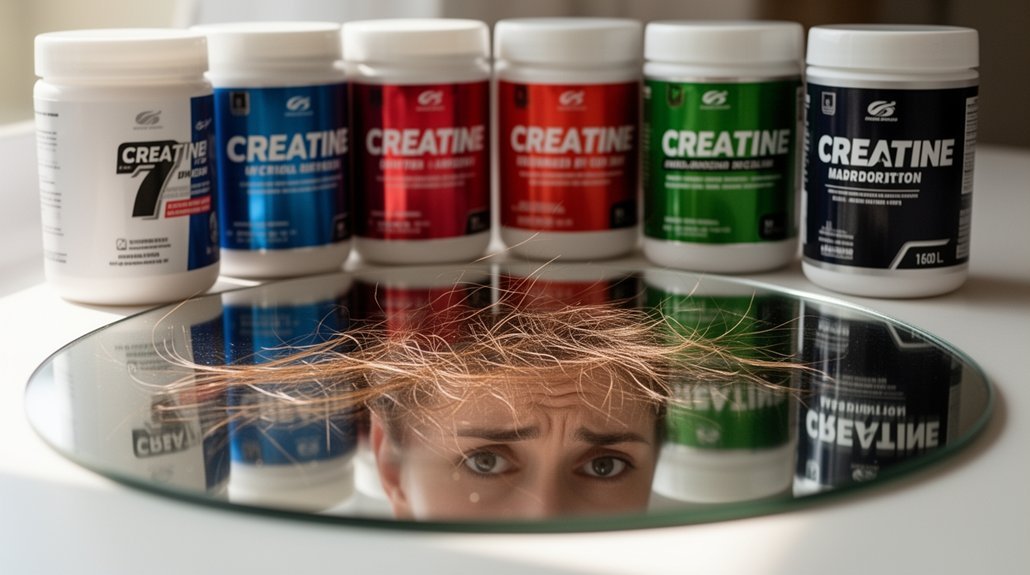
Want to use creatine without wondering whether every shed hair is its fault? Build a simple tracking system before your first scoop.
Stick to a fixed 3–5 g daily dose, and keep your brand, timing, and training routine consistent. That way, you’ll interpret any change more clearly. Skip loading phases unless a protocol requires one, since the 2009 rugby study used 25 g/day for seven days.
Here’s how to monitor your hair:
- Set a baseline. Photograph your hairline, temples, part line, and crown in identical lighting, and note your current shedding and any scalp symptoms.
- Log your start date. You’ll match later changes to timing.
- Recheck every 4 weeks. Repeat the photos and jot brief notes on diffuse shedding, a widening part, or crown thinning.
- Pause if shedding clearly increases. Stop creatine for 8–12 weeks while you keep tracking.
Also rule out stress, nutrition, thyroid, and scalp issues.
Frequently Asked Questions
Does Creatine Loading Affect Hair Differently Than a Standard Daily Dose?
Not in any way that’s been proven. Loading raised DHT in one small study, but that study didn’t measure your hair, so it can’t show shedding.
A 12-week trial found that 5 g daily didn’t change DHT, the DHT-to-testosterone ratio, or hair outcomes. If you’re cautious, you’d skip loading and take a simple daily dose.
Still, researchers haven’t replicated the DHT signal consistently, nor shown that loading causes hair loss.
Can Women Taking Creatine Experience Hair Thinning?
You could experience hair thinning while taking creatine, but nothing shows creatine causes it. No study has linked creatine to hair loss in women, and a 12-week trial found no change in DHT or testosterone.
Still, researchers haven’t studied women enough, so you can’t call the risk zero. If you’re predisposed to androgenetic alopecia, talk with your doctor.
If you notice thinning, you should check hormones, nutrition, stress, and scalp health.
Is Creatine Hair Loss Reversible if You Stop Supplementing?
Probably, yes, if creatine played any role at all. You haven’t got proof it causes hair loss, but if a temporary DHT bump triggered your shedding, stopping should let hormones settle and your hair regrow over the next few cycles.
If you’ve got male pattern baldness, though, quitting won’t restore follicles that DHT miniaturized. If you’re still shedding after stopping, you’re likely dealing with genetics, stress, or another medical issue.
Do Other Supplements Like Protein Powder or Testosterone Boosters Affect Hair?
Yes, but they don’t carry equal risk.
Protein powder is unlikely to cause hair loss if you’re healthy, since only protein deficiency typically thins hair.
Testosterone boosters worry researchers more. If they raise your androgen activity, they could speed up pattern hair loss when you’re genetically susceptible, though direct evidence is limited.
Ingredients vary widely, so you’ll want to check labels.
Also, you shouldn’t take extra vitamins or minerals unless you’re deficient, because some, like vitamin A and selenium, can worsen shedding.
Which Creatine Form Is Safest for People Worried About Hair Loss?
Creatine monohydrate is your safest bet.
It’s the best-studied form, and a 12-week randomized trial using 5 g daily found no changes in DHT or hair measures.
You won’t find head-to-head evidence showing HCl, ethyl ester, buffered, or nitrate forms protect hair better, and they’ve got less safety data.
Stick with standard doses instead of loading, since the old DHT concern came from 25 g daily.
Your genetics matter more.
Conclusion
You don’t need to panic about creatine and your hairline. The evidence doesn’t show that it causes hair loss. One small 2009 study found a DHT bump, but it didn’t measure baldness, and later research hasn’t confirmed a clear link. If baldness runs in your family, you’re smart to stay cautious. Start with a standard dose, track your shedding, and talk to your doctor if you notice changes. You can keep training with confidence too.