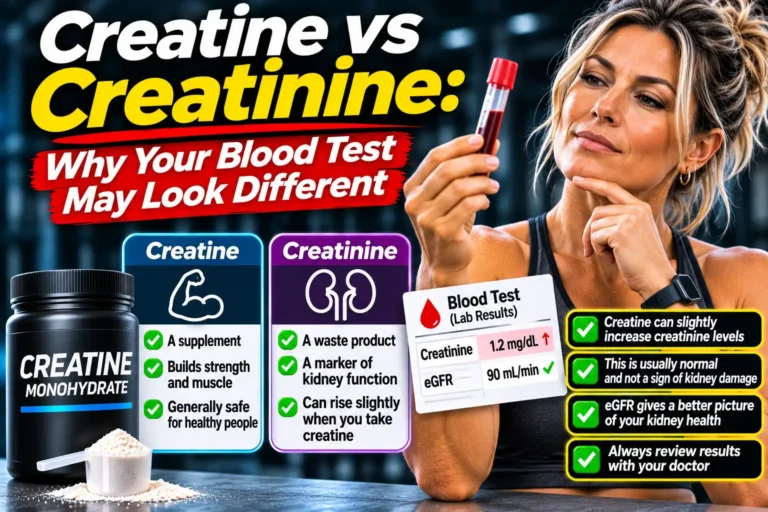

Creatine and DHT: What the Research Does and Doesn’t Show
Creatine hasn’t been shown to raise DHT in a way that matters for your hair. A small 2009 study of rugby players reported that blood DHT rose 56% after a creatine loading week, but it never measured hair. A 2025 randomized trial that measured both DHT and hair found no difference between creatine and placebo after 12 weeks at 5 g a day. Neither study looked at DHT inside the scalp, which is where pattern hair loss happens, so the question isn’t fully closed. Below, you’ll see what each study measured, why blood DHT tells only part of the story, and what it means if you’re prone to balding. For the hair side of this question, see our guide on whether creatine causes hair loss.
Key Takeaways
- A 2009 study of 20 college-aged rugby players reported a 56% rise in blood DHT after creatine loading, but it did not measure hair loss.
- A 2025 randomized trial of 45 resistance-trained men found no significant differences in DHT, the DHT-to-testosterone ratio or hair measures after 12 weeks of 5 g daily.
- Both studies measured DHT in blood, not in scalp tissue, so neither shows what happens at the follicle.
- The only DHT rise came from a loading protocol, and the 2025 trial didn’t use loading, so the effect of loading remains unproven.
- No human study shows creatine causes baldness. Genetics and follicle sensitivity matter far more than supplements.
What We Know and Don’t Know About Creatine and DHT
| Question | What the research shows |
|---|---|
| Does creatine raise blood DHT? | Yes in the 2009 loading study, no difference in the 2025 trial |
| Does it change testosterone? | No difference from placebo in either study |
| Does it raise DHT in the scalp? | Never measured |
| Does it change hair density or thickness? | No change in the 2025 trial |
| What about long-term use? | Unknown |
| What about women or men with a family history? | Not studied directly |
Does Creatine Raise DHT?

It might have in one small group, but the evidence doesn’t show a lasting or meaningful effect. The worry traces to a 2009 rugby study, in which players took 25 g daily for seven days, then 5 g daily for 14 days, and their blood DHT rose 56% after loading and stayed 40% above baseline during maintenance.
The researchers measured blood DHT, not DHT in the scalp, which is what matters most for androgenetic hair loss. They also didn’t measure hair. No human study has shown that creatine causes visible hair loss or baldness, and you can’t point to a proven causal link.
The rugby study measured blood DHT, not scalp DHT, and it didn’t measure hair at all.
A 2025 randomized trial tested resistance-trained men taking 5 g daily for 12 weeks. DHT, the DHT-to-testosterone ratio, hair density, follicular unit count and hair thickness didn’t differ from placebo. Still, the trial was small and short, and it measured DHT in blood too, so longer studies in people prone to balding would help.
How Does DHT Cause Hair Loss?

DHT, or dihydrotestosterone, forms when the enzyme 5-alpha-reductase converts testosterone. It binds androgen receptors more tightly than testosterone does, and in genetically susceptible scalp follicles, that binding changes how the follicle behaves. Variants in the gene for the androgen receptor are among the factors that influence how strongly follicles respond.
The result is a shorter anagen phase, which is the active growth stage. With each cycle, the follicle spends less time growing thick hair and more time resting. Repeated cycles lead to miniaturization: terminal hairs gradually grow thinner and shorter, and some follicles eventually produce fine, vellus-like hairs.
That’s the hallmark of androgenetic alopecia, which shows up as visible thinning in a patterned distribution. The key point for this topic is that susceptibility matters more than the amount of DHT in your blood. Two men can have the same DHT level, and only the one with sensitive follicles loses hair.
What Did the 2009 Creatine DHT Study Find?
The 2009 study in the Clinical Journal of Sport Medicine is the main human research behind the creatine and DHT debate. Researchers gave 20 college-aged male rugby players creatine and placebo in a double-blind crossover design with a washout period between the two phases. The creatine protocol used 25 g a day for 7 days, then 5 g a day for 14 days.
DHT rose 56% after the loading phase and stayed 40% above baseline after maintenance. The DHT-to-testosterone ratio climbed 36% after loading and remained 22% higher after maintenance. Serum testosterone didn’t change. The authors suggested that creatine may, in part, act through a faster conversion of testosterone to DHT, and they called for further investigation.
Don’t read more into it than it shows. The researchers didn’t measure hair outcomes, so you can’t conclude creatine causes hair loss. The study ran only three weeks, so it doesn’t show long-term effects. It’s a suggestive hormone signal from a small group of young male athletes, not proof of hair loss.
Why the 2009 Result Is Hard to Generalize
The study’s design was solid, since it was placebo-controlled and crossed over, but it can’t support the conclusion people draw from it. Here’s why:
- Small sample: 20 players is too few to show that a result will hold in other people.
- Short duration: three weeks can’t reveal long-term hormone effects or hair outcomes.
- Blood, not scalp: the researchers measured serum hormones, not hair density, thickness or follicle miniaturization.
- High loading dose: 25 g a day is far more than the 3 to 5 g most people take.
- Narrow group: the participants were young, athletic men, so the result may not apply to older men, women or non-athletes.
It also hasn’t been reproduced in the direct test that followed it, which we cover next.
Did the 2025 Trial Confirm That Creatine Raises DHT?

No. A 2025 randomized trial in the Journal of the International Society of Sports Nutrition randomly assigned 45 resistance-trained men, aged 18 to 40, to 5 g a day of creatine monohydrate or a maltodextrin placebo for 12 weeks. Thirty-eight men finished. There were no significant differences between groups in DHT, the DHT-to-testosterone ratio, total testosterone or free testosterone.
What makes it stronger than a hormone-only study is that it looked at hair too:
- Researchers assessed hair directly with a trichogram and FotoFinder imaging, so you’re not relying on blood markers alone.
- Hair density, follicular unit count and cumulative hair thickness didn’t differ from placebo.
- The 12-week design ran longer than the 2009 study, and it didn’t reproduce the DHT rise.
Don’t stretch these results too far. DHT was measured in blood, the group was healthy young men, the trial didn’t account for family history of hair loss, and it didn’t test a loading phase.
Does a Creatine Loading Phase Change the Picture?
It might, and that’s the one open point. The only DHT rise came from a loading protocol, while the 2025 trial used a steady 5 g a day. So the newer trial doesn’t directly test whether loading raises DHT.
Even so, don’t over-read the 2009 result. That study measured hormones, not hair, so it doesn’t show accelerated baldness or follicle damage. One small trial can’t prove that loading reliably raises DHT in everyone, and you can’t tell whether loading itself, the short burst of high dosing, or a quirk of that study drove it.
The practical takeaway is simple. Loading isn’t required, since 3 to 5 g a day saturates your muscles in about four weeks. If you’re worried about DHT, you can skip it at no cost. Our guides to the creatine loading phase and how much creatine to take per day explain how.
What Blood DHT Tests Can’t Tell You
A blood DHT test shows how much hormone is circulating, but it doesn’t show what’s happening inside your scalp. That gap matters when you’re asking whether creatine affects your hair. Even if your serum DHT rises or stays flat, you can’t tell how your follicles are responding.
Here’s what a blood test can’t tell you:
- Whether creatine changes DHT inside your scalp tissue.
- Whether your follicles are genetically sensitive to androgens.
- Whether creatine will cause visible shedding or pattern hair loss.
- Whether a temporary hormone variation is a meaningful long-term change.
Both studies measured blood markers, and neither measured scalp DHT directly. That’s why the 2025 trial’s hair measurements matter more than any blood number.
What Isn’t Known About Creatine and DHT?

The honest answer is that a few questions remain open, even though nothing in the current research points to harm:
- Scalp DHT: no study has measured it in creatine users.
- Long-term use: the longest direct trial lasted 12 weeks.
- Susceptible people: the trials didn’t separate men with a strong family history of balding.
- Women and older adults: the trials enrolled men aged 18 to 40.
- Loading: the only DHT rise came from loading, and the later trial didn’t test it.
Until researchers fill those gaps, the fair summary is that the claim is unproven, not disproven. For the full hair evidence, including what else can cause shedding, see our in-depth guide to creatine and hair loss.
Should You Skip Creatine If You’re Prone to Balding?
Based on current evidence, you don’t need to. The concern traces mostly to one small 2009 study, and the one trial that measured hair directly found no effect. Still, the evidence has limits, so a cautious approach is reasonable:
- Take 3 to 5 grams of creatine monohydrate a day and skip the loading phase.
- Watch your hairline and shedding after you start, and note any changes.
- If you have a strong family history of androgenetic alopecia, talk with a dermatologist or doctor.
- Choose products with third-party testing, as explained in our creatine quality checklist.
If hair concerns outweigh the performance benefits for you, skipping creatine is your personal choice, not an evidence-based requirement. For broader safety, see our guide to creatine side effects.
Frequently Asked Questions
Is 3 to 5 g a Day of Creatine Likely to Raise DHT?
The best direct evidence says no. In the 2025 trial, 5 g a day for 12 weeks produced no difference in DHT or hair measures compared with placebo. The only DHT rise came from a 25 g a day loading week in a small 2009 study.
Does Creatine Increase Testosterone?
Not in these studies. Testosterone didn’t change in the 2009 study, and total and free testosterone moved the same way in the creatine and placebo groups in the 2025 trial.
Does Creatine Monohydrate Differ From Other Forms Regarding DHT?
Nobody knows. The DHT data come from monohydrate, and researchers haven’t tested other forms head to head, so any difference is unproven. Monohydrate is also the best-researched form, as we explain in our guide on why creatine monohydrate is the gold standard.
Can Women Expect Different Effects on Hair or DHT?
Probably not, but nobody has tested it directly. The studies enrolled men, so there’s no women-specific evidence linking creatine to DHT changes or hair loss. If you notice shedding, check iron, thyroid and stress with your doctor.
Should I Take Finasteride or Minoxidil While Using Creatine?
Creatine doesn’t change whether you need hair loss treatment. If you’re noticing thinning, decide on treatment with a dermatologist based on your own hair, not on the supplements you take.
Is the DHT on a Creatine Lab Report the Same Hormone?
No. On a certificate of analysis, DHT stands for dihydro-1,3,5-triazine, a manufacturing impurity, and it has nothing to do with dihydrotestosterone. A good report shows it as not detected or within the stated limit.
Conclusion
You don’t have solid proof that creatine raises DHT in a way that thins your hair. One small 2009 study showed a rise in blood DHT after loading, but it didn’t measure hair loss, and the one randomized trial that did measure hair found no difference at 5 g a day. Blood DHT also can’t tell you what’s happening in your scalp. If you’re prone to balding, you can still use creatine, skip loading, watch your hairline and talk with a doctor if you’re worried. For picks, see our best creatine for men.