Best Creatine for Men: Top Picks Compared
You’ll get the best results from plain creatine monohydrate. It’s the most researched form, and it costs less than gummies or blends. If you want the purest option, you’ll like Creapure. Take 3–5 grams daily, and you’ll build strength, power, and training volume. Micronized and HCl versions mix easier or feel gentler for some, but they don’t outperform monohydrate. Keep going to see how each pick stacks up, so you can choose with total confidence.
Key Takeaways
- Pure creatine monohydrate is the best overall choice for men, offering the most research support and the lowest cost per serving.
- Take 3–5 grams daily; loading with 20–25 grams for 5–7 days is optional and only speeds up muscle saturation.
- Micronized creatine mixes more smoothly but offers no performance advantage, and it typically costs 20–50% more per serving.
- Creapure is 99.9% pure German monohydrate, making it a good pick for competitors who want higher purity and fewer contaminants.
- Buffered creatine, creatine HCl, blends, and gummies lack proven advantages over monohydrate and cost more, with gummies running $1.16–$3 per serving.
What Are the Best Creatine Picks for Men?
Which creatine should you buy? Start with pure creatine monohydrate powder. It’s the most researched option and usually the most cost-effective. Aim for 3–5 grams daily, and choose a micronized version if you hate clumps.
If you want minimal ingredients, pick unflavored, single-ingredient creatine. It mixes easily into shakes, water, or pre-workout, and it won’t saddle you with stimulants or blends. Consistent daily intake is key for effectiveness with creatine, and a loading phase isn’t necessary to see benefits.
Want a premium option? Creatine-HMB formulas target strength, lean mass, and recovery, but they cost more. Make sure you’re still getting an effective creatine dose.
Prefer portability? Creatine capsules or tablets work well for travel and office routines. They’re less economical per gram, and you may need several capsules to hit 3–5 grams.
Watching your budget? Buy a large tub of plain powder with third-party testing. You’ll get the lowest cost per serving, plus confidence in purity, banned-substance screening, and label accuracy.
That suits strength-focused lifters best.
Why Is Creatine Monohydrate the Gold Standard?
Creatine monohydrate has earned its “gold standard” label because no other form has been studied as thoroughly, with decades of human research across sports and clinical settings.
That evidence shows it consistently improves strength, power, sprint performance, and training volume, especially during repeated high-intensity efforts like the ones you’d do under a barbell.
Creatine monohydrate is also absorbed at nearly 100% absorption into the bloodstream, and it stays stable in solid form, though it degrades in solution at low pH and high temperatures.
Newer creatine products get measured against it for good reason, and that’s why you’ll want to understand what the research shows before you consider anything else.
Most Researched Form
When you’re comparing creatine products, monohydrate stands apart because no other form has been studied as thoroughly. Researchers treat it as the reference standard, so you’ll find it in most studies on creatine retention, tissue uptake, and performance.
Picture what that evidence base gives you:
- A decades-long track record that newer variants can’t match.
- Nearly 100% oral bioavailability, with plasma levels peaking about 60 minutes after you take it.
- Safety data covering doses up to 30 g/day for as long as five years.
- Direct use in clinical and performance studies, which makes results easier to interpret.
- A benchmark that ethyl ester, buffered, and liquid creatine haven’t beaten.
When you choose monohydrate, you’re relying on the form researchers use to judge every other creatine product. It also tends to be the most affordable option, since the cost of 5 grams of creatine monohydrate can be as low as 13 cents.
Proven Strength Results
Strength is where monohydrate earns its reputation. Meta-analyses show a small but statistically significant performance benefit, and you’ll see the biggest gains when you pair it with resistance training.
| Outcome | What research shows |
|---|---|
| Lower-body strength | +7.5 kg leg press 1RM in one recent meta-analysis |
| Best-suited efforts | Weightlifting, sprinting, explosive work |
| Training fatigue | Less performance decline within sessions |
You don’t need aggressive dosing to get there. Three to 5 g daily raises intramuscular creatine and supports performance, and consistency matters more than timing. Because your muscle stores build with repeated daily use, taking it every day helps you lift heavier and recover your output between sets. Controlled studies back this up with better maximal strength. Expect some water-weight gain early on, which is completely normal. Research also shows that creatine does not cause dehydration or cramping during exercise, and it may even help reduce muscle cramps.
Is Micronized Creatine Worth the Upgrade?
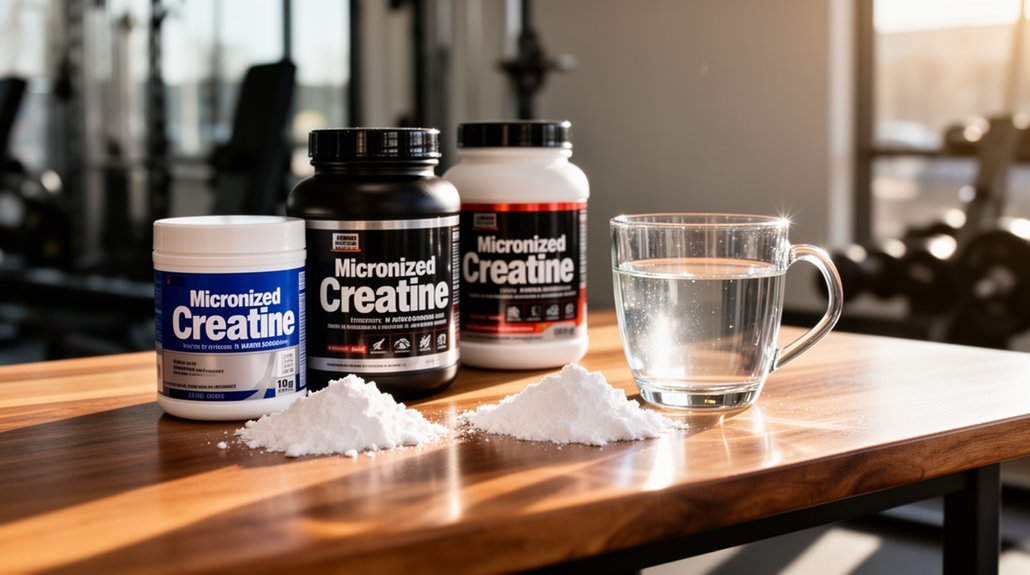
Micronized creatine is regular creatine monohydrate ground into smaller particles, so you’re getting the same active ingredient with a smoother texture.
It dissolves faster and settles less, which helps if you can’t stand a gritty shake. If you want to try a budget-friendly option, GNC Pro Performance Creatine Monohydrate in Blue Raspberry (30 servings) is currently $19.99 at 50% off.
But it usually costs $0.05 to $0.15 more per serving, so you’ll want to decide whether better mixability justifies paying extra for identical results.
Mixability and Texture Benefits
Why does your creatine sometimes leave a layer of sand at the bottom of the glass? Micronized creatine uses smaller monohydrate particles, so it disperses more evenly and dissolves faster, even though total solubility doesn’t change.
You’ll notice:
- You stir, and the powder vanishes instead of swirling into a cloudy pile.
- You tilt the glass, and you don’t see sediment clinging to the bottom.
- You sip a smoother, cleaner drink without chalky grit.
- You shake your bottle for 10–15 seconds, and the powder stays suspended.
- You drink immediately, and no residue lingers.
Same Creatine, Higher Price?
How much extra are you really paying for a finer powder? Usually about 20–50% more per serving, depending on the brand. You’re paying for processing and branding, not a different compound.
| Factor | Micronized vs. Standard |
|---|---|
| Active ingredient | Same molecule |
| Performance | No proven edge |
| Absorption | No broad advantage |
| Price | 20–50% higher |
Standard monohydrate is already well absorbed, and your uptake depends on saturation, not particle size. Larger research reviews found no strength, muscle, or performance advantage at equal doses, so the extra cost rarely pays you back. If you want the best performance per dollar, buy standard monohydrate and take your daily dose consistently. Micronized creatine makes sense if you value convenience, prefer premium products, or see a small price gap. Otherwise, skip the upgrade.
Is Creapure Creatine Worth the Premium?
Creapure costs more than standard creatine monohydrate, but you’re not paying for a different molecule. You’re paying for tighter purity specs and stricter lab testing.
Performance stays fundamentally the same: support for strength and repeated high-intensity exercise.
Here’s what your premium buys:
- A 99.9% pure monohydrate powder, made in a dedicated German facility
- Dicyandiamide below 20 mg/kg, far under the 50 mg/kg EFSA limit
- No detectable DHT, versus a 3 mg/kg limit
- HPLC analysis and documented, traceable results released batch by batch
- Third-party banned-substance screening, including Informed Choice and Cologne List
Picture a sealed tub with a lab report behind every scoop.
If you only want basic creatine benefits, a quality standard monohydrate likely delivers similar functional value.
But if you compete, follow strict supplement standards, or want batch consistency and anti-doping reassurance, Creapure clearly earns its price.
Think of it as paying for confidence, not extra muscle.
Is Creatine HCl Better for Sensitive Stomachs?
Creatine HCl has a reputation as the gentler option, but that reputation rests more on marketing and anecdotes than on clinical evidence.
Direct comparisons are limited. The comfort you might notice often comes from the smaller serving size, not the hydrochloride form itself. If you tolerate 3 to 5 grams of monohydrate daily, HCl probably won’t offer you much beyond convenience.
| Choose | If you |
|---|---|
| Monohydrate | tolerate standard doses well |
| HCl | get cramping or nausea, or dislike gritty texture |
Before switching, adjust how you take monohydrate. Take it with food, split your dose into two smaller servings, and dissolve the powder fully in enough water before drinking. Start with a smaller amount if you’re prone to early GI symptoms. Also check flavored powders, since additives can trigger stomach upset. If problems persist despite these changes, HCl is a reasonable next step, especially when stomach comfort is your main priority.
Does Buffered Creatine Beat Monohydrate?
Why pay more for buffered creatine if it doesn’t outperform monohydrate? In a 28-day double-blind trial of 36 resistance-trained participants, it didn’t. You’d see the same results either way:
- You’ll add pounds to your bench press with either form.
- You’ll pedal with more cycling power on both.
- You’ll load your muscles with creatine, though monohydrate showed the larger increase.
- You won’t feel fewer side effects, despite the marketing claims.
- You won’t gain a safety edge in body water or serum electrolytes.
Buffered creatine works as a creatine source, but it isn’t a superior ergogenic aid. Its higher-pH formula doesn’t improve retention in muscle tissue, and nothing supports choosing it for safety alone.
Monohydrate remains the benchmark because its research base is larger and more consistent. If you want strength, power, and muscle support, start with monohydrate. Choose buffered creatine only if you prefer it, but expect equal results.
Do Creatine Gummies and Blends Deliver?
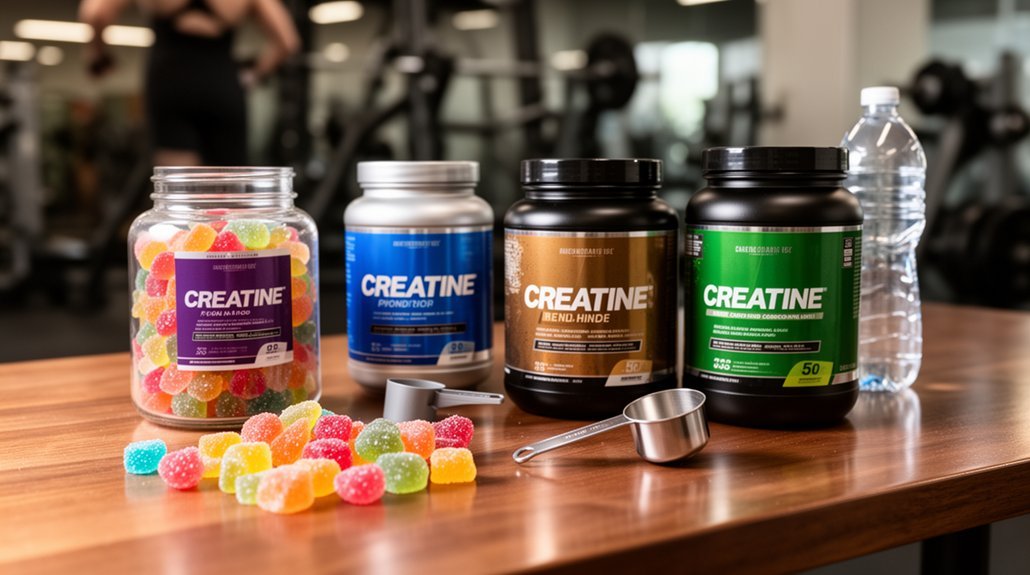
Creatine gummies look like an easy upgrade, but you’ll often need four or five of them to reach the 3 to 5 grams your muscles need each day.
That extra volume raises your cost per effective serving and adds calories and sweeteners you wouldn’t get with powder.
Blends don’t fix the problem either, since no well-controlled trial shows they beat plain monohydrate.
Convenience Versus Dosage
Gummies make daily creatine easier to stick with because you don’t have to measure, mix, or wash a shaker.
However, that convenience only matters if the dose holds up. Picture what that dose looks like:
- You’re tossing a fixed-count pouch into your gym bag, no scoop required.
- You’re chewing three to five gummies at 1.5 grams each to reach a full daily dose.
- You’re reading a blend label, wondering how much creatine hides among the extra ingredients.
- You’re checking for third-party testing, because some online gummies contained little or no creatine.
- You’re keeping the container cool, since heat affects gummies more than powder.
Powder offers flexible dosing.
Gummies match its results only when you verify 3 to 5 grams of creatine monohydrate per serving.
Cost Per Effective Serving
When you compare price tags, the number that matters is what you pay for a 5 g serving of creatine monohydrate, not the package price or the gummy count.
Plain powder wins that comparison. A 100-serving tub at $44.99 costs about $0.44 per serving, and a 60-serving tub at $23.99 runs about $0.40.
Gummies rarely compete. Most list between $1.16 and $1.67 per serving, and some reach about $3 per dose.
Legion’s gummies cost $1.66 per serving at one retailer and $1.16 at another. Either way, you’re paying roughly two to four times more than you’d for powder, often because of smaller packages.
Blends cost more than plain monohydrate for the same 5 g dose.
Unless you value the extras, skip the premium.
Blends Lack Added Benefit
Even though newer creatine forms and multi-ingredient blends promise faster digestion, better stability, or stronger results, the research doesn’t back those claims. Creatine monohydrate remains the gold standard, and no peer-reviewed study shows other forms raise muscle creatine more.
Gummies deserve extra scrutiny:
- You’d chew several gummies to hit 3 to 5 g, since most hold only 1 to 2 g each.
- Moisture, heat, and low pH can convert creatine into useless creatinine.
- Powder delivers the same absorption when doses match.
- Sugar helps uptake, but juice does that too.
- Some products contain less creatine than they claim.
Check the labeled creatine per serving first, then look for third-party testing. A simple, well-dosed monohydrate is your safest, most research-backed choice for strength and lean mass.
What Should a Quality Creatine Label Show?
A quality creatine label tells you exactly what’s in the tub and how much you’re getting.
Look for creatine monohydrate named as the main or only active ingredient. Skip “creatine blends” or “matrices,” since proprietary wording can hide the actual amount.
Choose creatine monohydrate as the main or only active ingredient, and skip vague “blends” or “matrices” that can hide the real amount.
Check that the label states exact grams of creatine per serving, separate from flavoring or additives. If you can’t find that number, you can’t compare products or dose consistently.
Prioritize third-party seals like NSF Certified for Sport, Informed Sport, Informed Choice, or USP Verified. Those screen for banned substances and label accuracy.
A certificate of analysis, especially batch-specific, shows potency and contaminant results.
Finally, check for GMP certification, a named manufacturer with a full address, and clear lot numbers and manufacturing dates.
Watch for red flags: long ingredient lists, stimulants, typos, vague directions, and exaggerated claims.
The best labels stay simple, specific, and easy to verify.
How Much Creatine Should Men Take Daily?
Once you’ve found a creatine monohydrate you can trust, the next question is how much to take. For most healthy men, 3–5 g daily keeps your muscle stores saturated, and 5 g is the simplest default.
Picture how that looks in practice:
- You scoop one level teaspoon of powder into your morning shake.
- You weigh 100 kg, so 0.03 g/kg gives you a 3 g maintenance baseline.
- You’re a larger lifter, so you might move toward 5–10 g daily.
- You skip loading, and you reach saturation in about four weeks.
- You load at 0.3 g/kg for 5–7 days, split into doses, and saturate faster.
Loading is optional, and maintenance dosing alone remains a valid strategy. Creatine monohydrate remains the best-studied form for daily dosing.
Healthy adults haven’t shown kidney harm at recommended doses, but if you have kidney disease, liver disease, or diabetes, talk with your doctor first.
Should Men Do a Creatine Loading Phase?
Why would you load creatine when you can reach the same muscle saturation with a smaller daily dose? Because loading saves time. You take 20 to 25 grams daily, split into four or five servings, for five to seven days. Your muscle creatine can rise 20% to 40%, and you’ll reach saturation faster than with low-dose use.
Loading isn’t necessary. Taking 3 to 5 grams daily for at least four weeks produces similar saturation, and your long-term strength and muscle gains will likely end up the same.
Loading has drawbacks. You may gain 1 to 3 kg, mostly water, and larger doses often cause bloating, cramping, or diarrhea, especially when you take more than 5 grams at once.
Load if you’re preparing for a competition or training block and can tolerate high doses. Skip it if you’d rather avoid stomach issues and accept slower results.
Choose creatine monohydrate.
Frequently Asked Questions
Does Creatine Cause Hair Loss in Men?
No, creatine doesn’t appear to cause hair loss in men. The worry traces to a small 2009 rugby study that showed DHT rising, but nobody’s replicated it, and it never measured hair loss.
A 12-week randomized trial showed you’d get no significant DHT, testosterone, or hair-growth changes with 5 grams daily.
Still, if you’re genetically prone to balding, you can’t fully rule out risk, since long-term data still don’t exist.
Can Men Take Creatine Without Working Out?
Yes, you can take creatine without working out, and it’s generally safe for healthy adults at 3 to 5 grams daily.
You’ll support quick-burst cellular energy, and some research suggests possible physical and cognitive benefits outside training.
However, you won’t notice results as much as you’d with exercise.
Take it daily to keep your stores steady, choose creatine monohydrate, and see your doctor first if you have kidney issues.
Is Creatine Safe for Kidneys in Healthy Men?
Yes, creatine’s generally safe for your kidneys when you’re healthy and follow standard dosing.
Large reviews haven’t found kidney damage, and a 2025 meta-analysis showed only a modest, temporary creatinine rise with no real GFR change. That bump reflects creatine metabolism, not injury, so tell your doctor you’re supplementing before labs.
Stick with plain creatine monohydrate, and check with a doctor first if you’ve got kidney disease, diabetes, or hypertension.
When Is the Best Time to Take Creatine?
The best time to take creatine is whenever you’ll remember it every day. Timing matters far less than consistency.
If you’d like a routine, take it within an hour before or after your workout, since studies show similar results, with post-workout holding a slight edge.
Don’t skip rest days. You’re keeping your muscle stores saturated, so pair your daily 5 grams of creatine monohydrate with a meal you never miss.
Can Men Mix Creatine With Caffeine or Protein Shakes?
Yes, you can mix creatine with both. Protein shakes are an easy, low-risk pairing, since protein doesn’t interfere with creatine’s absorption.
Moderate caffeine works too, though you’ll want to skip large doses if you’re loading creatine, because they might blunt its effects. If your stomach’s sensitive, take caffeine before training and creatine afterward.
Stay hydrated, and check with a doctor first if you’ve got kidney disease or Parkinson’s.
Conclusion
You don’t need a fancy formula to get results from creatine. Stick with plain monohydrate, or choose micronized or Creapure if you want smoother mixing and extra purity. If your stomach’s sensitive, you can try HCl. Check the label for third-party testing, take three to five grams daily, and skip loading unless you’re in a hurry. Pick one you’ll actually use every single day, stay consistent, and you’ll see the strength gains you’re truly chasing.