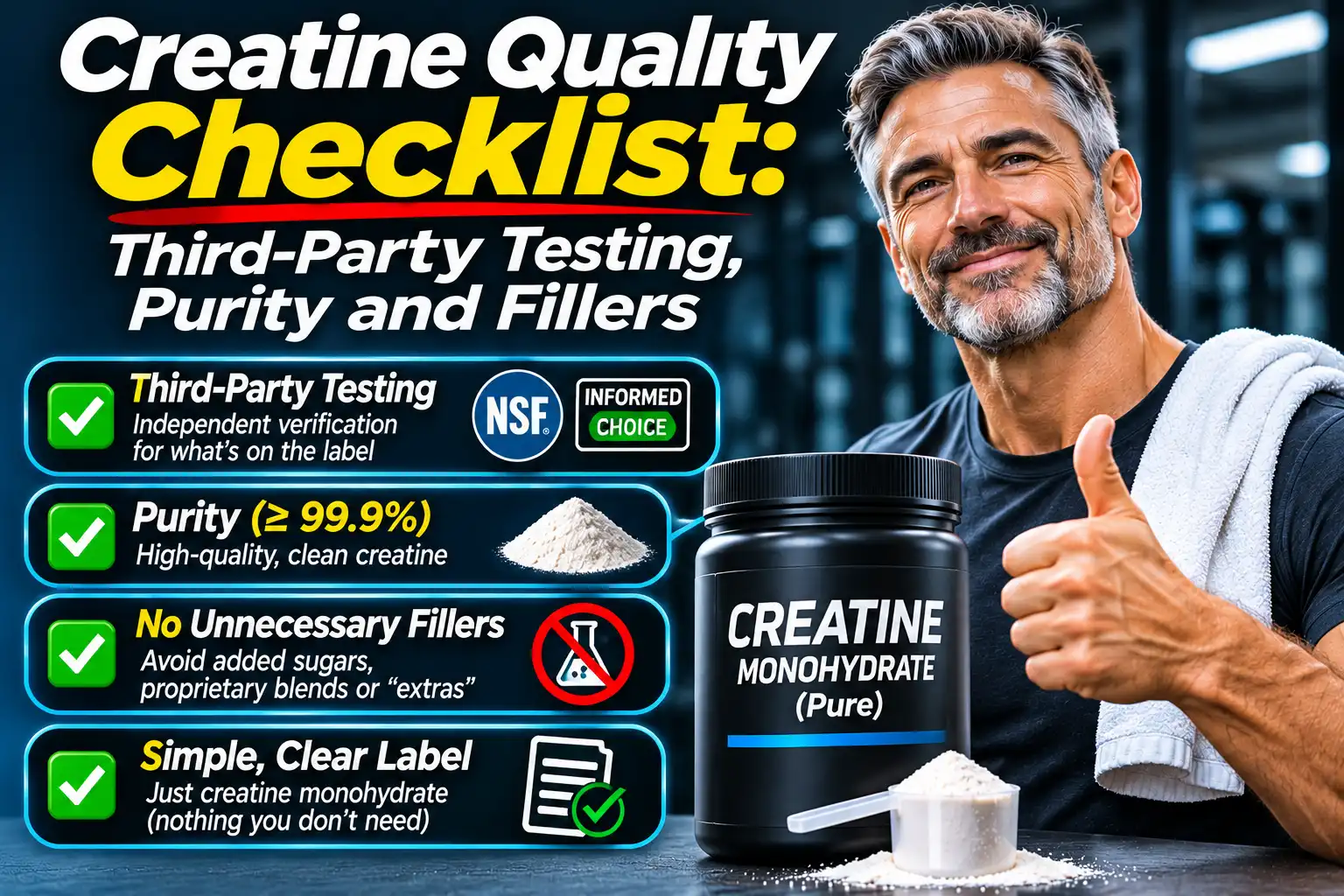
Creatine Quality Checklist: Third-Party Testing, Purity and Fillers
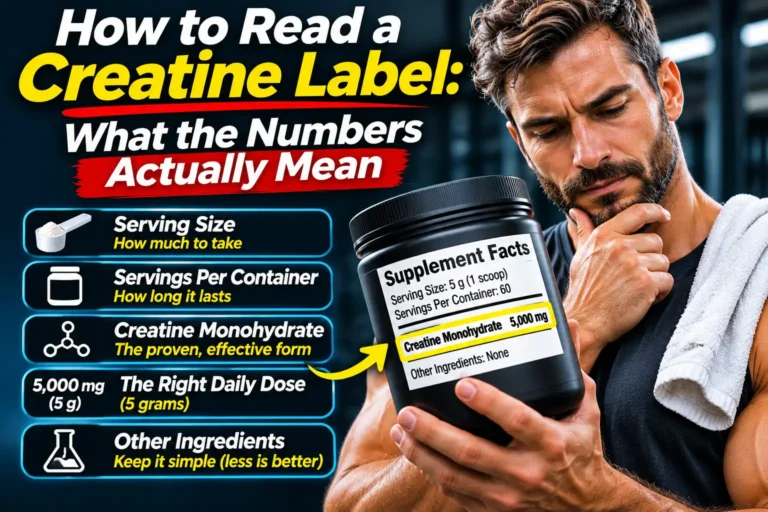
A quality creatine supplement is plain creatine monohydrate with a verified third-party seal, a short ingredient list, and a batch-specific lab report that matches the lot number on your tub. Check the seal in the certifier’s public database, scan “Other ingredients” for additives you don’t need, then confirm purity of 99.9% or higher, low impurity levels, and heavy metals within USP limits. The checklist below shows how to read each result, so you can judge a product in a few minutes instead of trusting the front label. If you only need the basics of the Supplement Facts panel, start with our guide on how to read a creatine label.
Key Takeaways
- Choose creatine monohydrate, the best-evidenced form, since research doesn’t show better results from other forms.
- Look for a third-party seal such as NSF Certified for Sport, and confirm it in the certifier’s public database, because brand reputation alone isn’t proof.
- Prefer single-ingredient, unflavored products, and treat fillers, artificial sweeteners and colorings as reasons to compare alternatives.
- Aim for 99.9% purity or better, with creatinine at 100 mg/kg or less, DCD at 50 mg/kg or less, and DHT not detected or within the stated limit.
- Match your lot number to a lab report from a named independent lab that lists arsenic, cadmium, mercury and lead individually.
Creatine Quality Checklist at a Glance
| Check | Good sign | Red flag |
|---|---|---|
| Form | Creatine monohydrate | “Activated” or exotic blends with no evidence |
| Third-party seal | Product found in the certifier’s database | Vague “tested” claim, no listing |
| Ingredients | Creatine monohydrate alone | Proprietary blend, long additive list |
| Lab report | Lot number matches your tub | Generic report, no lot or lab |
| Purity | 99.9% or higher, HPLC method | No purity figure or method |
| Impurities | Low creatinine and DCD, DHT not detected | Impurities not reported |
| Heavy metals | Each metal listed, under USP limits | One combined “heavy metals” total |
Choose Creatine Monohydrate First
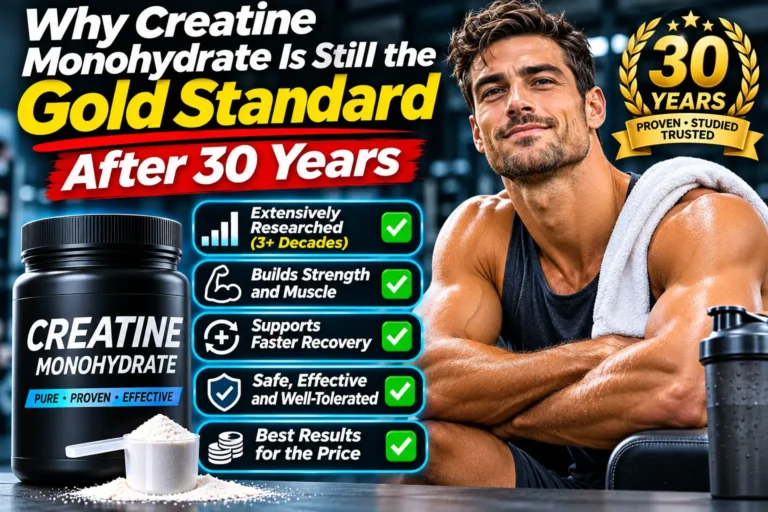
When you’re shopping for creatine, start with creatine monohydrate. Evidence-based reviews consistently call it the preferred form, and researchers use it as the standard reference when they compare creatine products.
You’ll find the strongest evidence behind it: it raises muscle creatine stores, improves exercise performance, and has a long safety record at normal doses. Our explainer on why creatine monohydrate is the gold standard covers the research in more detail.
Don’t pay extra for exotic formulations. Current clinical evidence doesn’t support claims that other forms work better, and monohydrate usually costs less. Even creatine hydrochloride, which is marketed for better solubility, hasn’t shown an advantage in effectiveness. Our comparison of creatine monohydrate vs HCl breaks down the claims.
Pick a simple, unflavored, high-purity product, then verify it with third-party testing. Independent labs check identity, purity, potency and safety markers, and batch-level certificates of analysis (COAs) document the results. Monohydrate plus third-party testing gives you the clearest, lowest-risk starting point.
Spot Fillers and Additives on the Label
Start with the “Other ingredients” line, since that’s where fillers and additives show up. You’ll often spot flow agents like magnesium stearate, bulking agents like microcrystalline cellulose, and colorants like titanium dioxide, especially in capsules, tablets and flavored powders. If the label lists only creatine monohydrate, you’ve found the simplest formula.
Read the Ingredient List
The Supplement Facts panel tells you how much creatine you’re getting, but the ingredient list tells you what else is in the tub or capsule. Look under “Other Ingredients,” where manufacturers list fillers, binders, preservatives, sweeteners and flavorings, usually in descending order by weight. A short list means fewer additives, and a single-ingredient label is the cleanest.
Check for these three things:
- Taste additives: Flavored products may contain artificial sweeteners, colors or added sugars, while unflavored powder usually skips them.
- Formulation helpers: Capsules and tablets often include gelatin, titanium dioxide, cellulose, magnesium stearate or silicon dioxide.
- Claim mismatches: Verify that “100% pure” or “no fillers” claims match the ingredient statement, which should list creatine monohydrate alone.
Pass on incomplete labels. Our guide to reading a creatine label walks through the full panel.
Common Fillers and Flow Agents
Five additives show up again and again on creatine labels: magnesium stearate, silicon dioxide, microcrystalline cellulose, maltodextrin and stearic acid. Most do practical jobs. Magnesium stearate and stearic acid lubricate machinery, silicon dioxide prevents clumping, and microcrystalline cellulose and maltodextrin add bulk.
You’ll see them mostly in capsules and tablets, where manufacturing needs flow agents and binders. They don’t automatically signal low quality, but they do make a label longer and less clean. Keep in mind that the FDA doesn’t approve dietary supplements before they’re sold, so the front label can leave out what matters. Always read the back.
Watch for additives beyond manufacturing needs. Titanium dioxide adds color, while dyes, sucralose, dextrose and natural flavors point to flavored or chewable products. Sorbitol can sweeten or bulk up capsules and tablets. If you want a simpler formula, choose a product listing only creatine monohydrate, with no flavors, colors or sweeteners. Some people notice stomach discomfort from certain additives, which our guide on creatine side effects covers.
Look for Third-Party Tested Creatine Seals
The clearest third-party seal to look for on a creatine tub is NSF Certified for Sport. It shows NSF reviewed the product against its sport certification requirements, which include screening for banned substances. Generic phrases like “tested” or “quality assured” don’t carry that weight.
| Seal | What it generally covers | How to verify |
|---|---|---|
| NSF Certified for Sport | Label accuracy, contaminants, banned substances, facility audits | NSF’s public listings |
| Informed Sport | Batch testing for banned substances | Informed Sport’s product search |
| USP Verified | Identity, potency, purity, good manufacturing practices | USP’s verified products directory |
| BSCG Certified Drug Free | Testing for banned and prohibited substances | BSCG’s certified products list |
Programs differ in scope and change over time, so check each certifier’s site for current details. Also, certification is product-specific, so a trusted brand doesn’t guarantee your tub qualifies. Verify the seal yourself:
- Search the certifier’s public database for the brand and product name.
- Confirm the exact flavor, form and package size appear in the listing.
- Check the current certification status.
Don’t rely on the front label alone, though. Seals can appear on the front label, the supplement facts panel or product images, but only the certifier’s database confirms the claim for the exact version you’re buying.
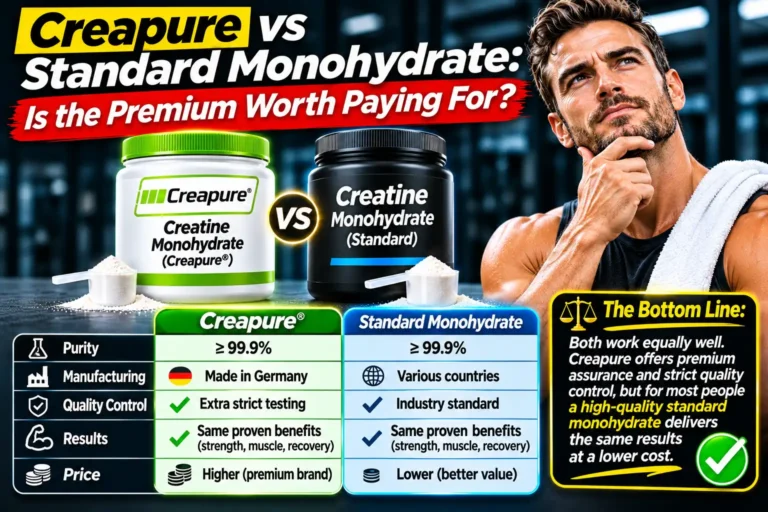
Also keep in mind that a brand name isn’t a seal. Creapure, for example, describes a raw material, not a certification, as we explain in our comparison of Creapure vs standard monohydrate.
Find the Batch-Specific Creatine Lab Report
How do you know the creatine in your tub is what the label says it is? Find the batch-specific lab report. Check the tub, pouch or label (often the bottom or back) for the lot number, then match it to a report on the brand’s testing page. Some brands make you enter the batch code first.
| Check | What to look for | Red flag |
|---|---|---|
| Lot number | Exact match to your container | Missing or different code |
| Lab | Independent lab named | No lab listed |
| Date | Test date fits the production timeline | No date |
| Method | HPLC or another validated method | Unnamed method |
If the site says no COA matches your lot, you may have entered the wrong code, or the report may not be available yet. Also confirm the report covers the finished product, not just the raw material. Generic reports without a lot number don’t prove your specific tub was tested, so don’t rely on them.
Check Creatine Purity and Impurity Levels
Once you’ve matched your lot number to a report, check what it says about purity. Look for creatine at 99.9% or better, but don’t stop there. Purity means little without impurity limits, and results should come from a validated method like HPLC.
Then check the core impurity trio. The figures below are common benchmarks for high-purity creatine, not legal limits, so also read the limit the lab prints next to each result:
- Creatinine: Look for 100 mg/kg (100 ppm) or less. Creatinine forms as creatine degrades, so a low reading suggests good drying control and less thermal breakdown.
- DCD (dicyandiamide): Look for 50 mg/kg or less. Measurable amounts point to incomplete purification or loosely controlled synthesis.
- DHT (dihydro-1,3,5-triazine): Expect “not detected” or a very low value within the stated limit. Detectable DHT often signals process control problems.
Two clarifications will save you confusion. First, the DHT on a creatine lab report is a manufacturing impurity, not the hormone dihydrotestosterone linked to hair loss. We cover that question in our guide on whether creatine causes hair loss. Second, the creatinine here is an impurity in the powder, not your blood creatinine, which is a separate topic explained in creatine vs creatinine and your kidney test.
Read each result against the stated limit, method and units. Remember that mg/kg and ppm are the same thing, but a percentage is a different scale: 0.01% equals 100 mg/kg.
Read Heavy Metal Results Line by Line
Heavy metals are the next thing to check, and each metal gets its own line. Confirm the report covers arsenic, cadmium, mercury and lead, not just a subset. Don’t accept a combined “heavy metals” total.
Read the unit next. ppm and mg/kg describe concentration, while µg per serving describes exposure. To compare with limits, multiply the concentration (µg per gram) by the grams you take per day. For example, lead at 0.2 ppm in a 5 g daily dose gives 1 µg per day. Then compare the result with the USP <2232> daily limits for dietary supplements:
| Metal | USP daily limit | If you exceed it |
|---|---|---|
| Lead | 5 µg | Skip the product |
| Cadmium | 5 µg | Skip the product |
| Inorganic arsenic | 15 µg | Skip the product |
| Total mercury | 15 µg | Skip the product |
If a report lists only total arsenic and the number is high, ask the brand for an inorganic arsenic result, since the USP limit applies to that form. Check the method and detection limit too. ICP-MS is common. “Not detected” means the instrument found nothing above its reporting threshold, which isn’t the same as proving zero. If the report lacks a method, a limit or serving-based exposure, ask the brand for a complete certificate before you buy.
Red Flags That Mean Skip the Product
If you spot any of these, compare other options before you buy:
- A “third-party tested” claim with no named lab or certifier.
- A seal that doesn’t appear in the certifier’s public database.
- No lot-specific lab report, or a report that doesn’t match your lot number.
- A combined “heavy metals” result instead of separate lines.
- A proprietary blend that hides the creatine amount.
- A brand that won’t share its testing when you ask.
When your shortlist passes these checks, compare prices with our guide on how lifters can choose a creatine without overpaying.
Frequently Asked Questions
Is “Third-Party Tested” the Same as Third-Party Certified?
No. “Tested” means someone ran a test, but it doesn’t say who, what they tested for, or whether the result was good. “Certified” means an independent program reviewed the product against published requirements and lists it publicly, so you can verify it.
What Is the Difference Between NSF Certified for Sport and Informed Sport?
Both are independent programs that screen supplements for banned substances, and both publish product databases. They differ in how they audit manufacturers and what else they check, so look at each program’s current requirements on its own site. Either one is a stronger signal than a brand’s own “tested” claim.
Do I Still Need a Lab Report if My Creatine Has a Seal?
Not always. A seal covers its program’s testing, while a batch COA shows specific purity, impurity and heavy metal numbers for your lot. If you want to check those numbers yourself, ask for the COA. A brand with a good product will usually share it.
Are Fillers Like Magnesium Stearate Harmful?
At the small amounts used in capsules and tablets, they’re widely used manufacturing aids, not a sign of a dangerous product. The simpler choice is a single-ingredient powder, which skips them entirely. If a capsule is more convenient for you, a short ingredient list and a third-party seal matter more than avoiding every additive.
What Does DHT Mean on a Creatine Lab Report?
On a creatine COA, DHT stands for dihydro-1,3,5-triazine, an impurity that can form during manufacturing. It has nothing to do with the hormone dihydrotestosterone. A good report shows it as not detected or well within the stated limit.
Is Flavored Creatine Lower Quality Than Unflavored?
Not necessarily, but it has more ingredients to check. Flavored products add sweeteners, acids, colors and flavorings, which makes the label longer and adds items you don’t need for the creatine to work. If a flavored product has a seal and a matching lab report, it can still be a good choice.
Conclusion
You don’t need a fancy formula to get quality creatine. Start with plain monohydrate, scan the label for fillers, and look for a trusted third-party seal you can verify. Then pull up the batch-specific lab report, confirm the purity numbers, and read the heavy metal results line by line. If a brand won’t share its testing, you’ve got your answer. When you’re ready to shop, see our tested and ranked creatine supplements and our best creatine monohydrate supplements.


One Comment