
How to Choose Creatine Without Overpaying: Cost Per Gram Guide
To choose a creatine without overpaying, buy plain creatine monohydrate, compare the cost per gram of creatine instead of the price per tub, and check for a third-party seal you can verify. Monohydrate is the most studied form and usually the cheapest, and pricier versions like HCl or buffered creatine haven’t shown better results. Aim for 3 to 5 grams a day, read the grams per serving on the label, and skip proprietary blends. The steps below show you how to spot an underdosed product and run the math before you buy. For background on the form itself, see why creatine monohydrate is the gold standard.
Key Takeaways
- Choose creatine monohydrate, since it’s the most studied and effective form and costs less than premium alternatives.
- Skip pricier forms like HCl, ethyl ester and buffered creatine, which offer no proven advantage over monohydrate.
- Check grams of creatine per serving, because vague scoop, capsule or tablet counts can hide underdosing.
- Compare cost per gram, or cost per 5 g dose, not the sticker price or the price per serving.
- Prefer products with a verifiable seal like NSF Certified for Sport or Informed Sport, and avoid proprietary blends and terms like “matrix.”
Choose Creatine Monohydrate First
If you’re shopping for creatine, start with monohydrate. It’s the most studied form, and reviews consistently call it the most effective option for boosting high-intensity exercise capacity and lean mass. Hundreds of clinical trials back it, and healthy users report few side effects at standard doses.
You’ll likely notice the benefits in your training. Monohydrate raises your muscle creatine stores, which helps you squeeze out more repetitions at a given weight and complete more total volume. It’s well absorbed, and it’s usually the cheapest form per gram, so you’re not giving up results to save money. Expect about 0.5 to 2 kg of water weight early on, which isn’t fat. If you have kidney disease, talk with your doctor first.
Skip Pricey Creatine Upgrades You Don’t Need
Monohydrate already does the job, so you can skip most of the other creatine products on the shelf. Premium forms mostly sell marketing, not measurable results. Don’t pay extra for these:
Creatine monohydrate already delivers results, so skip the premium forms, which mostly sell marketing instead of measurable gains.
- Creatine HCl: marketed for better solubility and smaller doses, but studies haven’t shown it beats monohydrate. Our comparison of creatine monohydrate vs HCl breaks down the claims.
- Creatine ethyl ester: it has performed worse than monohydrate in studies and breaks down more easily, so you’re buying instability.
- Buffered creatine: you’re paying for pH stability, not better training outcomes.
- Multi-ingredient blends: extra ingredients raise the price faster than the creatine content, and they make price comparisons harder.
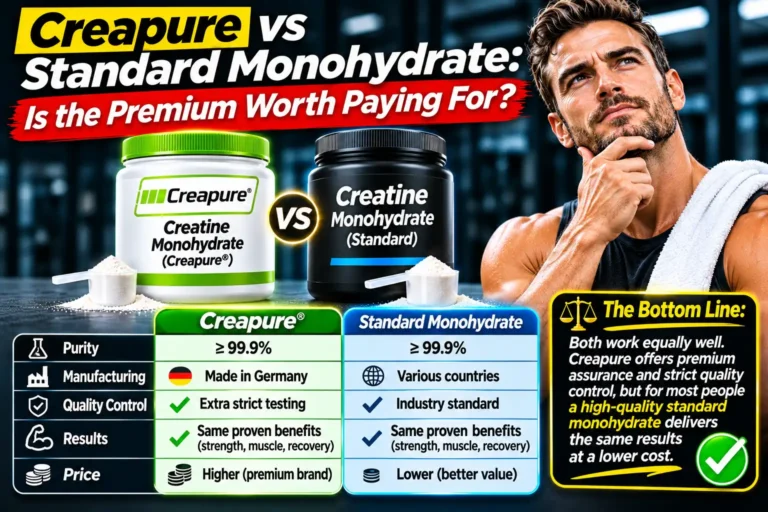
Branding deserves the same skepticism. Fancy tubs and influencer endorsements raise prices, but results depend on the creatine form and dose, not the packaging. A branded raw material like Creapure can be a reasonable premium if you value documentation, and our guide to Creapure vs standard monohydrate helps you decide. Powder also usually costs less per gram than capsules, gummies or other specialty formats.
Know the Creatine Dose You’re Paying For
Two numbers decide what you’re really paying for: the grams of creatine in each serving and the number of servings you need per day. Ignore pill counts, scoops and stick packs. Check grams per serving.
Most guidance targets 3 to 5 grams daily for maintenance, or about 0.03 g/kg of body weight. If you load, you’ll take 20 to 25 grams daily for 5 to 7 days, or about 0.3 g/kg. Loading empties a tub fast. Skipping it works too, and 3 to 5 grams daily saturates your muscles in about four weeks. Our guides on how much creatine to take per day and the creatine loading phase cover both options.
Read labels carefully. Some products list a serving of 3 g, others 3.6 g, 4.2 g or 5 g, and some spread a dose over several tablets or capsules. “Pure creatine monohydrate” doesn’t guarantee a generous serving, and a premium format won’t change the target dose. Before you buy, divide the container’s total grams of creatine by your daily dose. That gives you days of use.
Compare Creatine Cost Per Gram, Not Per Tub
Don’t judge a creatine by the price on the tub. Container sizes and serving sizes vary widely, so a product that looks cheaper per serving can cost you more per dose.
Calculate Price Per Gram
- Find the grams. Multiply servings per container by the creatine grams per serving.
- Divide. Price divided by total grams gives your cost per gram.
- Match your dose. Multiply cost per gram by 5 for the cost of a 5 g daily dose, or by 3 for a 3 g dose.
- Compare. Choose the lowest cost per dose, not the lowest sticker price.
A Worked Example
These prices are illustrative, but the math works for any product:
| Product | Price | Servings | Creatine per serving | Cost per serving | Cost per gram | Cost per 5 g dose |
|---|---|---|---|---|---|---|
| A | $30 | 60 | 5 g | $0.50 | $0.100 | $0.50 |
| B | $20 | 60 | 3 g | $0.33 | $0.111 | $0.56 |
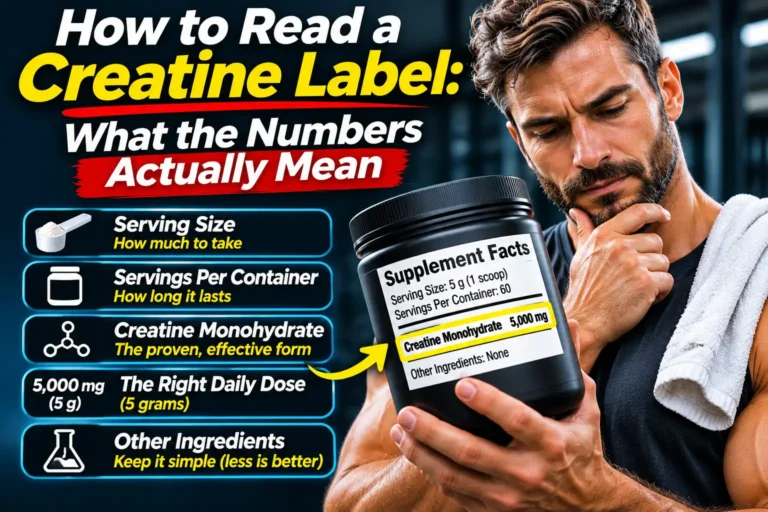
Product B looks cheaper per serving, but it holds only 180 g of creatine against 300 g in product A, so each gram costs more. That’s why per-serving prices mislead. Our guide on how to read a creatine label shows where to find each number.
Spot Underdosed Products
How do you know a creatine product gives you a full dose? Skip the tub size and the unit count, and find the grams of creatine monohydrate per serving. A smaller serving isn’t automatically bad, since 3 g is a valid maintenance dose, but it should be priced for what it delivers.
The common traps are:
- Capsules and tablets that need several units to reach even 3 g.
- Labels that use “about,” “approx.” or teaspoon measures, since fill levels vary.
- Terms like “micronized,” “Creapure” or “pure,” which describe form or source, not dose.
Capsules also tend to cost more per gram than powder because you need more of them to reach the same dose. If you’re weighing gummies, see our comparison of creatine gummies vs powder before you pay the premium.
When a Big Tub Makes Sense
Bigger tubs often cost less per gram, but only if you’ll use them. Divide the grams in the tub by your daily dose to see how long it lasts. A 500 g tub at 5 g a day lasts 100 days. Dry creatine monohydrate is stable, but moisture is its enemy, so keep the lid sealed, use a dry scoop and check the expiry date. If you doubt you’ll finish a large tub before the date, buy a smaller one.
Look for Third-Party Tested Creatine
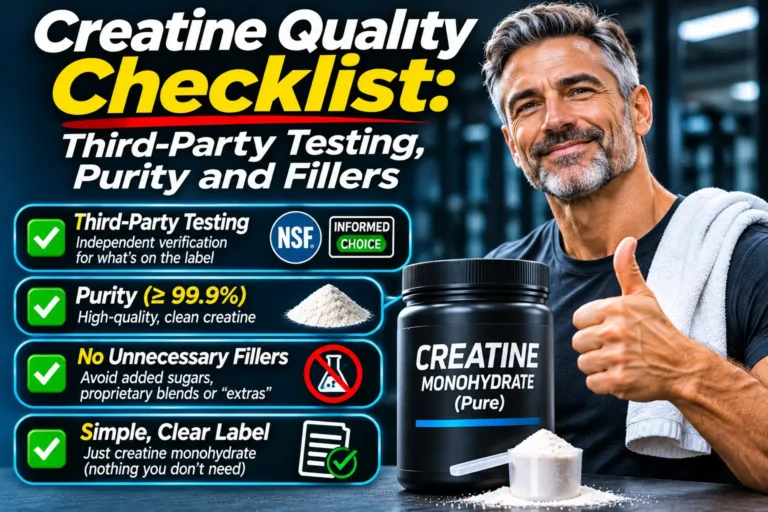
A creatine label can say “third-party tested” and still leave you guessing. A certification seal gives you stronger evidence, because you can check the product in a public listing. If you’re a drug-tested athlete, that verification matters most.
Use these steps before you pay a premium:
- Choose recognized programs, such as NSF Certified for Sport, Informed Sport or BSCG, which screen for banned substances.
- Verify the listing by searching the certifier’s registry for the exact product.
- Compare cost per gram, so you see the real price of the certified option.
- Skip add-ons. If you want plain monohydrate, don’t pay extra for blends or flashy packaging.
Certification costs money, and that overhead often explains part of a higher price, not a better creatine molecule. If you don’t compete in tested sports, a cheaper product with clear third-party verification may still serve you well. Our creatine quality checklist shows how to verify seals and read lab reports.
Read the Creatine Label for Red Flags
Even a certified product can have label problems that make it poor value. Watch for these three:
- Proprietary blends: the label gives a total weight but not the amount of each ingredient, so a “creatine” product could contain only 1 to 2 g of creatine. Look for creatine listed alone, with an exact gram amount.
- Vague serving sizes: “1 scoop” alone tells you nothing, because scoop sizes vary. Only the gram value shows the dose.
- Missing documentation: no certifier seal, no lot number or no way to match the package to a public listing means you can’t verify anything.
Checking these takes about a minute and can keep you from paying for a product that doesn’t deliver what it promises. For a deeper look at each item, see our guides on reading a creatine label and the quality checklist.
Quick Buying Checklist
- Choose creatine monohydrate in powder form unless you have a reason not to.
- Find the grams of creatine per serving on the Supplement Facts panel.
- Calculate cost per gram using total grams, not servings.
- Look for a seal you can verify in the certifier’s database.
- Avoid proprietary blends, vague serving sizes and missing lot numbers.
- Buy the size you’ll finish before the expiry date.
When your shortlist is ready, compare options in our best creatine monohydrate supplements and tested and ranked creatine supplements.
Frequently Asked Questions
Is Expensive Creatine Better?
Not by itself. Price often reflects branding, packaging, flavors, certification costs or a branded raw material, not a better creatine molecule. A plain monohydrate with a verified seal and a matching lab report can perform the same as a premium one.
How Do I Compare Creatine Prices Fairly?
Calculate cost per gram of creatine. Multiply servings per container by creatine grams per serving, then divide the price by that total. Compare products on cost per gram or cost per 5 g dose, not on price per tub or per serving.
Is It Cheaper to Buy a Big Tub of Creatine?
Usually, per gram, but only if you finish it. Check the cost per gram, and consider how many days the tub lasts at your dose. Keep it sealed and dry, and don’t buy more than you’ll use before the expiry date.
Are Creatine Gummies or Capsules Worth the Extra Cost?
For most lifters, no. Gummies and capsules usually cost more per gram of creatine and often need several units to reach a full dose. They can make sense if convenience matters more to you than price, but compare cost per gram first.
Do I Need a Third-Party Seal if I’m Not a Competitive Athlete?
It isn’t required, but it’s a useful quality check, since supplements aren’t approved before they’re sold. A verified seal lowers the risk of contamination or an inaccurate label, and it’s worth a small premium if the price is close.
Is Creapure Worth the Extra Money for Lifters?
Only if you value documented purity and traceability. Creapure is a branded creatine monohydrate that works the same as standard monohydrate, so it won’t build more muscle. See our full comparison of Creapure vs standard monohydrate.
Conclusion
You don’t need a fancy formula to get results. Stick with creatine monohydrate, take the standard 3 to 5 gram dose, and ignore the pricey upgrades that promise more than they deliver. Compare cost per gram, choose a product that’s third-party tested, and scan the label for red flags like proprietary blends or vague serving sizes. When you shop smart, you’ll save money, protect your health, and put every dollar toward the gains you’re chasing. For picks, see our best creatine for men and best creatine for women.