Creatine vs Creatinine: Why Your Blood Test May Look Different
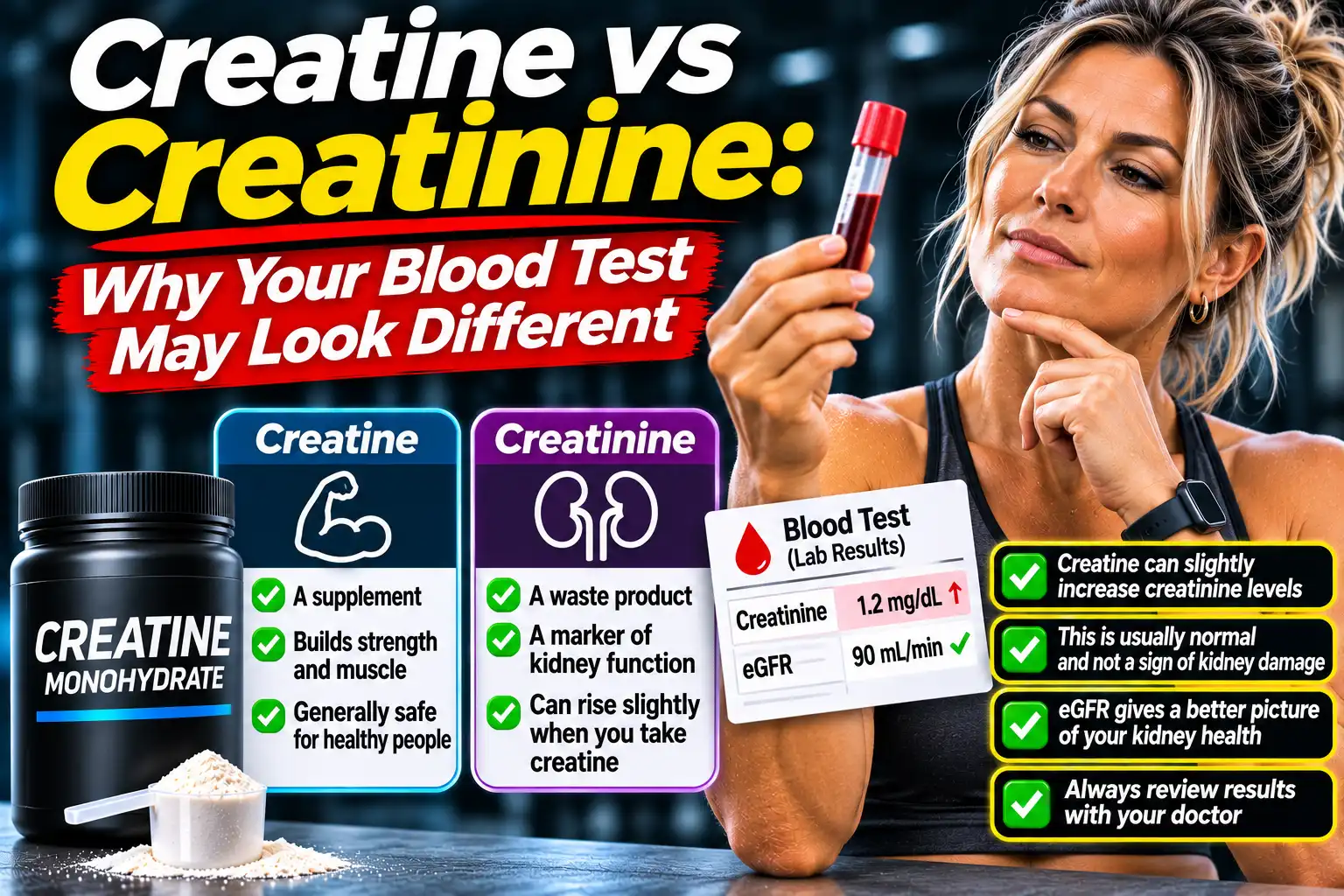
Creatine fuels your muscles, while creatinine is the waste product that creatine breaks down into. A blood test measures creatinine to estimate how well your kidneys filter, and taking creatine supplements can nudge that number up even when your kidneys are fine. Big meat meals, hard workouts, dehydration and high muscle mass can do the same. A single high result isn’t a diagnosis, so doctors look at trends and other tests. Below, you’ll see what your numbers mean, how much creatine can move them, which tests give a clearer picture, and how to prepare for your next blood draw. For the broader overview, see our guide on creatine vs creatinine and your kidney test.
Key Takeaways
- Creatine is a muscle compound that helps regenerate energy during intense activity, while creatinine is its waste product and supplies no energy.
- Your body converts roughly 1% to 2% of its creatine to creatinine each day, and your kidneys filter the creatinine out of your blood.
- A common adult range is 0.7 to 1.3 mg/dL for men and 0.5 to 0.95 mg/dL for women, but ranges vary by lab, so use the one printed on your report.
- Creatine supplements, cooked meat, intense exercise, dehydration, muscle mass and some medications can raise creatinine without kidney damage.
- Tell your clinician you take creatine, and ask about cystatin C or a repeat test if your result looks off.
What’s the Difference Between Creatine and Creatinine?
Creatine and creatinine sound almost identical, but they do very different jobs in your body.
| Creatine | Creatinine | |
|---|---|---|
| What it is | A natural compound stored in muscle | A waste product of creatine |
| Job | Helps regenerate energy quickly | Supplies no energy |
| Source | Made in your body, plus meat, fish and supplements | Formed when creatine breaks down |
| What happens to it | Stored and used by muscle | Filtered by the kidneys into urine |
| On a blood test | Not measured routinely | Measured to estimate kidney filtration |
Creatine is stored mostly in your muscles, where it helps you regenerate energy quickly during short, intense activity. Your body makes it from three amino acids, glycine, arginine and methionine, mainly in the liver, kidneys and pancreas, and you also get it from meat and fish or take it as a supplement.
Creatine is a natural compound stored mostly in your muscles, helping you regenerate energy quickly during short, intense activity.
Creatinine is what’s left over. Your body can’t recycle it, so your kidneys filter it from your blood and remove it in your urine. The two are linked, because about 1% to 2% of your creatine converts to creatinine each day through a spontaneous, irreversible reaction. That’s why taking more creatine can raise your creatinine level, and why a higher creatinine doesn’t necessarily mean you have more creatine in your body.
What Does a Creatinine Blood Test Show?
A creatinine blood test measures the waste product your muscles produce, which shows how well your kidneys are filtering your blood. Healthy kidneys remove creatinine at a fairly steady rate, so when filtration declines, creatinine builds up. That makes serum creatinine the most widely used filtration marker in routine kidney checks. It measures filtration, not direct kidney damage.
Doctors usually use your creatinine result to estimate your eGFR, a measure of how quickly your kidneys filter blood. They read it alongside your age, sex, body size, muscle mass and other labs. If your level runs high, it may signal reduced kidney function, but doctors don’t diagnose anything from that number alone. You can read more at MedlinePlus on the creatinine blood test.
What Is Normal Creatinine for Men and Women?
“Normal” depends mostly on your sex, since men usually carry more muscle and produce more creatinine. A typical adult range looks like this:
| Group | mg/dL | µmol/L |
|---|---|---|
| Men | 0.7 to 1.3 | 62 to 115 |
| Women | 0.5 to 0.95 | 44 to 84 |
These ranges aren’t universal. Labs use different analyzers, calibration standards and reference populations, so some list slightly wider intervals. Your result may be reported in mg/dL or µmol/L, and your lab’s printed range matters more than any number you see online. Your muscle mass, body size, age, diet and activity level also shift what’s normal for you. Older adults may run lower, and people with a lot of muscle can run higher without any kidney problem.
If your result lands slightly outside the range, that doesn’t automatically signal a problem. Compare it with the range on your own report, and ask about your eGFR, since creatinine alone doesn’t tell the whole story. Some medications can also affect results, including cimetidine, trimethoprim and certain antibiotics, so tell your provider about everything you take.
Why Does Creatine Raise Creatinine?
Think of creatine as the raw material and creatinine as the byproduct. Your body converts a small fraction of its creatine into creatinine every day through a spontaneous chemical reaction. When you take a supplement, you’re expanding that creatine pool, so more is available to convert. Your kidneys haven’t changed. Your chemistry has.
Standard labs measure creatinine, so the result can look high, and your estimated GFR can look lower, even when your filtration is normal.
| Factor | Effect on creatinine | Reason |
|---|---|---|
| Creatine supplement | Rises | Larger pool converts |
| Cooked meat meal | Rises temporarily | Dietary creatinine and creatine |
| Muscle mass | Higher baseline | More production |
| Dehydration or intense exercise | Rises temporarily | Concentration, muscle breakdown |
| Kidney dysfunction | Rises | Reduced excretion |
Creatine alone doesn’t indicate kidney injury, but you shouldn’t ignore a rising number without follow-up. Context, not a single value, determines what your result means.
How Much Does Creatine Raise Creatinine?
For most healthy people, the rise is small. Studies of creatine users typically report modest increases in serum creatinine, often a fraction of a mg/dL, but the size varies from person to person and depends on dose, muscle mass and how long you’ve been supplementing. Here’s what to keep in mind:
- Timing: Your level may climb after you start, then settle into a new steady state while you keep taking creatine.
- Variation: Results aren’t uniform, so your change could be larger or smaller than someone else’s.
- eGFR formulas: Creatinine-based estimates can turn a small creatinine rise into a lower eGFR that looks worse than your real filtration.
- Reference range: Even a modest rise can push your result just outside your lab’s range, especially if you were near the upper end.
The lower eGFR reflects a marker change, not necessarily kidney damage. Your filtration can stay stable while the number looks worse. Because individual results vary, don’t judge a single blood test on its own. Tell your clinician you take creatine before you test, and interpret the number in context.
Does High Creatinine Always Mean Kidney Damage?
No. A higher number doesn’t automatically mean your kidneys are damaged. Dehydration, intense exercise, a meat-heavy diet, creatine supplements and muscle injuries can all raise your level without harming your kidneys. A single raised result may also be temporary.
Still, don’t dismiss a high result. Acute kidney injury, chronic kidney disease, infection, urinary obstruction, heart failure, diabetes and high blood pressure can all raise creatinine, and many people with high creatinine have no symptoms at all. That’s why doctors look at how large the rise is, how your levels change over time, and what other tests show. If your result stays high on a repeat test, or you have kidney disease, diabetes or high blood pressure, follow up with your clinician rather than assuming it’s the supplement.
Which Kidney Tests Go Beyond Creatinine?
Why does your doctor sometimes order more than a single creatinine test? Because creatinine is only one piece of the picture, and it can mislead when muscle mass, age or diet skews the result. Doctors often add:
- Cystatin C: a blood marker that estimates eGFR a different way. The National Kidney Foundation notes it can give a more accurate result than creatinine in people with a lot of muscle, such as bodybuilders, though untreated thyroid conditions and steroid use can affect it. See its page on cystatin C.
- Combined eGFR (creatinine plus cystatin C): often a more accurate filtration estimate than creatinine alone.
- Urine albumin-to-creatinine ratio (uACR): detects albumin leaking into urine, a key sign of kidney damage that creatinine can miss.
- Urinalysis: screens your urine for blood, protein and other abnormalities.
Doctors also repeat testing over time, since you can’t diagnose chronic kidney disease from one result. Persistent changes matter most. If you take creatine and your creatinine-based result looks off, asking for cystatin C is a reasonable, practical request.
How to Prepare for a Creatinine Blood Test
Most creatinine tests need little preparation, but a few habits can keep your result from looking worse than it is:
- Meat: you may be told to skip meat for 24 hours beforehand, since it can temporarily raise creatinine.
- Fasting: if creatinine is part of a CMP or BMP panel, you may need to fast for up to 12 hours.
- Exercise: many clinicians suggest avoiding vigorous workouts for a day or two, because heavy activity can raise creatinine.
- Hydration: drink normally. Dehydration concentrates creatinine, but you don’t need extra water.
- Medications: tell your provider about every prescription, over-the-counter medicine and supplement you take, and don’t stop any medicine unless your provider tells you to.
Creatine deserves a separate note. Skipping it for a day or two won’t reset your numbers, because your muscle stores take about four to six weeks to return to baseline. The practical move is to tell your clinician you take it, ask whether they want you to pause it before this test, and request cystatin C if the result is unclear. Follow your lab’s specific instructions, since preparation varies.
What to Tell Your Doctor
A short, clear message helps your clinician read the result correctly:
- “I take creatine monohydrate, about 3 to 5 grams a day, and I’ve taken it for this long.”
- “I train regularly and carry more muscle than average.”
- “Can we confirm this with a cystatin C test or a repeat in a few weeks?”
For more on safety, see our guides on whether creatine is bad for you and creatine side effects, and our advice on how much creatine to take per day.
Frequently Asked Questions
Should I Stop Creatine Before a Blood Test?
Ask your clinician. A short pause of a day or two won’t fully reset your creatinine, but some providers want you to stop for longer before a decisive test. Don’t stop prescribed medicines on your own, and tell the provider about the supplement either way.
How Long After Stopping Creatine Does Creatinine Return to Baseline?
Your blood creatinine usually drifts back toward your baseline over days to a few weeks, while your muscle creatine stores take about four to six weeks to return to baseline. Your clinician can tell you how long to wait before a repeat test.
Can Creatine Supplements Cause Kidney Damage in Healthy People?
Research in healthy people at standard doses hasn’t shown kidney harm, although creatinine can rise. A higher number doesn’t mean injury, but if you’ve got kidney disease or another kidney risk, see your doctor before you start. Our guide to creatine for men over 40 covers kidney cautions for older lifters.
Should People With Existing Kidney Disease Avoid Creatine Supplements?
Don’t start creatine without clearance from your nephrologist. Creatine can raise creatinine readings and complicate kidney monitoring, so your care team needs to know about it and watch your trends.
Does Drinking More Water Lower Creatinine Levels Before Testing?
Not meaningfully. If you’re dehydrated, drinking normal amounts of water can bring a falsely high result back down, but extra water won’t lower it further. Don’t chug water beforehand, and follow your clinician’s fluid instructions.
Can High Protein Diets or Intense Workouts Also Raise Creatinine?
Yes. Eating lots of meat or training hard can temporarily raise your creatinine, though that usually doesn’t signal kidney damage. You’ll get a cleaner baseline by skipping heavy workouts and meat meals before the test if your instructions say so.
Conclusion
Creatine supplements can nudge your creatinine higher without harming your kidneys, so don’t panic if your results look off. Still, don’t ignore them. Tell your doctor about your supplement use, and ask about cystatin C or a repeat test for a clearer picture. Use your lab’s printed range, prepare for the test as instructed, and look at trends instead of a single number. You’ll get more accurate results and feel more confident interpreting them. For the basics, see why creatine monohydrate is the gold standard.