Creatine Monohydrate vs HCL: Which Form Is Best?
Creatine monohydrate is your best bet. It’s the most studied form, and it costs far less than HCl. Trials show both forms build strength similarly, so you won’t gain an edge by paying more. HCl dissolves better, but that doesn’t improve absorption, and smaller doses haven’t proven equal. You might choose HCl if you want an easier mix or a gentler stomach. Stick around, and you’ll uncover how dosing, safety, and side effects truly compare.
Key Takeaways
- Creatine monohydrate is the best-supported form, with over 680 clinical trials showing improved muscle creatine stores, strength, recovery, and muscle growth.
- Studies, including a 2025 trial, found no significant strength differences between monohydrate and HCl at comparable doses of about 5 g daily.
- HCl dissolves far better in water, but solubility doesn’t predict absorption, and monohydrate is already about 99% absorbed.
- Monohydrate costs roughly $0.03–$0.05 per gram, while HCl and other alternative forms typically cost 5–10 times more per serving.
- HCl may suit users with stomach sensitivity or mixing preferences, but claims that 1–2 g matches 3–5 g of monohydrate lack supporting evidence.
Creatine Monohydrate vs HCl: Which Should You Buy?
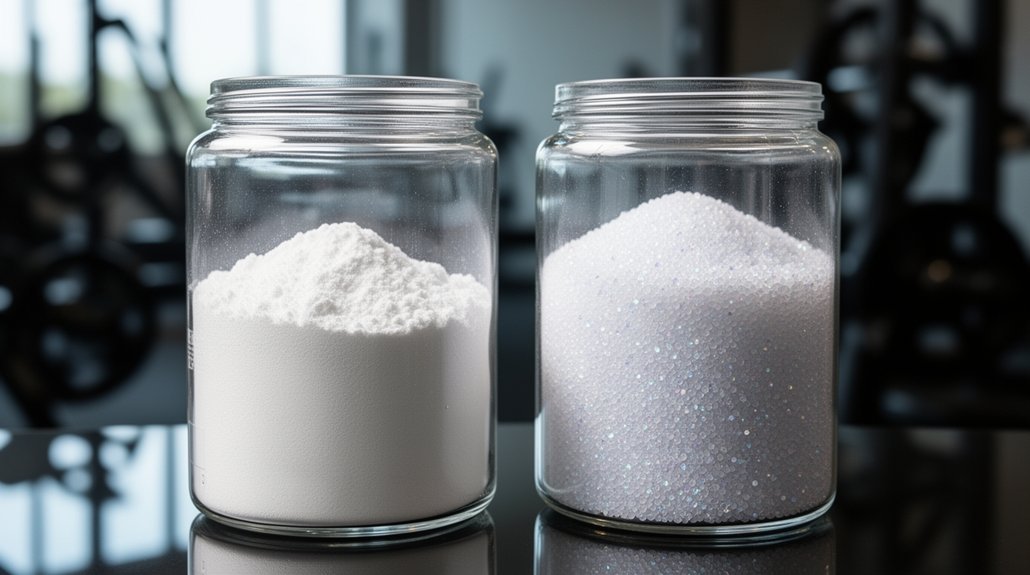
Which creatine should you actually buy? For most people, you’ll want monohydrate. It has the strongest research for raising muscle creatine stores and improving exercise performance, and its bioavailability is 100%.
Solubility doesn’t determine absorption, so HCl’s easier mixing doesn’t guarantee better results. Price matters too. Monohydrate runs about $0.03–$0.05 per gram, while HCl and other alternative forms usually cost more per gram.
You’ll also find monohydrate everywhere, typically as a simple single-ingredient powder, and you can follow the well-established 3 to 5 gram daily dose. For the best mixing, look for a micronized version, since it dissolves better than standard powder.
Consider HCl if monohydrate bothers your stomach or mixes poorly for you. It dissolves more easily, feels less gritty, and brands recommend smaller servings, often 1 to 2.5 grams.
Just don’t assume a smaller dose means better effectiveness, because HCl hasn’t outperformed monohydrate for muscle building or recovery.
Buy monohydrate for evidence, price, and consistency. Choose HCl only for mixability or comfort.
Does Creatine HCl Build More Strength?
You’ve probably seen creatine HCl marketed as the stronger, more efficient option, but the research doesn’t back that up. Trials from 2015, 2024, and 2025 show both forms improve strength similarly.
Strength Evidence Compared
No, creatine HCl doesn’t build more strength than creatine monohydrate. A 2025 placebo-controlled trial in elite team-sport athletes found no statistically notable differences between the two forms across neuromuscular and strength measures, and jump effect sizes looked similar. The authors called HCl superiority claims unfounded and misleading.
A 2024 review reached the same conclusion. Both forms increased bench press and leg press strength when you paired them with resistance training, but the between-group differences weren’t notable.
In a 2015 weightlifter study, every creatine group improved leg press 1RM, yet the groups didn’t differ notably.
A 2022 analysis also found no evidence that HCl increases muscle creatine retention or that lower doses work better. You’ll get similar strength benefits from either form, so compare prices.
Solubility Versus Performance
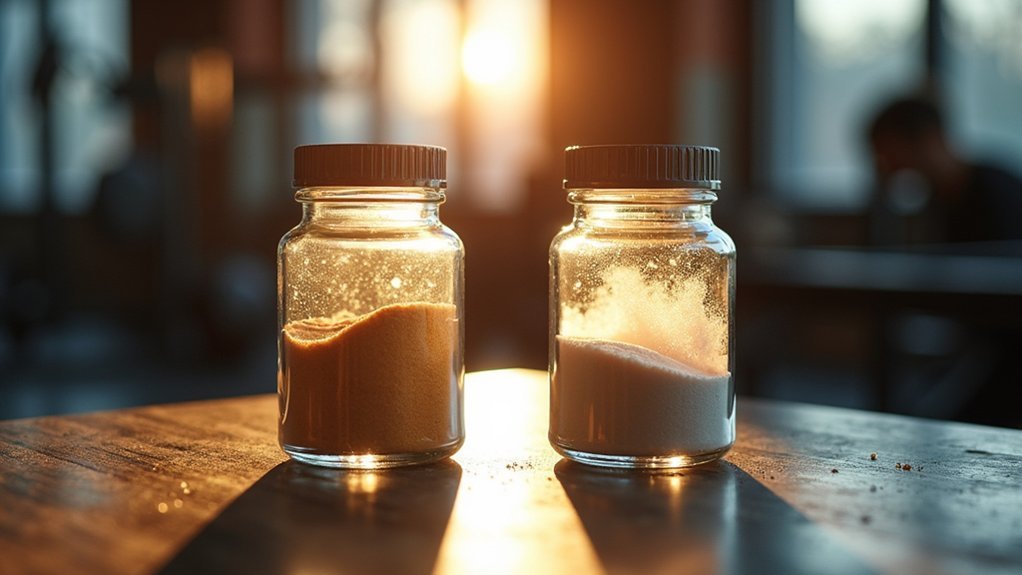
Although creatine HCl dissolves far better in water, that solubility edge doesn’t make it a stronger performer. Reviews list monohydrate at about 0.0133 g/mL and HCl at roughly 0.679–0.709 g/mL, so you’ll mix HCl more easily in small volumes.
But dissolving well in a glass isn’t the same as working better in your muscles.
- Mixability: You’ll see less residue and need less liquid with HCl.
- Strength: A 2025 trial in elite handball and softball players found no significant differences between the two forms.
- Absorption: Humans haven’t shown greater muscle creatine retention with HCl at equal dosages.
Choose HCl if mixability truly matters to you. HCl also typically costs 5–10 times as much as monohydrate per serving. If you want the form with the strongest evidence for strength and training adaptations, monohydrate still sets the clear benchmark.
Dosing Claims Examined
Creatine HCl hasn’t been shown to build more strength than monohydrate, and that includes the popular claim that smaller doses do the job better.
When researchers matched training and dosed by body mass, HCl offered no performance advantage over low-dose monohydrate. Another trial compared 5 g/day of monohydrate with HCl and found similar changes in strength and jump performance.
A 2022 review found no evidence that lower HCl doses outperform standard monohydrate doses in humans.
So you shouldn’t assume a smaller scoop gives you an edge. Bioavailability sounds impressive, but it hasn’t translated into better strength gains.
What you’re getting is the benefit of creatine itself, not of a particular form.
If you’re choosing between them, don’t pay for dosing promises data doesn’t support.
Does Better Solubility Mean Better Absorption?
Why would a form of creatine that dissolves 38 times better in water not absorb better in your body?
Because solubility and absorption measure different things. Solubility tells you how easily creatine dissolves in liquid; absorption tells you how much actually enters your bloodstream and reaches your muscles.
Solubility measures how easily creatine dissolves in liquid, while absorption measures how much actually reaches your bloodstream and muscles.
Consider what the evidence shows:
- Monohydrate already absorbs well. Digestion studies report that about 99% of ingested monohydrate gets taken up by tissue or excreted as creatine, so it’s considered 100% bioavailable.
- HCl’s advantage is mostly convenience. You’ll mix it more easily, but reviews find no proof that it boosts absorption or muscle retention at equivalent doses.
- Supporting data is weak. Bioavailability claims come mainly from patents, a rat study, and models. One patent reported a 1.65 relative bioavailability, yet reviewers don’t treat it as definitive.
Don’t pay extra expecting better uptake. Higher solubility helps with mixing, not with results. Creatine supplementation in general is backed by more than 500 peer-reviewed publications, and it is well tolerated at the recommended 3-5 g per day.
Can Smaller HCl Doses Match Monohydrate?
Can you take less HCl and still get the same results as monohydrate? Not reliably. A 2025 randomized trial compared 5 g/day of each form and found similar changes in strength, jump performance, and body composition. The authors called claims of HCl superiority at low doses unfounded and misleading.
An older trial tested monohydrate at 5 g, HCl at 5 g, and HCl at 1.5 g. You’d see strength benefits across creatine groups, but the study didn’t show that the smaller HCl dose matched monohydrate for muscle creatine. That same trial found no significant strength differences between groups, though fat mass dropped in both HCl groups, and the researchers noted that skinfold-based hydration status assumptions may have influenced those body composition readings.
So a small HCl serving can work, yet it isn’t proven equivalent.
Marketing claims that 1–2 g of HCl equals 3–5 g of monohydrate lack controlled equivalence trials. Monohydrate also has validated protocols: 20 g/day for five days, or 3–5 g/day for about 30 days.
HCl has no comparable framework. If you want maximum evidence-backed muscle saturation, choose monohydrate instead.
Which Creatine Is Easier on Your Stomach?
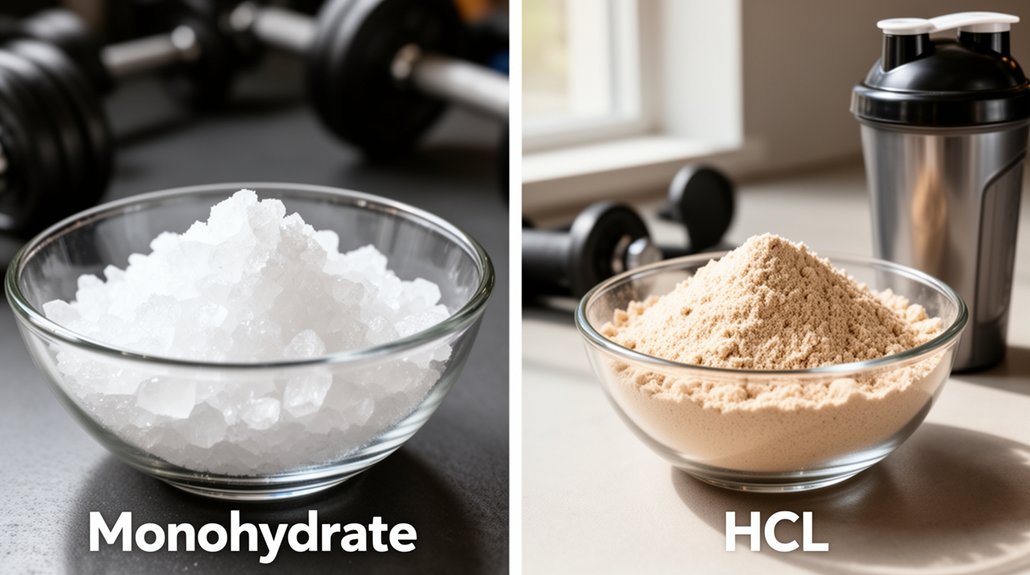
When it comes to stomach comfort, you can’t yet say HCl beats monohydrate. Marketing calls HCl gentler because it dissolves more easily, but strong comparative studies don’t back that up.
Monohydrate, meanwhile, showed no increase in 35 side effects versus placebo, and its digestive complaints are usually mild. The most common side effects of creatine supplements include bloating, diarrhea, muscle cramps, and stomach pain.
Your dosing pattern matters more than the form you pick. You’ll lower your risk of stomach trouble if you:
- Keep servings to 3–5 g, and split larger daily totals across the day.
- Dissolve the powder fully in liquid to reduce bloating and cramping.
- Skip aggressive loading phases, such as 20 g per day.
Large single doses pull water into your intestine, and 10 g in one serving caused more diarrhea than smaller doses.
If your digestion’s sensitive, don’t take creatine on an empty stomach.
For now, monohydrate in divided doses has the stronger evidence for stomach comfort, so start there.
Is Creatine Safe for Long-Term Use?
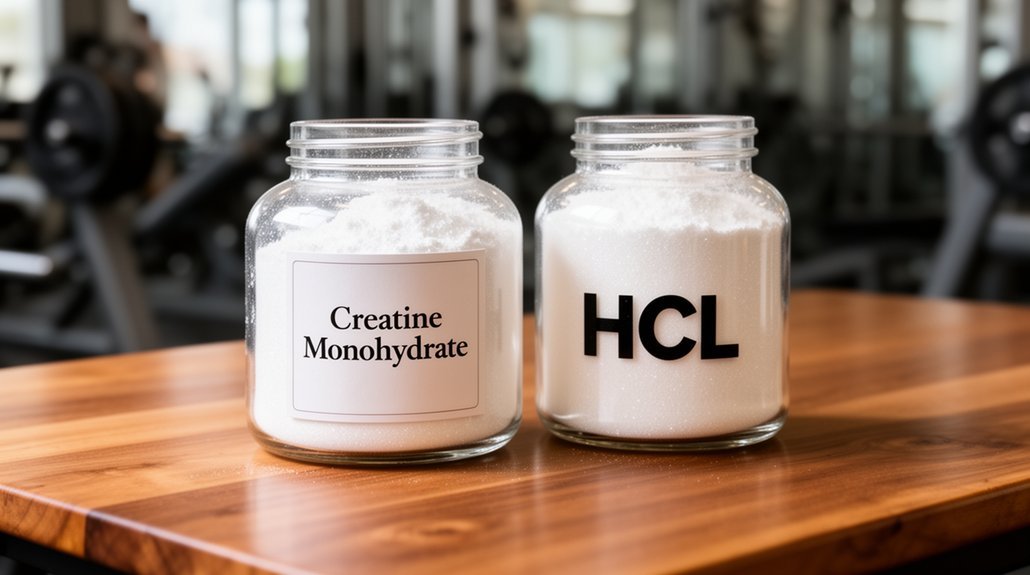
You’re likely wondering whether taking creatine every day for years is a smart move, and the research is reassuring: studies in healthy adults show no increased risk of kidney or liver damage at 3 to 5 g daily, with safety data extending up to 5 years.
You might notice mild side effects early on, such as slight weight gain from water shifting into your muscles, but that isn’t fat gain or a sign of organ stress.
If you have kidney disease, liver disease, or diabetes, or if you’re pregnant or breastfeeding, you’ll want to talk with your doctor before you start.
Long-Term Safety Record
If you’re planning to take creatine for years, monohydrate has the safety record to back it up. Over 680 clinical trials and 12,800 participants have tested it, and 95% of those studies used monohydrate. Researchers haven’t reported clinical adverse events, and minor side effects have stayed rare and similar to placebo.
The data shows:
- Kidneys and organs: Studies found no clinically significant renal dysfunction at doses up to 30 g/day for five years.
- Diverse groups: Safety findings cover infants, older adults, athletes, and clinical populations.
- Duration: Athletes have used it for three to five years without meaningful side effects.
HCL doesn’t offer this depth. Its safety evidence includes a 28-day trial, so you can’t assume long-term equivalence.
For long-term use, monohydrate is better supported.
Common Side Effects
Although creatine is one of the safest supplements you can take, it can still cause a few mild side effects, mostly digestive or fluid-related. Bloating, stomach upset, and loose stools are the most common complaints, especially if you take high doses or use a rapid loading protocol.
Creatine can draw water into your intestines, which may cause discomfort. Taking it with food and splitting your daily dose can help.
Creatine HCL is marketed as gentler, but strong evidence that it causes fewer side effects than monohydrate is limited.
You might gain a little weight during the first week, particularly during loading. That’s water moving into your muscle cells, and it’s temporary and harmless.
Cramps and dehydration claims lack support, but staying hydrated is smart.
Who Should Use Caution
Mild stomach issues and temporary water weight are one thing, but a few groups need to think harder before adding creatine to their routine.
Long-term use looks safe for healthy adults, but that evidence doesn’t extend equally to everyone. Talk with a clinician first if any of these apply to you:
- Kidney concerns: Chronic kidney disease, a transplant, a single kidney, diabetes, high blood pressure, or past acute kidney injury raises your risk, and you shouldn’t use creatine without medical review.
- Medications: If you take kidney-affecting drugs or often use ibuprofen or naproxen, discuss creatine with your doctor first.
- Pregnancy, breastfeeding, or under 18: Safety data are limited, so consult a physician.
Creatine can raise serum creatinine, so mention it before your kidney tests.
Who Should Pick Creatine HCl Instead?
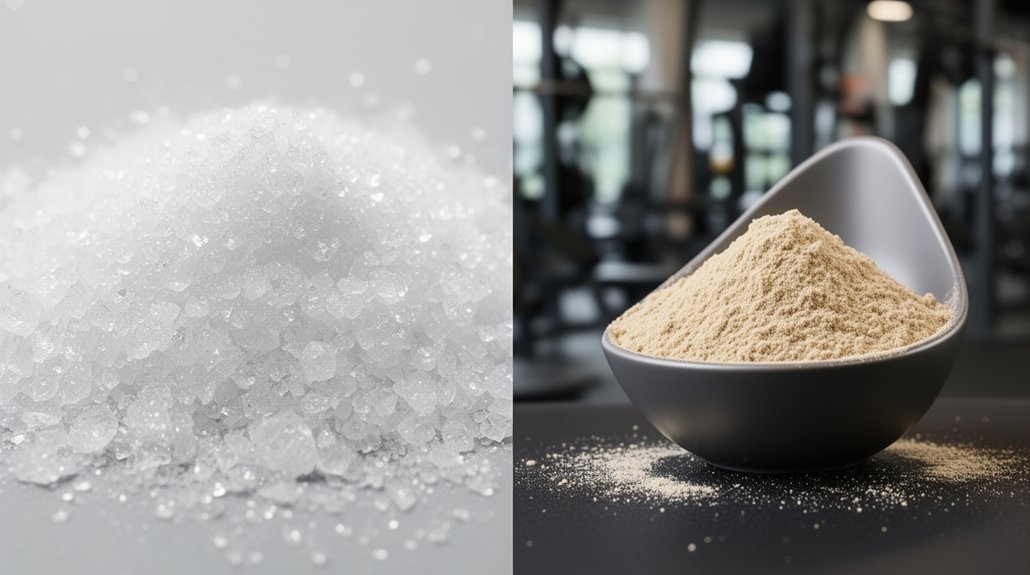
Creatine HCl isn’t the better supplement for most people, but it’s a reasonable fallback in a few specific situations. Choose it if monohydrate gives you bloating, cramping, or stomach discomfort. You might also prefer it if you hate gritty texture, since HCl dissolves more easily and leaves less sediment.
| Your Priority | Better Pick |
|---|---|
| Stomach comfort or easy mixing | Creatine HCl |
| Lowest cost and strongest evidence | Monohydrate |
HCl suits you if you’d rather take smaller servings. Don’t assume a smaller scoop works better; evidence doesn’t support claims that lower HCl doses match standard monohydrate doses. Expect to pay more per gram. You’re buying solubility and convenience, not proven superior results.
If monohydrate causes you no problems, switching offers little evidence-based advantage. Monohydrate remains the most studied, cost-effective option for strength, power, and muscle mass. Treat HCl as a niche alternative for tolerance and mixing preferences, not a universal upgrade.
Frequently Asked Questions
Do I Need a Creatine Loading Phase With Monohydrate?
No, you don’t need a loading phase with monohydrate. Taking 3–5 g daily will still saturate your muscle creatine stores, though it’ll take about 3–4 weeks.
Loading, typically 20–25 g daily for 5–7 days split into 4–5 doses, just gets you there faster. You might gain some water weight in your muscles early on.
Choose loading if you truly want quick results; skip it if you prefer a simpler routine.
When Is the Best Time of Day to Take Creatine?
There’s no single best time of day, so you’ll do well by picking whatever time you can stick with daily.
Consistency matters far more than the clock. If you train, you might take it near your workout, before or after, since research shows no clear advantage either way.
On rest days, just take your usual daily 3–5 grams whenever you’ll remember. Morning, evening, or bedtime all work about equally well.
Should I Take Creatine on Rest Days Too?
Yes, you should take creatine on rest days too. Your goal is keeping muscle creatine stores elevated, and skipping days lets those levels drift downward, especially after loading.
You don’t need to change anything: stick with 3–5 grams of monohydrate daily. Timing matters far less on rest days, so you can pair it with a meal or shake for convenience.
Consistency is what counts, and you’ll maintain saturation without effort.
Can I Mix Creatine With Coffee or Other Caffeinated Drinks?
Yes, you can mix creatine with coffee or other caffeinated drinks. Research hasn’t shown a dangerous interaction, and normal caffeine amounts usually won’t cancel creatine’s benefits.
Still, you’ll want to watch your dose, since high caffeine intakes raise more concerns, especially during loading. If your stomach feels upset, you can separate them by taking caffeine before training and creatine afterward.
Ultimately, you should trust how your body tolerates the combination.
Do Women Need Different Creatine Dosing Than Men?
No, you don’t need a different creatine dose than men. You’ll get the same results from 3–5 grams of creatine monohydrate daily, and you can add a loading phase of 0.3 g/kg for 5–7 days if you’d like faster saturation.
Your baseline stores might differ, but that doesn’t change the recommendation. Consistency matters most.
If you’ve got kidney concerns or take kidney-affecting medications, you’ll want to ask your doctor first.
Conclusion
Creatine monohydrate is still your best bet. It’s cheaper, it’s backed by decades of research, and it’s proven to build strength and muscle. Creatine HCl dissolves better and may be gentler on your stomach, but you won’t find strong evidence that it outperforms monohydrate. If monohydrate upsets your digestion, try HCl. Otherwise, stick with the basics, take it consistently, drink plenty of water, and let your training results do the talking.