
Is Creatine Bad for You? Separating Fact From Fear
No, creatine isn’t bad for you. At 3 to 5 grams daily, it’s one of the safest supplements you can take. A 2025 review of over 13,500 participants found no clinical adverse events, and you’ll likely notice only mild water weight. It won’t damage healthy kidneys, though it can nudge your creatinine higher. If you have kidney or liver disease, you’ll want to check with your doctor first. Keep going to learn what else matters.
Key Takeaways
- Creatine monohydrate is safe for most healthy adults at 3 to 5 grams daily, with a 2025 review of over 13,500 participants finding no clinical adverse events.
- Creatine does not damage healthy kidneys; it can raise serum creatinine by 0.1 to 0.3 mg/dL without indicating kidney dysfunction.
- Common side effects are mild, including water retention, 2 to 4 pounds of weight gain, and occasional bloating or nausea, and they are not significantly more frequent than with placebo.
- Tell your healthcare provider about creatine use, since cystatin C and urine protein tests can assess kidney function more accurately than creatinine-based eGFR.
- People with kidney or liver disease, who are pregnant or breastfeeding, or who are under 18 should consult a doctor first, and everyone should choose third-party tested products.
Is Creatine Safe for Healthy Adults?

For most healthy adults, creatine monohydrate is safe at recommended doses. It’s one of the best-studied sports supplements, and researchers have found it well tolerated in both short- and long-term use, including up to five years in some reviews.
The numbers back that up. A 2025 review of more than 13,500 participants reported no clinical adverse events, and minor side effects didn’t differ meaningfully from placebo.
Another analysis found no increase in 35 evaluated side effects compared with placebo. The International Society of Sports Nutrition says there’s no compelling evidence of harm from creatine monohydrate in otherwise healthy people. Research also shows no increased risk of kidney or liver damage at recommended doses.
Stick with the standard 3 to 5 grams daily. You might notice some water-weight gain early on, and if you’re prone to bloating or stomach upset, you’ll tolerate steady daily dosing better than aggressive loading.
Keep in mind that these conclusions apply best to healthy adults using standard doses.
Does Creatine Damage Your Kidneys?
Creatine won’t damage your kidneys if you’re a healthy adult using standard doses, but it can change the lab numbers doctors use to judge kidney function.
Your serum creatinine may rise modestly because creatine metabolism produces more creatinine, which can make your creatinine-based eGFR look worse even when your kidneys are filtering normally. In a meta-analysis of 26 randomized trials, when kidney filtration was measured directly with Cr-EDTA, there was no significant difference between creatine and placebo.
If you have chronic kidney disease, reduced kidney function, a transplant, one kidney, or a history of acute kidney injury, you’ll want medical supervision before you start.
Creatinine Levels Explained
Your creatinine number can climb after you start taking creatine, and that’s usually a lab quirk rather than a sign of kidney trouble. Creatine converts spontaneously into creatinine, so your blood level rises even when your kidneys filter normally.
| Marker | What it tells you |
|---|---|
| Serum creatinine | Rises about 0.13 mg/dL with creatine |
| eGFR | Can look lower; true function unchanged |
| Urea and proteinuria | Show no meaningful injury |
| Urinary creatinine | Adds context |
Typical ranges run about 0.74–1.35 mg/dL for men and 0.59–1.04 mg/dL for women, but muscle mass, diet, and supplements all shift your result.
Pooled studies show no significant GFR decline, so a higher number isn’t kidney damage. A systematic review of 21 studies found that the rise in serum creatinine was transient, showing up mainly in studies with follow-up of one week or less and not in those lasting 1 to 12 weeks. If your results look off, tell your clinician that you take creatine; they can order alternative kidney biomarkers.
Kidney Disease Precautions
A higher creatinine number doesn’t mean creatine is hurting your kidneys, and the research backs that up. Studies in healthy adults show no clinically meaningful changes in GFR, proteinuria, or urea at standard doses.
Your situation changes if you have kidney disease. Reduced kidney reserve may make you more vulnerable to added stress, and evidence in this group remains limited, so clinicians generally don’t recommend creatine for chronic kidney disease.
If your kidney function is very low, avoid it.
Talk with your clinician before starting any supplement if you have diabetes, hypertension, or heart disease. Get baseline kidney function testing, and tell every provider you’re taking creatine. You should stop creatine and see a doctor right away if you notice decreased urination, swelling in your legs or around your eyes, or dark or bloody urine.
Creatinine-only tests can mislead you during supplementation, so ask for additional markers to confirm your kidney health.
Why Does Creatine Raise Creatinine Levels?
How does a supplement that’s safe for healthy kidneys end up making your lab results look worse? Your muscles naturally convert creatine into creatinine, a breakdown product. When you supplement, you increase the creatine available for that conversion, so your blood creatinine can climb.
Here’s what that means for you:
- Your kidneys still filter normally; only the blood level changes.
- Doctors use creatinine to estimate GFR, so a higher reading can make your eGFR look lower than it truly is.
- The rise is usually small, around 0.1 to 0.3 mg/dL, especially if you use a loading dose.
- Levels typically fall after you stop creatine, which points to a metabolic effect, not permanent kidney damage.
Because a higher number doesn’t automatically signal kidney injury, tell your doctor about your creatine use before any blood test to avoid unnecessary worry. Establishing baseline lab numbers through routine blood work before you start can also help your provider interpret any later changes. The real issue is test interpretation, not harm in healthy people.
Which Kidney Tests Are Reliable on Creatine?
Since serum creatinine can mislead you on creatine, you’ll want to lean on tests that don’t depend on it.
Creatinine-based eGFR may read falsely low because supplementation raises creatinine.
Start with cystatin C. It’s less dependent on muscle mass, and recent clinical discussion reports creatine doesn’t affect it.
Start with cystatin C. It depends less on muscle mass, and clinical discussion suggests creatine supplementation doesn’t skew it.
Ask for a combined creatinine-plus-cystatin C eGFR. Adding cystatin C improves accuracy and reduces misclassification, and KDIGO-aligned guidance supports confirmatory testing when creatinine falls short.
If your results still seem uncertain, or the two markers disagree, consider a directly measured GFR.
Studies show creatine doesn’t greatly change it, so a normal result helps you separate true dysfunction from a harmless creatinine bump.
Doctors reserve it for unclear cases.
Finally, add urine testing.
Proteinuria and albuminuria checks reveal kidney damage creatinine might miss and clarify whether a low eGFR reflects CKD.
Skip urinary creatinine as a safety marker; supplementation shifts it.
What Side Effects Can Creatine Cause?

You’ll most likely notice mild effects first, like weight gain from water retention in your muscles, along with occasional nausea, diarrhea, or bloating, especially if you take large doses or load.
Serious reactions, such as allergic responses or a pounding heartbeat, are rare, and large reviews haven’t found more side effects in creatine users than in people taking a placebo.
You can lower your risk of stomach trouble by splitting your doses and taking creatine with food, and it’s worth knowing which symptoms should prompt you to stop.
Common Mild Side Effects
Most people tolerate creatine well, and the side effects you’re likely to notice are mild and short-lived.
Watch for these four effects:
- Water retention and weight gain: Creatine pulls water into your muscle cells, so you might gain 2 to 4 pounds without adding fat.
- Bloating: You might feel puffy or full, especially during a loading phase. This comes from fluid shifts, not digestive distension.
- Digestive discomfort: Large doses can trigger nausea, stomach pain, or diarrhea.
- Muscle sensations: You might notice cramps, stiffness, extra sweating, or a sense of muscle fullness.
These effects usually fade on their own and rarely pose any danger to healthy users.
If they bother you, lower your dose or skip the loading phase. That simple adjustment usually keeps symptoms manageable.
Rare Concerns And Precautions
Although creatine is safe for most healthy adults, a few rare concerns deserve your attention before you start. Kidney and liver issues are uncommon, and reports often involve other substances or confounding factors. Creatine can also raise creatinine readings, which may mimic kidney dysfunction without true damage.
| Group | Concern | Precaution |
|---|---|---|
| Kidney disease | Limited safety data | Consult a clinician first |
| Liver disease | Rare injury reports | Get abnormal liver tests evaluated |
| Pregnant people or adolescents | Limited evidence | Avoid unsupervised use |
Dehydration and cramps aren’t supported by controlled trials, but you should still drink enough fluids during intense training or heat exposure.
Choose third-party tested products, since contamination and multi-ingredient formulas cause risks unrelated to creatine itself. Taking kidney-affecting medications or high doses long-term? Ask about monitoring.
Who Should Skip Creatine or Ask a Doctor First?

Who should think twice before scooping creatine into a shaker bottle? Certain conditions call for skipping it or getting medical clearance first.
- Kidney problems: If you’ve got chronic kidney disease, one kidney, a transplant, or past acute kidney injury, talk to your doctor first. Protein or blood in your urine needs evaluation too.
- Pregnancy or breastfeeding: Safety data is limited, so don’t start without clinician guidance.
- Liver disease, heavy drinking, or diabetes: Ask your doctor first, since liver stress and blood sugar effects are concerns.
- Medications and other risks: Regular ibuprofen or naproxen, transplant drugs, certain antibiotics, or chemotherapy can increase kidney risk. Uncontrolled high blood pressure or a history of rhabdomyolysis also warrants a conversation.
Under 18? Get physician supervision first.
When in doubt, ask for a kidney-function test before you start. Your doctor can also monitor you afterward, especially if you’ve got a pre-existing renal condition.
How Much Creatine Monohydrate Should You Take?
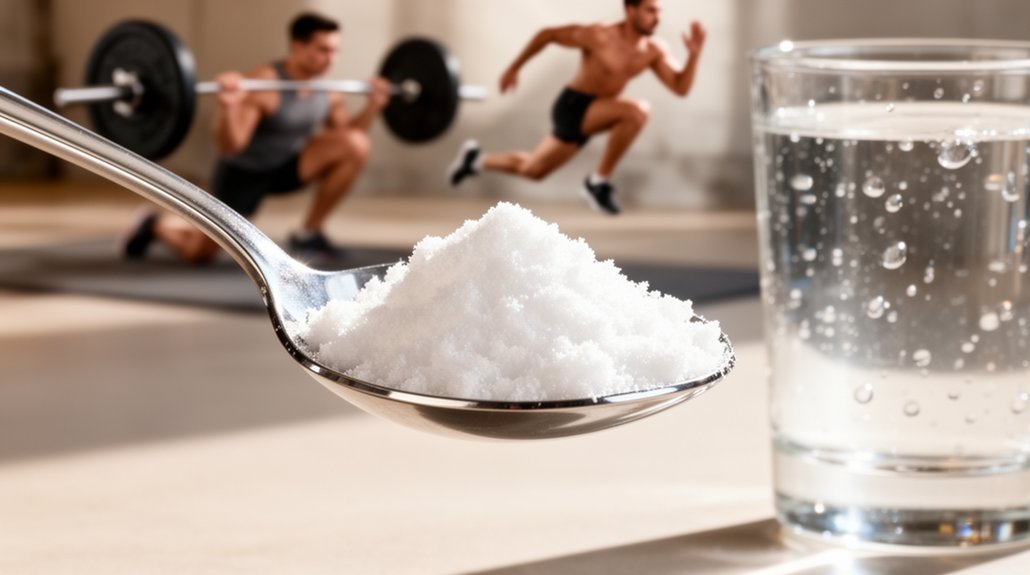
How much creatine monohydrate you need depends on how fast you want results, but 3-5 grams a day works for most healthy adults. Fixed doses keep things simple, though you can use body-weight dosing for a more individualized plan.
If you take 3-5 grams daily without loading, your muscles typically reach saturation in about four weeks. This approach avoids high doses and suits you if you prefer a simple routine. Most long-term users rely on it.
If you want faster results, you can load. Take 20-25 grams daily for 5-7 days, split into four or five doses to improve tolerability. Some guidance uses 0.3 grams per kilogram of body weight daily instead. Loading is optional.
After loading, use 3-5 grams daily (or 0.03 grams per kilogram) to keep your levels elevated. Research shows no major difference between loading and steady low-dose routines for many users.
Stick with monohydrate.
Frequently Asked Questions
Do I Need to Cycle on and off Creatine?
No, you don’t need to cycle creatine if you’re a healthy adult.
Research doesn’t show any benefit from taking breaks, and your body won’t become dependent or stop producing its own creatine. You can take 3 to 5 grams daily to keep your muscle stores saturated.
Some people cycle for budgeting or preference, but that’s optional. If you’ve got kidney disease or take kidney-affecting medications, talk with your doctor first.
Is Creatine a Steroid or a Banned Substance?
No, creatine isn’t a steroid, and it isn’t a banned substance.
You’re taking a naturally occurring compound that supports your phosphocreatine energy system, not a hormone that raises testosterone. WADA doesn’t list it as prohibited, and USADA, NCAA, and the IOC treat it as permitted.
Standard drug tests don’t screen for it, either. What you should watch is product quality, so always choose certified supplements that don’t carry hidden contaminants.
Does Creatine Cause Hair Loss?
No, creatine doesn’t cause hair loss, and you won’t find solid proof that it does. The worry started with a 2009 rugby study that showed a 56% DHT increase, but researchers didn’t measure hair loss, and later studies haven’t repeated that result.
A 2025 randomized trial found no changes in DHT or hair outcomes over 12 weeks. If you’re genetically prone to pattern baldness, though, you might still feel cautious.
Can Teenagers or Older Adults Safely Take Creatine?
Yes, if you’re healthy, you can take creatine safely, though age changes the advice.
If you’re an older adult, research shows 3 to 5 grams daily is safe and may support muscle, strength, and function, especially alongside resistance training.
If you’re a teenager, the evidence looks reassuring, but long-term data are thin, so you shouldn’t treat it as routine.
If you’ve got any kidney concerns, talk to your doctor first.
Does Creatine Work for Women and Non-Athletes?
Yes, creatine works for women and non-athletes, though you’ll see modest changes rather than dramatic ones.
You’ll get the clearest gains in lean mass and strength if you pair 3–5 grams of creatine monohydrate daily with resistance training, especially if you’re postmenopausal, vegetarian, or vegan.
Research doesn’t show serious safety problems in women.
Cognitive and fatigue benefits look promising, but you shouldn’t expect them to match the exercise results yet.
Conclusion
Creatine isn’t the villain it’s often made out to be. If you’re a healthy adult, you can safely take standard doses without worrying about your kidneys. Just remember that creatine can raise creatinine levels without signaling damage, so tell your doctor you’re supplementing before any lab work. If you’ve got existing kidney issues or take medications, check with a professional first. Stick with creatine monohydrate at 3–5 grams daily, stay hydrated, and you’ll get the benefits without the fear.