
Creatine for Women: Benefits, Dosage, and Myths Debunked
You don’t need to fear creatine. Take 3–5 grams of creatine monohydrate daily, and you’ll support strength, lean muscle, energy, and even focus. You can skip the loading phase, since consistency matters more than timing. You might notice a small water-weight bump, but creatine doesn’t add fat. Pair it with resistance training for the best results. Healthy women can use it safely, and the sections below will show you which myths to ignore and why.
Key Takeaways
- Creatine boosts strength, lean muscle, and workout performance in women, and may help preserve muscle and support bone health during menopause.
- The standard dose is 3–5 grams of creatine monohydrate daily, with no separate women’s dose and no required timing.
- Loading (20 grams daily for 5–7 days) is optional and can cause stomach upset, so a steady daily dose works fine.
- Creatine may add 1–2% body weight through muscle water retention, not fat, and persistent bloating deserves medical attention.
- Creatine monohydrate is safe for healthy, non-pregnant women, but those pregnant, breastfeeding, or with kidney disease or chronic conditions should consult a doctor first.
What Does Creatine Do for Women?
Creatine does several things for women, and most of them start with energy. It helps your muscles regenerate ATP faster, so you’ve got a quicker fuel source during short, intense efforts like lifting or sprinting.
Pair it with resistance training, and you’ll likely see gains in strength, power, and lean muscle without automatically bulking up. Some research even shows women gaining more relative performance than men, including a 15% improvement over 10 weeks.
Pair creatine with resistance training, and you’ll likely gain strength, power, and lean muscle without automatically bulking up.
As you age, creatine may help you preserve muscle during perimenopause and menopause, when loss accelerates. Postmenopausal women may also improve muscle mass, strength, and physical function with resistance training.
Emerging evidence suggests it may support your bones after estrogen declines, though the best results come alongside exercise. Because fluctuations in estrogen and progesterone can affect creatine levels, daily supplementation may help stabilize hormonal levels in women.
Creatine may sharpen your memory, concentration, and thinking speed, especially under stress or sleep loss. It might ease fatigue and lift mood, though brain benefits are emerging.
How Much Creatine Should Women Take Daily?
You’ll get the best results from creatine by taking 3–5 grams of creatine monohydrate daily, or about 0.1 g/kg of body weight if you’d rather dose by weight.
You can also start with an optional loading phase of 20 grams a day for 5–7 days to saturate your muscles faster, though it isn’t necessary and may upset your stomach.
Whichever route you choose, you don’t need to worry about timing, because taking it consistently every day matters most. It’s also important to stay well hydrated, especially during the first week of supplementation.
Standard Daily Dosage
Most women do well on 3 to 5 grams of creatine monohydrate a day, and that range works for both new and long-term users.
Researchers haven’t established a separate, lower dose for women, so you’d follow the same guidelines men do. If you’d like a conservative start, take 3 grams daily.
Five grams is the most common maintenance dose, and it’s effective for females. Higher loading doses are unnecessary because smaller daily doses can yield similar benefits over time.
You can also personalize your dose at about 0.1 grams per kilogram of body weight. If you’re postmenopausal, aim for at least 5 grams, especially alongside resistance training.
Take creatine daily; consistency matters more than timing. If it upsets your stomach, split the dose.
Skip supplementation if you have kidney disease or take kidney-affecting medications, unless your doctor clears it.
Optional Loading Phase
A loading phase is optional, and you can skip it without losing any long-term benefit. Loading simply saturates your muscle creatine stores faster.
Most protocols call for 20–25 g daily for 5–7 days, or about 0.3 g/kg/day. Split that into four or five doses of roughly 5 g each, which helps your stomach tolerate it. Afterward, drop to a maintenance dose of 3–5 g daily.
Without loading, 5 g daily reaches similar saturation in three to four weeks. Loading makes sense if you’re heading into a training block or competition and want quicker performance support. Loading phases are often more relevant for elite athletes than for casual users.
If gradual progress works for you, a consistent lower dose is simpler. It also spares you the bloating, stomach upset, and diarrhea that higher short-term doses can sometimes cause.
Consistency Over Timing
Whether you load or skip it, the daily dose you settle on matters more than when you take it. Aim for 3–5 grams of creatine monohydrate every day, or roughly 0.1 g/kg. Most women simply take 5 grams once daily.
Research shows no clear advantage to taking creatine before or after exercise, so don’t stress over workout-minute precision. What counts is taking it every day, including rest days, because you’re maintaining muscle creatine saturation.
Tie your dose to a habit you’ll remember, like breakfast. You can take it with or without food.
Be patient, too: at 5 grams daily, your muscle stores take about 3–4 weeks to fill, similar to what a short loading phase achieves. A traditional loading phase uses 20–25 grams daily for 5–7 days before dropping to a maintenance dose. Steady intake works over time. Simple beats complicated.
Do You Need a Loading Phase?
Do you really need to load creatine before it works? No. Loading only shortens the time it takes to saturate your muscles, not the outcome you reach.
The standard loading protocol uses 20 g daily, split into four doses, for 5–7 days. Then you drop to a maintenance dose. Research shows women respond much like men, with muscle creatine concentrations rising about 19%.
Women respond much like men to creatine loading, with muscle creatine concentrations rising about 19% on 20 g daily for 5–7 days.
If you’d rather skip loading, take 3–5 g of creatine monohydrate daily. You’ll reach full saturation in roughly 3–4 weeks instead of one week. Studies in women have reported benefits with both approaches, and daily dosing works equally well over time.
Loading can upset your stomach. If digestive comfort matters to you, lower daily doses are the safer bet, though a systematic review found both regimens appear safe.
Choose loading only if you want faster results. Otherwise, take 3–5 g every day and stay consistent.
Does Creatine Cause Weight Gain in Women?
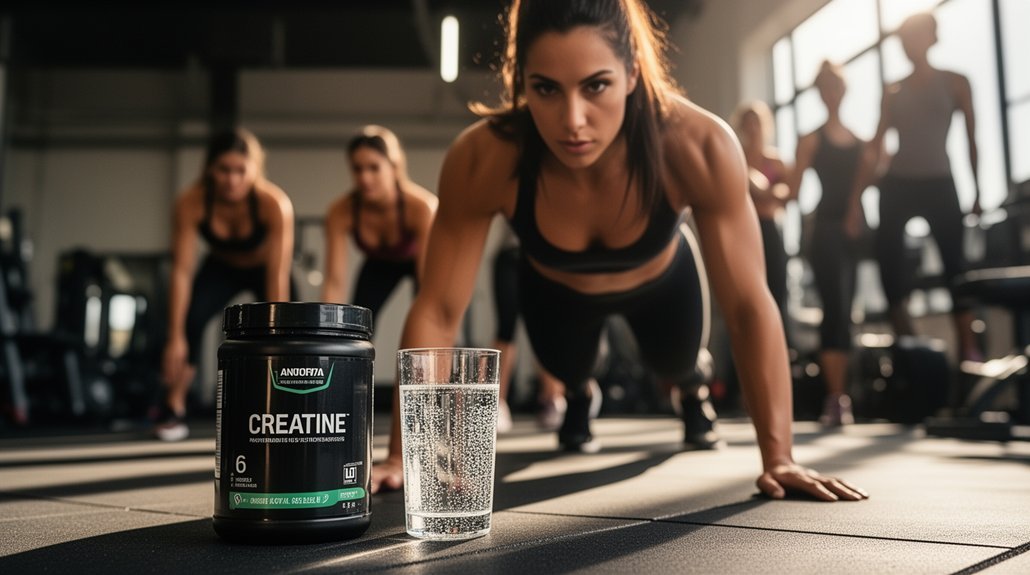
Can creatine make the number on your scale go up? Sometimes, but it’s rarely fat. Creatine pulls water into your muscle cells, so you might gain 1–2% of your body weight early on. A 2025–2026 meta-analysis found an average increase of about 0.89 kg, with no significant effect on fat mass or BMI.
If you load, you might notice 0.5–2 kg during the first week. That water makes your muscles look fuller, not puffy. The increase typically levels off once your creatine stores saturate.
Standard doses rarely cause big scale jumps, while excessive doses more often trigger bloating and GI discomfort. A small scale bump doesn’t automatically mean you’ve actually gained fat.
Creatine isn’t a hormone, and it doesn’t directly cause fat accumulation. Studies in women show performance benefits with minimal body-composition changes.
If you notice persistent bloating, swelling, or rapid unexplained weight gain, look for another cause.
Why Creatine Works Best With Lifting
Creatine doesn’t build muscle on its own, so you’ll get the most from it when you pair it with resistance training.
Lifting provides the stimulus, and creatine helps you regenerate the ATP you need to push through heavy sets and repeated reps.
That combination can improve your workout performance and lead to greater strength and lean mass gains than training alone.
Resistance Training Synergy
Although creatine gets plenty of attention as a supplement, it works best when you pair it with resistance training. Lifting provides the stimulus, and creatine amplifies the adaptations it triggers instead of creating them itself.
The numbers show this synergy. A 2024 meta-analysis found about 1.14 kg more lean body mass when people combined creatine with resistance training instead of training alone.
Cleveland Clinic notes some users gain an extra 2 to 4 pounds of muscle over 4 to 12 weeks of regular exercise. In postmenopausal women, a 2026 review found small but meaningful gains in lean mass and strength.
Results vary, though. Some trials in younger active women found no clear added effect.
Keep lifting as your foundation and progressively overload your muscles.
Better Workout Performance
Two things explain why lifting is where creatine earns its keep: how your muscles fuel short, hard efforts, and how those efforts add up over a session.
Creatine helps you regenerate ATP rapidly, which heavy sets and explosive reps demand. That’s why you’ll notice benefits in strength, power, and anaerobic output, not steady-state cardio.
Across a session, you’ll likely squeeze out more quality reps in later sets, and short-rest hypertrophy work holds up better. Squats, deadlifts, bench press, rows, and overhead presses are your prime targets.
Pair creatine with progressive overload on compound lifts, and you’ll get the most from it. Expect the clearest gains in upper-body strength; lower-body results have been less consistent. In many cases, your body weight won’t change dramatically, either.
Can Creatine Help During Menopause?
When you hit menopause, falling estrogen levels speed up the loss of muscle mass and strength, and that’s where creatine may help. Paired with resistance training, it may help you preserve muscle, build strength, and move more confidently through daily life.
| You want | Creatine may offer | Evidence |
|---|---|---|
| Strong, capable body | More lean mass and strength | Meta-analysis: +0.37 kg lean mass, +7.5 kg leg press |
| Sharp, steady mind | Faster reaction time | Early, small trials |
Research in postmenopausal women typically uses at least 5 g/day of creatine monohydrate alongside resistance training. Some studies use a loading phase of 0.3 g/kg/day for 5 to 7 days, split into multiple doses, then 3 to 5 g/day for maintenance. Lower doses, like 750 mg/day, show less consistent effects. Creatine isn’t a proven menopause treatment, and it won’t replace lifting. Sleep and mood findings remain limited, so treat those benefits as possible, not guaranteed.
Is Creatine Safe for Women Long Term?
Creatine monohydrate looks safe for long-term use if you’re a healthy, non-pregnant woman past puberty. A systematic review found no link to mortality, serious adverse events, weight gain, or kidney and liver complications in females. Trials show you’re no more likely than placebo users to have side effects.
Stick with 3 to 5 g daily. Healthy people using up to 5 g daily for six months or longer showed no renal problems, and summaries describe safe use over several years. You’ll probably notice temporary water retention, and some report nausea, bloating, or diarrhea. Doses drive these effects, so skip the 20 to 25 g loading phase.
Creatine can raise serum creatinine without harming your kidneys, so tell your doctor before lab work.
With kidney disease or kidney-risk medications, talk with a clinician first. Pregnant or breastfeeding? Data remain insufficient.
Choose high-quality products, and don’t extend these findings to supplement stacks.
Which Women Should Talk to a Doctor First?

Should you check with a doctor before starting creatine? If any of the following applies to you, yes.
If you’re pregnant or planning to conceive, talk with a doctor first. Safety data are limited, and some clinical sources advise against use during pregnancy. The same caution applies if you’re breastfeeding, since creatine can pass into breast milk.
Get medical review if your infant was born prematurely or has health issues.
If you have kidney disease or reduced kidney function, don’t start creatine on your own. Your kidneys process it, and it can raise creatinine levels, which complicates monitoring.
Tell your clinician about every prescription and over-the-counter product you take, especially medications that affect kidney function.
You should also get guidance if you have diabetes, liver disease, uncontrolled high blood pressure, or another chronic condition.
A history of rhabdomyolysis or unexplained muscle pain warrants a medical pre-supplement evaluation too.
Frequently Asked Questions
Does Creatine Affect the Menstrual Cycle or Hormones in Women?
No, creatine doesn’t appear to disrupt your menstrual cycle or throw your hormones off balance. Studies haven’t shown it raising estrogen or progesterone to harmful levels, and it hasn’t stopped anyone’s periods.
Instead, your hormones influence how your body handles creatine, especially during the low-estrogen follicular phase. Higher dietary intake links to fewer irregular periods, though that doesn’t prove causation.
You can expect performance and recovery benefits throughout your cycle.
Can Women Take Creatine With Caffeine or Coffee?
Yes, you can take creatine with coffee or caffeine. Healthy adults generally don’t face major safety concerns, and caffeine doesn’t change your creatine blood levels.
Some research suggests caffeine might blunt creatine’s benefits, but that evidence is weak and mostly involves high caffeine doses.
If you’re sensitive to stomach upset, or you want to play it safe, space them apart: have coffee before your workout and creatine afterward.
Stick with 3–5 g daily.
What Type of Creatine Should Women Look for on Labels?
Look for creatine monohydrate on the label, since it’s the most researched form.
You’ll want a simple ingredient list without proprietary blends, and you should confirm it lists about 3 to 5 grams of creatine per serving.
Don’t let “women’s” branding or “micronized” claims sway you.
Choose products with third-party certification, like NSF Certified for Sport or Informed Sport, and verify the listing in the public registry over vague claims.
Does Creatine Cause Bloating or Hair Loss in Women?
You might notice temporary bloating, but you won’t likely see hair loss.
Creatine can pull extra water into your muscles, especially during the first one to two weeks or if you’re loading. Stick with 3–5 grams daily and take it with food to keep that puffiness and stomach discomfort down.
Research hasn’t linked creatine to hair loss in women, so if you’re shedding, you’ll want to look at other causes.
Can Vegetarian or Vegan Women Benefit From Creatine?
Yes, you can benefit, and you might respond even more than omnivores do.
Since creatine comes mainly from animal foods, you likely start with lower muscle stores, so supplementing makes a bigger difference.
Take 3–5 g of creatine monohydrate daily; you don’t need to load.
You’ll probably notice better strength, power, and explosive performance, and some research suggests sharper memory and less mental fatigue, too.
Conclusion
Creatine isn’t just for bodybuilders. You can use it to build strength, support recovery, and protect your muscle as you age. Stick with 3 to 5 grams daily, skip the loading phase if you’d like, and pair it with resistance training for the best results. You’ll likely notice only minor water retention, not fat gain. If you’ve got kidney concerns or take medications, check with your doctor first, then start confidently.