
What Does Creatine Do for Women?
Creatine helps you build muscle and strength, especially when you pair it with resistance training. You’ll likely gain a bit more lean mass and lift heavier than you would without it. It may also sharpen your memory, ease brain fog, and lift your mood. Bone benefits after menopause remain mixed and aren’t guaranteed. It’s generally safe for healthy adults. Stick with us to learn the right daily dose, safety tips, and who should skip it.
Key Takeaways
- Creatine supports muscle and strength gains alongside resistance training, though women typically gain less muscle than men, and some studies show minimal benefit beyond training alone.
- Postmenopausal women gained about 0.37 kg more lean mass and roughly 7.5 kg more on the leg press than those taking a placebo.
- Evidence for bone protection after menopause is mixed, with one 12-month trial showing less femoral neck loss but a 2-year trial showing no benefit.
- Creatine may improve memory, attention, and processing speed, and may ease brain fog in perimenopausal and menopausal women.
- Creatine may help depressive symptoms, especially alongside antidepressants; the typical dose is 3–5 grams daily, and it is generally safe for healthy adults.
Does Creatine Build Muscle and Strength in Women?
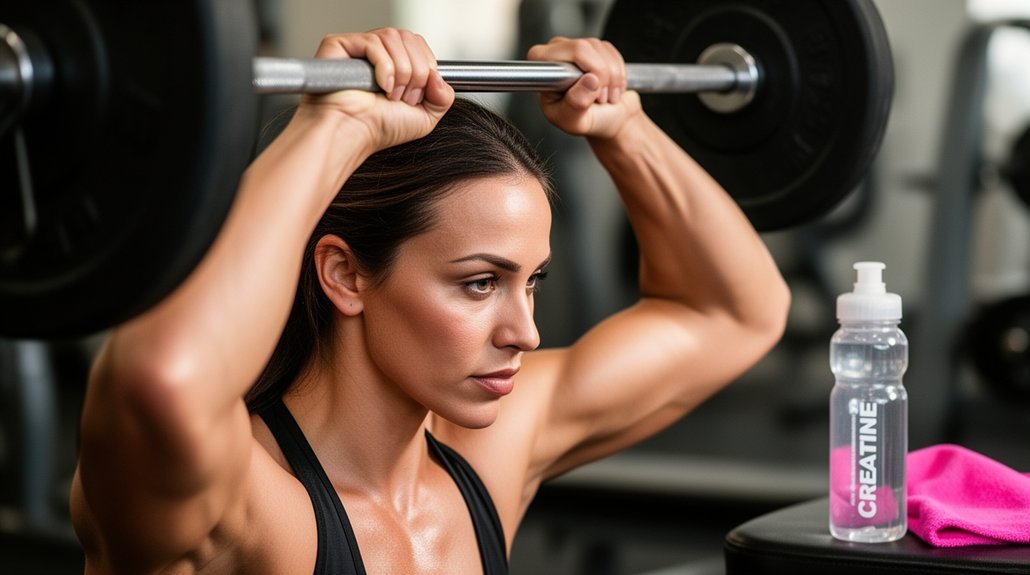
Does creatine actually help you build muscle and get stronger? Yes, but the effects are modest, and training matters a lot.
When you pair creatine with resistance training, you’ll likely see small gains in lean mass. In postmenopausal women, a 2026 meta-analysis found 0.37 kg more lean mass than placebo. Not every study agrees, though. Some show little added muscle beyond training alone, and the evidence has low certainty. Research also suggests that women may experience less muscle mass and strength gains compared to men.
Strength is where you’ll notice more. The same meta-analysis reported leg-press 1RM improved by 7.5 kg versus placebo. Reviews show strength and power benefits in both trained and untrained women, though younger, physically active women don’t always respond.
To improve your odds, lift progressively and take at least 5 g daily, or load first and then maintain. If you take 3 g or less without lifting, you probably won’t see much.
Creatine supports your training; it doesn’t replace it.
Can Creatine Support Bone Health After Menopause?
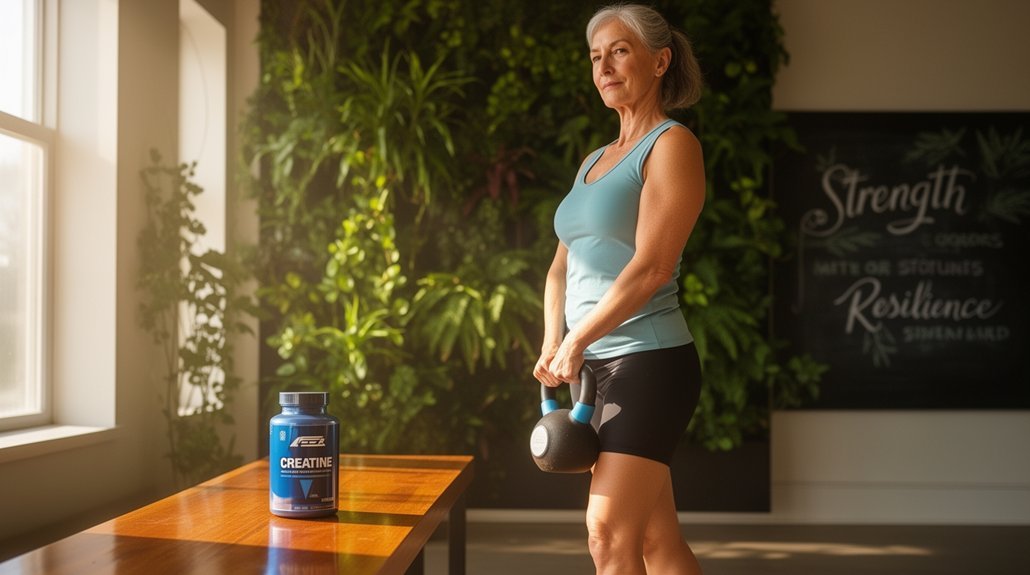
Can creatine protect your bones after menopause? Maybe, but the evidence doesn’t give you a clear yes. Most studies pair creatine with resistance training, so you can’t assume creatine works alone.
Here’s what research shows:
- Density: A 2-year trial of 237 postmenopausal women found no bone mineral density benefit, and a meta-analysis agrees.
- Early promise: A 12-month trial reported femoral neck loss of 1.2% with creatine versus 3.9% with placebo during resistance training.
- Structure: Some studies show thicker cortical bone and better proximal femur geometry, even when density doesn’t budge.
- Mechanisms: Creatine may reduce inflammation, oxidative stress, and bone resorption, but these findings are still preliminary.
Creatine won’t replace bone treatment on its own. If you lift weights, it may offer modest structural support, though results vary.
Postmenopausal women may also see age-related muscle loss slow with creatine, which matters because stronger muscles put helpful load on bones.
Treat it only as an add-on, not a solution. Talk with your clinician before you rely on it for bone health.
Can Creatine Improve Memory and Mood?

Although creatine is best known for muscle, it may also support your memory and, to a lesser degree, your mood. A 2024 meta-analysis of 16 trials found modest improvements in memory, attention, and processing speed. However, it didn’t find clear gains in overall cognition or executive function.
You might notice the clearest memory benefit if you’re older, and research in perimenopausal and menopausal women suggests creatine may ease brain fog. Creatine works as an energy catalyst within cells by helping regenerate ATP, which supports optimal brain function.
Mood evidence is earlier. Creatine may help depressive symptoms, especially when you add it to antidepressant treatment. In eight-week studies of females with major depression, symptoms dropped when researchers added creatine to antidepressants, and one adolescent group’s scores fell 56%.
A small postmenopausal study also reported better mood and reaction time. Creatine may even help when sleep deprivation strains your brain’s energy supply.
Still, these findings are preliminary, so treat creatine as possible support, not a guaranteed treatment.
How Much Creatine Should Women Take Daily?

If you want to try creatine for your brain or your muscles, the dose is simpler than you might expect. Most research supports 3–5 grams of creatine monohydrate daily, and women’s recommendations match men’s.
Creatine dosing is simpler than you might expect: 3–5 grams of monohydrate daily works for your brain and muscles, and women’s recommendations match men’s.
Here’s how to choose your approach:
- Keep it simple: Take 5 grams daily. It’s a widely used default, and you don’t need to overthink it.
- Go lower: Take 3 grams daily if you prefer a maintenance dose.
- Load if you’re impatient: Take 20 grams daily for 5–7 days, split into four 5-gram servings, to saturate your muscles faster. It’s optional.
- Personalize it: Use about 0.1 grams per kilogram of body weight daily for an individualized plan.
Consistency matters more than timing, so take creatine every day, whenever it fits your routine. Pairing it with a meal containing carbs or protein may enhance absorption.
If you skip loading, you’ll still reach similar results over time. Choose creatine monohydrate, since researchers have studied it most extensively in women.
Is Creatine Safe, and Who Should Skip It?

Is creatine safe for you? Usually, yes. If you’re a healthy adult, standard doses are well tolerated, and studies haven’t found kidney harm. Creatine can modestly raise serum creatinine without signaling real kidney damage, so tell your clinician you’re supplementing before lab work. Long-term use appears safe, but you’ll want monitoring if you’re higher-risk.
| Your situation | What to do |
|---|---|
| Chronic kidney disease | Avoid, or use only under medical supervision |
| Pregnant or breastfeeding | Skip; safety isn’t established |
| Under 18 | Avoid unless a clinician directs you |
| Diabetes, liver disease, bipolar disorder, heart disease, high blood pressure | Talk with a clinician first |
Also check with a clinician first if you take nephrotoxic medications, use NSAIDs like ibuprofen or naproxen frequently, or take glucose-lowering drugs. Caffeine may blunt creatine’s effect, though evidence is incomplete. If you have protein or blood in your urine, get evaluated before you start. Staying hydrated is also crucial while you’re taking creatine. Otherwise, expect only rare intolerance.
Frequently Asked Questions
Will Creatine Make Women Look Bulky or Cause Weight Gain?
No, creatine won’t make you look bulky.
You might notice the scale creeping up 1–3 kg early on, but that’s mostly water inside your muscles, not fat.
It’ll make your muscles look a bit fuller, not puffy.
Resistance training drives visible muscle growth, and creatine simply helps you train harder and recover better.
At recommended doses, you shouldn’t expect meaningful weight gain or unwanted bloating, according to research in women.
Does Creatine Cause Water Retention or Bloating in Women?
Creatine can cause a small, early shift in body water, but you probably won’t notice lasting bloating. Most of that fluid moves into your muscle cells rather than puffing up your whole body.
You’re likelier to feel it during a high-dose loading phase, especially in your luteal phase, when you’re already prone to bloating. Stick with 3–5 grams daily, and track your symptoms across your cycle to see what’s happening.
What Time of Day Should Women Take Creatine?
You can take creatine at any time of day, because consistency matters far more than timing. Research shows similar muscle benefits whether you take it before or after workouts, in the morning, or at bedtime.
Stick with 3–5 grams of creatine monohydrate daily, including rest days. If you want a simple habit, take it near your workout or with a regular meal. Food can also ease digestive discomfort.
Which Type of Creatine Is Best for Women?
Creatine monohydrate is your best choice. It has the strongest research behind it, and no other form has shown better results for women.
You’ll raise your muscle creatine stores reliably, and you’ll usually pay less, too. Pricier versions like hydrochloride, ethyl ester, or buffered creatine don’t outperform it.
Take a consistent daily dose of at least 5 grams, and pick the simplest formulation instead of specialty blends.
Does Creatine Affect Hormones or Menstrual Cycles?
No, creatine doesn’t appear to disrupt your hormones or worsen your menstrual cycle. Research suggests your estrogen and progesterone shifts change how your body handles creatine, not the other way around.
During the luteal phase, creatine may increase your body water and support cellular energy. Higher dietary creatine intake has also been linked to fewer irregular periods, though that’s association, not proof.
You’ll need more controlled trials for firm conclusions.
Conclusion
Creatine isn’t just for bodybuilders. If you’re a woman, it can help you build lean muscle, boost strength, and possibly protect your bones as you age. It may even sharpen your memory and lift your mood. You don’t need much, so stick with three to five grams daily. Most healthy women tolerate it well, but you should talk with your doctor first if you’re pregnant, nursing, or managing kidney concerns.