
Creatine Gummies vs Powder: Which Should You Buy?
You’ll get the same creatine from either format, so your choice comes down to priorities. Powder wins on price, costing roughly $0.22 to $1 per serving, while gummies run $1 to $3. It matches label doses more closely and lasts two to three years. Gummies win on convenience, though you’ll often need three to get 4.5 grams. Tests found five of 12 gummies underdosed, and the details below explain how to choose the right one.
Key Takeaways
- Buy powder if cost matters: it typically runs $0.22–$0.88 per serving, while gummies cost roughly $1–$3 for the same dose.
- Powder delivers an effective 3–5 grams per scoop, whereas gummies often supply only 1–2 grams each, requiring several pieces.
- Both forms of creatine monohydrate are nearly 100% bioavailable, so effectiveness depends on accurate dosing rather than format.
- Gummies are less reliable: independent testing found five of 12 underdosed, and they often add sugar, so look for NSF Certified for Sport.
- Choose gummies only for convenience and taste, since they are portable and pre-portioned, but they expire sooner (12–18 months versus 2–3 years).
Creatine Gummies vs Powder: Which Should You Buy?
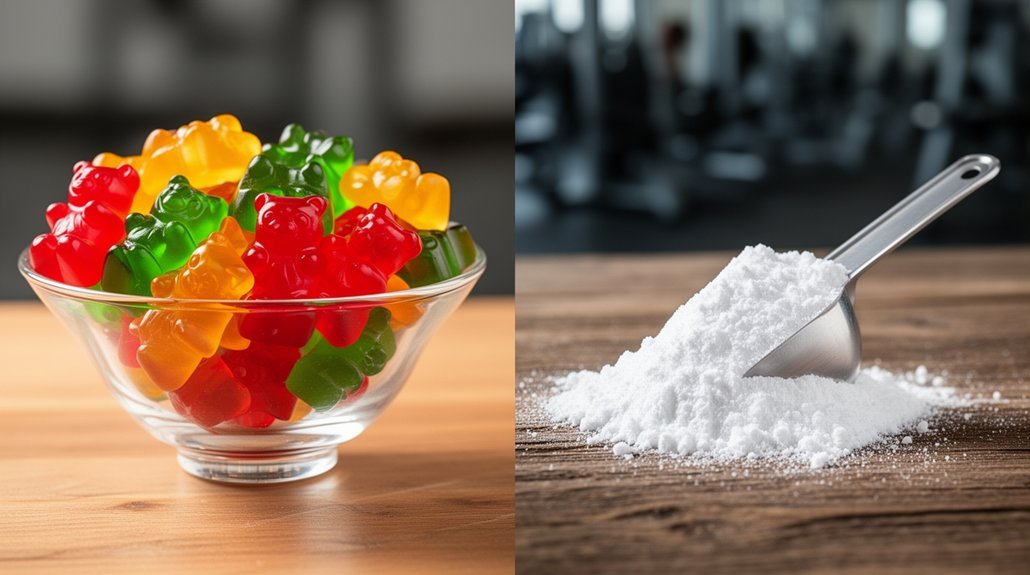
Why pay more for less creatine? For most buyers, powder is the smarter choice. It costs less per serving, about $0.88 versus $1.47 for gummies, and it delivers a simple 3–5 gram dose in one scoop. Many gummies contain just 1–2 grams each, so you’d need several pieces to match a standard serving.
Some third-party tests also found underfilled or trace-level creatine in gummies, and the creatine can degrade from heat, moisture, and acidity. Manufacturing temperatures of 180–200°F can convert creatine into inactive creatinine before the gummies ever reach you.
Powder keeps ingredients minimal. You’ll get nearly pure creatine monohydrate instead of sweeteners, gelling agents, colors, and preservatives. It stays stable in dry storage, and it has a long research history.
Gummies win on convenience. You can toss them in a gym bag, chew them without mixing, and enjoy the taste. If you travel often or hate prepping shakes, they’re a reasonable option.
Otherwise, buy powder for more reliable creatine at a lower price.
Do Creatine Gummies Work as Well as Powder?
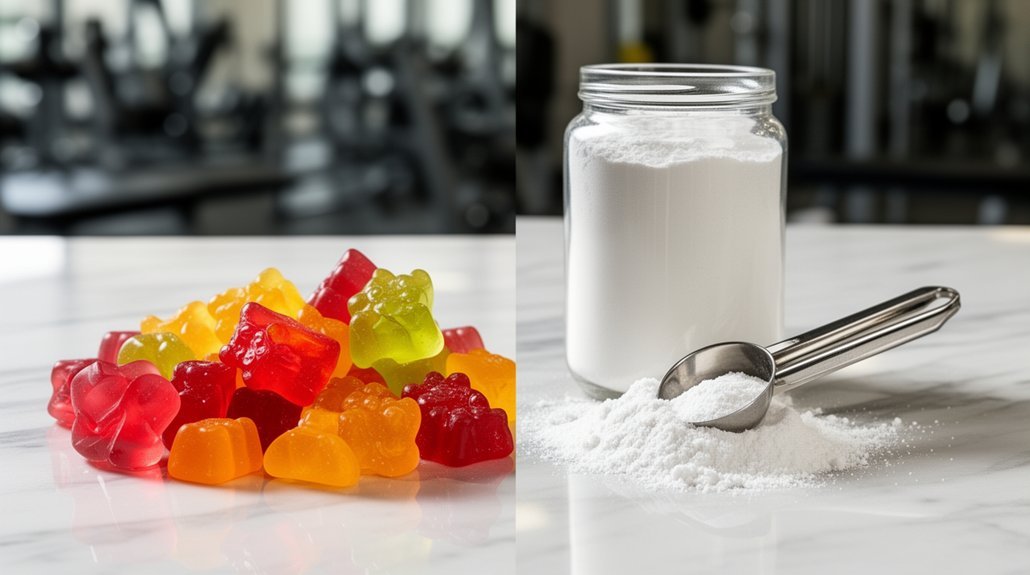
Creatine gummies can work as well as powder, but only if you get the same amount of creatine.
Absorption isn’t the issue, since creatine monohydrate is nearly 100% bioavailable in either format.
What matters is whether you’re reaching the 3 to 5 grams you need each day, because many gummies contain just 0.5 to 2 grams per piece and some contain far less than the label claims. Getting an effective dose from gummies usually means eating several pieces, which leads to increased sugar intake.
Absorption and Effectiveness
If the creatine in a gummy stays intact, your body will absorb it about as well as it absorbs powder. Creatine monohydrate has near-99% oral bioavailability, and your muscles can’t tell which format delivered it.
No head-to-head trial has measured muscle creatine stores after gummies versus powder, so you shouldn’t trust claims that gummies work better.
The real question is dose integrity. Creatine degrades into creatinine when it meets water, heat, and unfavorable pH, and gummies contain moisture and often require heat during manufacturing.
Testing reports show some gummies contain far less creatine than their labels claim, while powders usually match more closely. Powder also remains stable at room temperature, which helps it deliver the dose printed on the label.
If you choose gummies, look for third-party testing and transparent manufacturing. A degraded or underfilled gummy won’t raise your muscle creatine.
Reaching Your Daily Dose
Gummies can match powder on daily dose, but you’ll need to do more math to get there. Most routines target 3–5 grams daily, and powder delivers that in one 5-gram scoop. Gummies vary, so check the label first.
- At 0.5 g per gummy, you’ll eat 6–10 gummies daily.
- At 1.0 g, you’ll need 3–5 gummies.
- At 1.5 g, 2–3 gummies cover it.
Independent testing found some gummies contain a fraction of the claimed creatine, or none at all. Look for products that are third-party lab tested by Labdoor™ for purity and accuracy. Loading phases become impractical because the gummy count climbs sharply.
More gummies make sticking with the routine harder over time. Choose third-party-tested gummies if you prefer convenience, and expect extra sugar and fillers.
If you want a fixed, reliable, economical dose, powder’s the more direct option.
How Many Gummies Equal One 5g Scoop?
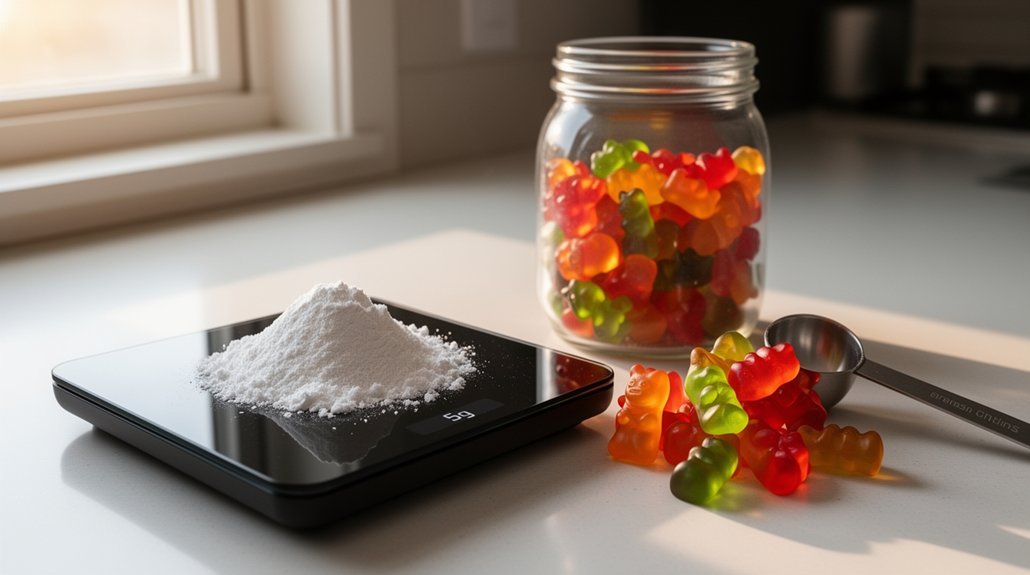
If your gummy label lists 5 g of creatine per serving, you’ll need 5 gummies to match one 5 g scoop of powder, which works out to 1 g per gummy.
That math only holds when the label says so, since serving sizes vary by brand, and some list 3 gummies per serving.
Check the supplement facts panel before you assume any conversion, because you’re relying on the manufacturer’s numbers being accurate. By contrast, Designs for Health’s powder lists 5g micronized creatine per scoop, so the serving size is straightforward.
Gummy-to-Scoop Conversion Math
A standard creatine scoop delivers 5g of creatine monohydrate, but gummies don’t follow one universal count. You’ll need simple math to match your gummies to that scoop. Divide 5g by the grams of creatine in each gummy, or divide 5,000mg by the milligrams per gummy.
Use these reference points:
- 0.5g per gummy: You’ll eat 10 gummies.
- 1g per gummy: You’ll eat 5 gummies.
- 1.25g per gummy: You’ll eat 4 gummies.
- 1.5g per gummy: You’ll eat about 3 to 4 gummies.
- 1.67g per gummy: You’ll eat 3 gummies.
Brands vary. Optimum Nutrition and Bucked Up list 3 gummies, The Well Theory and Smash list 4, and Myprotein lists 5.
Always check the serving size on the label, because count alone won’t tell you the dose.
Label Accuracy Concerns
That conversion math only works if the label tells the truth, and with creatine gummies, that’s not a safe bet. Independent testing found five of 12 gummy products failed; two contained only a fraction of the claimed creatine, and three contained none.
| Test finding | Result | Meaning |
|---|---|---|
| Five of 12 gummies | Failed | Underdosed or empty |
| Six of 12 brands | Matched label | Half were accurate |
The problem isn’t the gummy format itself. It’s inconsistent manufacturing and verification, plus batch-to-batch variation, since U.S. supplement rules don’t require pre-market approval of ingredient accuracy.
Choose gummies with NSF Certified for Sport, Informed Choice, or USP Verified seals, and batch-specific Certificates of Analysis. Avoid proprietary blends and vague serving details. If you need precise dosing, powder is easier to standardize.
Is Powder Better for Creatine Loading?
When you’re trying to saturate your muscles with creatine quickly, powder is the better choice. Loading typically calls for about 20 g per day, split into four 5 g doses, for 2-7 days. Powder makes that target easy to hit.
- You can mix each 5 g dose into liquid or food.
- You can adjust servings to your body weight, such as 0.3 g/kg/day for five days.
- You’ll avoid swallowing dozens of pieces when gummies offer only 1.5 g each.
- You’ll rely on the format used in most loading research.
- You’ll sidestep label-accuracy gaps that can leave you short on grams.
Gummies can work if the label is accurate and the serving size makes high intake realistic. Loading depends on total creatine grams, not convenience. Missing grams quickly derail the protocol.
Save gummies for maintenance, 2-5 g daily, where convenience matters more than speed. For fast saturation, choose powder.
Is Creatine Powder Really Cheaper Per Gram?
Yes, creatine powder is cheaper per gram, and the gap is wide. Published comparisons put powder at about $0.17–$0.49 per 5 g serving, while gummies run $1.00–$2.22. Industry data shows gummies costing roughly 3–8x more per effective dose.
| Format | Example | Cost per 5 g |
|---|---|---|
| Powder | 500 g tub, $16.97 | $0.17 |
| Gummies | Force Factor, 150 for $39.99 | $1.33 |
Why the gap? Gummies need sweeteners, flavors, gelatin or pectin, and molded processing. They also weigh more in packaging and shipping per usable gram. Each gummy holds less creatine, too. Create Wellness gummies provide 1.5 g each, so you’d need three to reach 4.5 g.
Even the cheapest $1.00 gummy costs roughly six times as much. Powder also works well for loading and daily maintenance, so you save money in both phases. If you want the lowest cost, buy powder. Choose gummies only when convenience and taste matter more than price.
Are Creatine Gummies Easier to Stick With?
Gummies often are easier to stick with, mainly because they cut out the daily steps that make powder feel like a chore. You don’t need a scoop, shaker, or water, so you can take them anywhere.
Gummies are easier to stick with because they skip the scoop, shaker, and water, so you can take them anywhere.
Here’s what helps you stay consistent:
- Convenience: You chew and go, whether you’re at the gym, your desk, or traveling.
- Taste: Candy-like flavors make daily use more enjoyable than chalky powder.
- Fixed servings: Pre-portioned doses simplify routine building, since you’re not scooping.
- Dose match: Most products target the 3 to 5 g daily range, and consistent intake drives results.
- Gummy count: Some servings require several pieces, which may annoy you enough to quit.
Powder still works better if you want flexible dosing and fewer pieces per serving.
Gummies suit you better if you value taste and portability. Ultimately, choose the format that fits your daily routine, because you’ll follow that one longest.
What’s Really in Your Creatine Gummies?
Most creatine gummies contain three things: creatine monohydrate as the active ingredient, a sweetener base, and gelling agents that give them their chew.
You’ll typically see glucose syrup, tapioca syrup, sugar, pectin, citric acid, and natural flavors and colors. Beet, spirulina, carrot, or roselle extracts often provide the color.
Sugar varies widely. Some gummies pack 10 g of added sugar per serving, others 3.3 g, and some swap in maltitol, stevia, allulose, or monk fruit.
Even then, glucose or tapioca syrup can keep total carbohydrates meaningful, so check the full label.
Dose matters more than format. One gummy might deliver 1.5 g of creatine, while a two-gummy serving provides 6,000 mg, so compare per-serving totals against a 4.5 to 5 g target.
Testing found 6 of 12 brands matched their label claims, and another review saw 4 of 6 gummies fail identity or potency tests.
Choose third-party-tested brands.
Which Creatine Fits Your Routine and Budget?
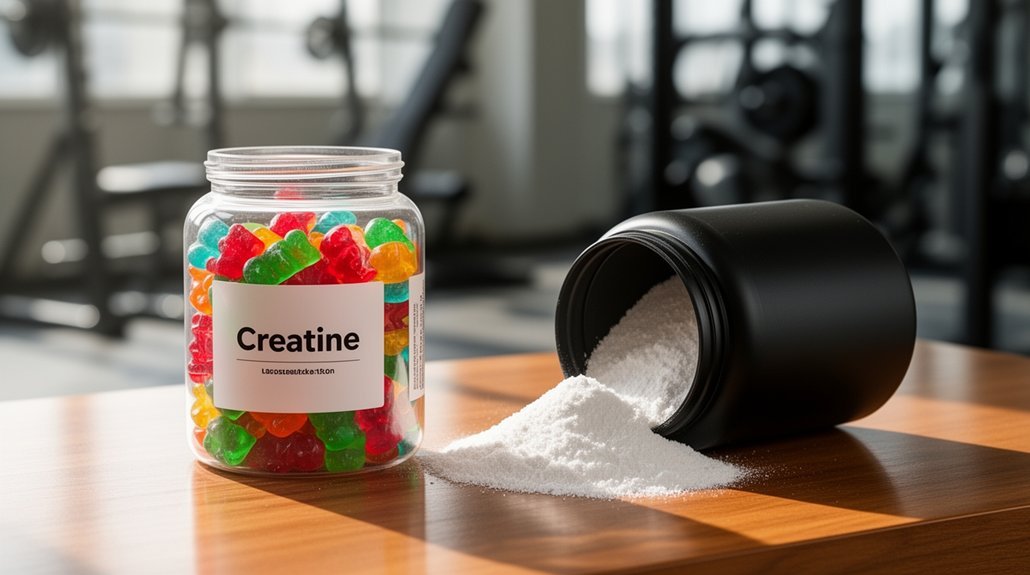
How do you choose between creatine gummies and powder? Start with your budget, your daily habits, and how much control you want over your dose.
Choosing between creatine gummies and powder comes down to your budget, your daily routine, and how much control you want over your dose.
- Budget: Powder often costs under $1 per serving, sometimes $0.22 to $0.33. Gummies run $1 to $2, and you’ll pay up to $3 for some doses.
- Convenience: Gummies travel easily and need no mixing. Powder works best if you already make shakes or pre-workout drinks.
- Dosing: Powder lets you adjust grams precisely, from a 20 to 25 gram loading phase to 5 grams for maintenance. Some gummies contain just 1 to 2 grams each.
- Effectiveness: Your body absorbs both similarly when you take the same amount, though powder has more research behind it.
- Storage: Powder lasts 2 to 3 years; gummies last about 12 to 18 months and react more to heat and humidity.
Choose gummies for portability, powder for value and flexibility.
Frequently Asked Questions
Can I Take Creatine Gummies and Powder on the Same Day?
Yes, you can take creatine gummies and powder on the same day. Both deliver creatine monohydrate, and total daily intake matters more than timing.
Just count every gram from both sources so you don’t accidentally exceed your target, usually 3 to 5 grams daily. You’ll often use one form as your main source and the other to fill gaps.
If your stomach’s sensitive, split doses. Kidney issues? Ask your doctor.
Does Creatine Need to Be Taken at a Specific Time of Day?
No, you don’t need to take creatine at a specific time of day. Your muscles saturate over weeks, so daily consistency matters far more than the clock.
If you want to fine-tune, take it close to your workout, before or after, since studies show both work and the evidence isn’t definitive.
On rest days, you’ll do fine taking it whenever you remember. Consistency always comes first, and timing comes second.
Are There Side Effects of Creatine I Should Know About?
Yes, but you’ll probably notice only mild ones, if any. You might gain a few pounds from water retention, and you could feel nausea, bloating, or diarrhea, especially if you take large doses or load.
Splitting your dose, taking it with food, and skipping loading can help.
Creatine can also raise creatinine on blood tests without harming your kidneys, so tell your doctor you’re taking it.
Kidney disease? Ask first.
Is Creatine Safe for Teenagers or Older Adults?
Creatine’s generally safe for healthy adults, including many older adults, when you take it as directed.
If you’re a teenager, though, doctors don’t recommend routine use under 18 without medical or sports-dietitian supervision, since long-term data are limited.
If you’re an older adult with kidney disease or diabetes, you’ll want a clinician’s approval first.
Either way, you should choose reputable, tested products, stay hydrated, and avoid self-directed high doses.
Do I Need to Drink Extra Water When Taking Creatine?
You don’t need extra water just because you’re taking creatine. Research doesn’t link creatine to dehydration or cramping, and it mostly pulls water into your muscle cells rather than draining your body.
You should still meet your normal daily fluid needs, though. Drink more when you’re training in heat, sweating heavily, or working out for long sessions.
During loading, you’ll notice temporary water weight, so track your hydration and weight.
Conclusion
If you want the most creatine for your money, powder wins. It’s cheaper per gram, it’s easy to dose, and it makes loading simple. But if gummies help you stay consistent, they’re worth considering. Just check the label, because you’ll often need several gummies to match a 5g scoop. Choose the option you’ll actually take every day. Consistency matters more than format, so pick what fits your routine, your budget, and your goals.