Creatine and Hair Loss: Separating the Single Study From the Hype
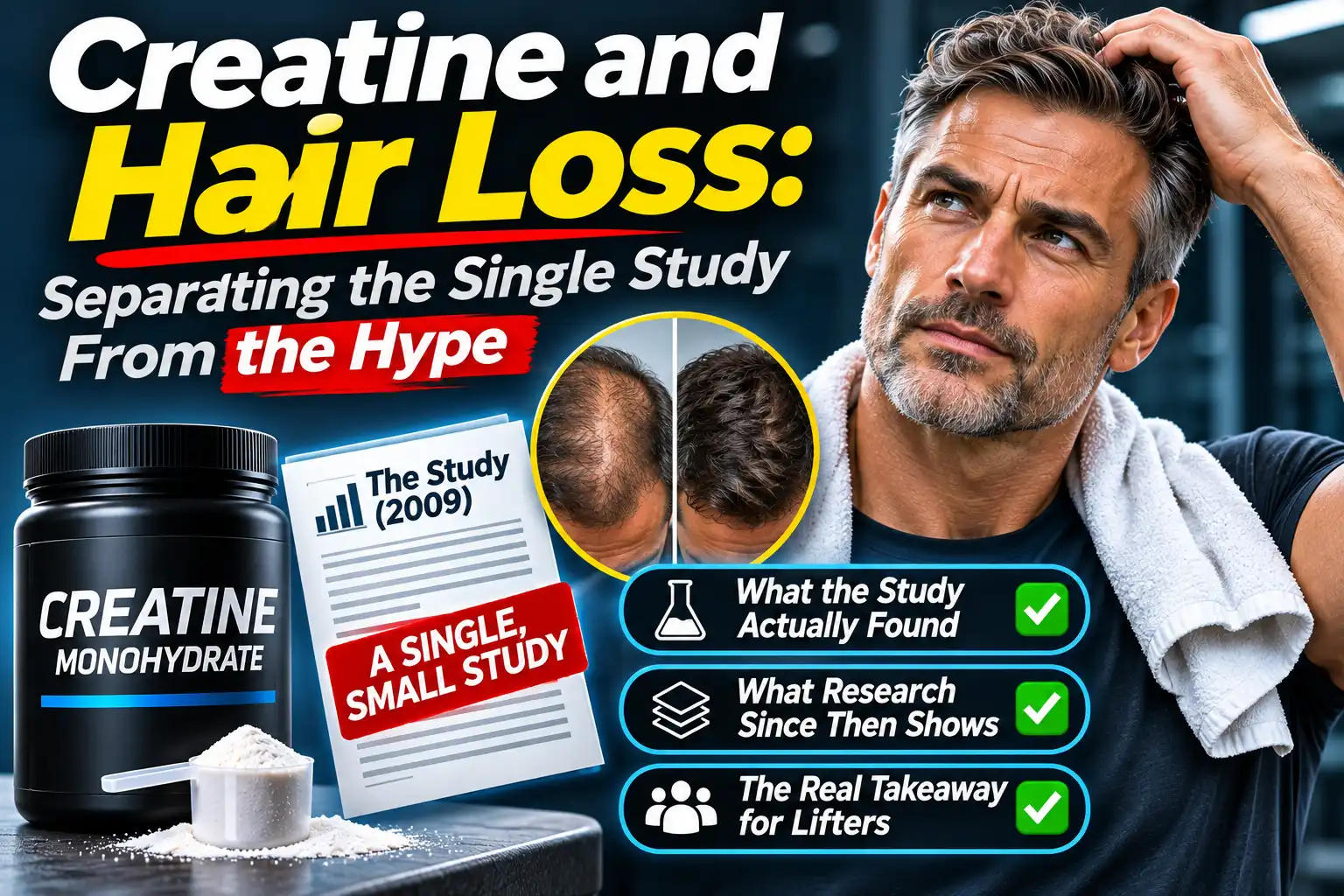
No good evidence shows that creatine causes hair loss. The worry traces back to a single small 2009 study of rugby players that reported a rise in DHT, a hormone linked to pattern baldness, but that study never measured hair. The only randomized trial that measured hair directly, published in 2025, found no difference in DHT or in hair density, follicle count or hair thickness between creatine and placebo after 12 weeks. That doesn’t settle the question for good, since the trial was small, short and limited to men aged 18 to 40, but it’s reassuring. Below, you’ll see what each study did and didn’t show, and what to do if your hair is shedding. For the short version, see our main guide on whether creatine causes hair loss.
Key Takeaways
- The creatine and hair loss myth comes from one 2009 study of about 20 college-aged rugby players that reported a 56% DHT rise after a loading week.
- That study measured hormones in blood, not hair, and it hasn’t been shown again in later research.
- A 2025 randomized, placebo-controlled trial of 45 resistance-trained men found no differences in DHT, the DHT-to-testosterone ratio or hair measures after 12 weeks at 5 g daily.
- That trial included only men aged 18 to 40, lasted 12 weeks and didn’t account for family history, so long-term and individual risk remain unproven.
- Genetics, not supplements, are the main driver of pattern hair loss.
The 2009 Study and the 2025 Trial at a Glance
| 2009 rugby study | 2025 randomized trial | |
|---|---|---|
| Participants | 20 college-aged rugby players | 45 resistance-trained men aged 18 to 40 (38 finished) |
| Design | Double-blind, placebo-controlled crossover | Randomized, double-blind, placebo-controlled |
| Dose | 25 g/day for 7 days, then 5 g/day for 14 days | 5 g/day for 12 weeks, no loading |
| What was measured | Testosterone and DHT in blood | Testosterone, DHT, hair density, follicle count, hair thickness |
| Result | DHT up 56% after loading, 40% above baseline after maintenance | No difference in DHT or hair measures |
| Hair loss measured? | No | Yes |
Does Creatine Cause Hair Loss?
Why does this question keep coming up? It traces back to a 2009 study in the Clinical Journal of Sport Medicine, in which DHT rose 56% after a week of 25 g/day creatine loading and stayed 40% above baseline after 14 days at 5 g/day.
DHT is linked to androgenetic hair loss, so people connected the dots. But that study measured a hormone, not hair. You can’t conclude from it that creatine caused shedding or thinning. The only trial that tested hair directly found no effect, which we cover below.
How Did the Creatine Hair Loss Myth Start?
The myth started with the 2009 rugby study, and it spread because of what that study left unmeasured. Researchers gave 20 college-aged rugby players 25 g of creatine daily for a week, then 5 g daily for two more weeks, and compared it with a placebo. They reported higher DHT and a higher DHT-to-testosterone ratio, while testosterone itself didn’t change. They didn’t measure hair loss.
Popular media filled that gap. Headlines treated a hormone shift as proof of baldness risk, and the study’s limits rarely made it into the coverage. The result is a claim that sounds scientific but rests on one small study with no hair data:
- The sample was small and narrow: 20 young, trained men.
- The loading dose was 25 g a day, far more than the 3 to 5 g most people take.
- Researchers never examined anyone’s scalp.
- The authors themselves called for further investigation.
What Does DHT Have to Do With Creatine?
Although creatine contains no hormones, DHT is the one link researchers have drawn between the supplement and hair loss. DHT, or dihydrotestosterone, forms when the enzyme 5-alpha-reductase converts testosterone. It’s more androgenic than testosterone, and in genetically susceptible people, it binds to receptors in scalp follicles and gradually shrinks them.
That’s why even a small hormone shift got attention. But a change in DHT in your blood doesn’t automatically mean changes at the follicle. Follicle sensitivity and genetics matter more than circulating levels, and DHT is a normal hormone in men. You’d need a predisposition to androgenetic alopecia for a modest increase to matter.
One note to avoid confusion: the “DHT” on a creatine lab report is a different thing. It stands for dihydro-1,3,5-triazine, a manufacturing impurity, and it has nothing to do with the hormone. Our creatine quality checklist explains how to read it.
Why Can’t the 2009 Study Settle the Question?

The 2009 study wasn’t a bad study. It was a placebo-controlled crossover design, which is a solid approach, and its finding was real in that group. It’s just too narrow to carry the weight people put on it.
Small Sample and Short Duration
Twenty young male rugby players made up the whole study, so you can’t generalize its results to every creatine user. It ran for three weeks, which tells you nothing about long-term use. Small, short studies produce unstable estimates, and a result that shows up once needs to be seen again before you trust it.
Hormones, Not Hair Loss
Even if you accept the 2009 finding at face value, it measured serum DHT in blood. The researchers didn’t assess scalp DHT, shedding, follicle miniaturization or hair density, and they didn’t check whether any participant lost hair. Male-pattern hair loss depends on how sensitive your scalp follicles are to androgens, not only on what circulates in your blood. A change in blood DHT can’t tell you what’s happening inside a follicle.
Has Anyone Replicated the DHT Rise?
Not clearly. The 2025 trial below measured DHT directly and found no difference between creatine and placebo. We didn’t find another study that reproduced the 2009 DHT rise.
There’s one honest caveat. The 2025 trial used 5 g a day and no loading phase, while the 2009 study used a 25 g loading week. So the newer trial doesn’t directly test whether loading raises DHT. If hair concerns you, that’s one more reason to skip loading, which isn’t necessary anyway. Our guides to the creatine loading phase and how much creatine to take per day explain why steady dosing works.
What Did the 2025 Creatine Hair Trial Show?
A 2025 randomized, placebo-controlled trial in the Journal of the International Society of Sports Nutrition finally tested creatine’s effect on hair directly.
Trial Design and Dosing
Researchers randomly assigned 45 resistance-trained men, aged 18 to 40, to 5 g a day of creatine monohydrate or 5 g of maltodextrin placebo for 12 weeks. Thirty-eight men finished. There was no loading phase, and participants kept their usual diet and training.
The team measured hair directly, not indirectly. They took blood samples at the start and at week 12 to track total testosterone, free testosterone and DHT. They also assessed hair with a trichogram and the FotoFinder imaging system, tracking hair density, follicular unit count and cumulative hair thickness.
Hormone and Hair Results
Creatine didn’t move DHT or any hair measure. DHT, the DHT-to-testosterone ratio, hair density, follicular unit count and hair thickness showed no significant differences between creatine and placebo. Total testosterone rose slightly in both groups and free testosterone dipped in both, so neither change can be credited to creatine.
Limits of the Trial
You shouldn’t stretch this conclusion beyond what the data supports:
- It’s one trial, so the question isn’t closed.
- The sample was small, so subtle effects could have been missed.
- Twelve weeks says nothing about years of use.
- Participants were men aged 18 to 40, so results may differ for women and older men.
- It didn’t account for family history of hair loss.
Is Creatine Riskier If Baldness Runs in Your Family?
Why does family history make people so nervous about creatine? Because DHT matters in male-pattern baldness, and people who are genetically prone feel any DHT claim more strongly. This is the group the research can’t fully speak to. The 2025 trial didn’t factor in family history, so it can’t tell you whether men with a strong family history respond differently.
What we can say is this: your baseline risk is higher if baldness runs in your family, and genetics and follicle sensitivity drive that risk. Nothing in the current evidence shows creatine adds to it. You might also notice shedding while you’re training, dieting or stressed, and the timing can feel meaningful. Coincidence is more likely than causation, since inherited baldness often begins in adulthood with or without supplements.
If you’re genetically prone and worried, it’s reasonable to talk with a dermatologist before starting, skip loading and watch your hairline over time. For the wider picture, see creatine for men over 40 and our guide to creatine side effects.
How Can You Take Creatine Without Hair Worries?

The creatine hair-loss rumor traces back to one small 2009 study that measured DHT, not hair loss, and the only direct hair trial found no effect.
Keep it simple and stick to evidence-based habits:
- Take 3 to 5 grams of creatine monohydrate daily, the form and range used in the strongest hair-related trial.
- Skip loading. It isn’t required, and the only DHT rise came from a loading protocol.
- Choose products verified by independent third-party testing, as explained in our guide to reading a creatine label.
- Track your hairline and general tolerance over time.
If you notice shedding, consider other causes first. Common ones include stress, illness, crash dieting, low iron or thyroid problems, some medications and inherited pattern hair loss. Shedding usually shows up weeks to months after a trigger, so a recent change in your life is more likely than a supplement you started last week. If it persists or you see clear thinning, ask a doctor or dermatologist. You don’t need to avoid creatine outright.
Frequently Asked Questions
Does Creatine Cause Hair Shedding When You First Start Taking It?
Research hasn’t shown that it does. Shedding usually lags behind its trigger by weeks or months, so if you notice it soon after starting creatine, another trigger like stress, illness or dieting is a more likely explanation.
Is a Creatine Loading Phase More Likely to Affect Hair?
It’s unproven either way. The 2009 study that saw a DHT rise used a 25 g/day loading week, while the 2025 trial used 5 g/day with no loading and found no change. If you’re cautious, skip loading, since steady dosing reaches the same saturation in about four weeks.
Should Women Worry About Creatine and Hair Thinning?
There’s no evidence that creatine causes hair thinning in women, but the trials were done in men, so women haven’t been studied directly. If you notice shedding, it’s worth checking iron, thyroid and stress levels with your doctor.
Does Creatine Affect Testosterone?
Not in the studies we’ve covered. Testosterone didn’t change in the 2009 study, and total and free testosterone moved the same way in the creatine and placebo groups in the 2025 trial.
Can You Stop Creatine and See Hair Regrow?
If creatine isn’t behind your shedding, stopping won’t help, especially with pattern hair loss. Hair cycles move slowly, so you’d need months to judge, and a change after stopping doesn’t prove creatine was the cause.
What Else Causes Hair Shedding in Lifters?
Calorie restriction or rapid weight loss, low iron or protein intake, high stress, poor sleep, thyroid problems and genetic pattern hair loss are common causes. Anabolic steroids and some other products can also affect hair, which is separate from creatine. If shedding continues, see a doctor.
Conclusion
You don’t need to toss your creatine over hair fears. One small 2009 study found a DHT rise, but it never measured hair loss, and the only randomized trial that did measure hair found no difference after 12 weeks. If baldness runs in your family, you can still take creatine, but you may want to skip loading, watch your hairline and talk with your doctor if you’re worried. Stick with a standard 3 to 5 gram daily dose, and you’ll keep building strength without trading away your hair. For picks, see our best creatine for men.