

Why Creatine Monohydrate Is Still the Gold Standard After 30 Years
Creatine monohydrate is still the gold standard after more than 30 years because no newer form has beaten it. It’s the most studied form of creatine, it helps your muscles regenerate ATP so you can lift more and gain strength, and it’s safe at 3 to 5 grams daily for healthy adults. It also costs less than HCl, buffered and other “advanced” versions. Below, you’ll see what the research shows, where creatine helps and where it doesn’t, and how to choose a quality product. New to creatine? Start with our beginner’s guide to what creatine is.
Key Takeaways
- Creatine monohydrate is the most researched form, and it’s the reference researchers compare other forms against.
- Paired with resistance training, it consistently improves strength, power and lean mass, with the clearest gains in short, intense efforts.
- It doesn’t improve endurance performance, so it’s not a fit for steady-state aerobic goals.
- HCl, buffered, ethyl ester and nitrate forms haven’t shown better results than monohydrate, and ethyl ester has performed worse.
- A standard dose is 3 to 5 grams daily, and long-term research in healthy people hasn’t shown kidney or liver harm at that dose.
- Choose a plain monohydrate with a verifiable third-party seal and a lot-specific lab report.
What Is Creatine Monohydrate and How Does It Work?
Creatine monohydrate is a creatine molecule bound to one water molecule, and it’s the most common form you’ll find in supplements. It’s affordable, easy to dose, and researchers generally regard it as safe at recommended doses. The large majority of creatine studies have tested this specific form.
Inside your body, creatine’s main job is to help form phosphocreatine (PCr). Phosphocreatine rapidly regenerates adenosine triphosphate (ATP), your cells’ immediate energy currency. This ATP-PCr system fuels short bursts of high-energy effort and speeds recovery between them. For the full mechanism, see our guide on how creatine works.
Creatine helps form phosphocreatine, which rapidly regenerates ATP, fueling short bursts of high-energy effort and speeding recovery between them.
Supplementing raises your muscle creatine and phosphocreatine stores, so you can resynthesize ATP faster during and after intense exercise. The benefit comes from energy availability, not from a stimulant effect, which is why it doesn’t work like caffeine. Our article on whether creatine gives you energy explains the difference.
How Creatine Became the Standard Over 30 Years
Creatine isn’t new. A French chemist, Michel Chevreul, first identified it in meat in 1832, and the name comes from the Greek word for flesh. For more than a century, it was a lab curiosity.
The turning point came in 1992, when researchers showed that taking creatine by mouth raises the creatine stored in human muscle. Creatine supplements reached the market not long after, and athletes adopted them quickly. Since then, thousands of papers have followed, and monohydrate has been the form researchers test most often, which is why newer forms get compared against it, not the other way around.
That history matters for one reason: a supplement with decades of research behind it has had decades of chances to fail, and monohydrate hasn’t.
Why Is Creatine Monohydrate the Gold Standard?
Because researchers have tested creatine monohydrate more than any other form, you’re getting the most reliable evidence available. Trials have covered young adults, older adults and many sports, so newer products don’t have a comparable track record.
That evidence shows consistent results in three areas:
- Effectiveness: it raises muscle creatine predictably, and you gain strength and lean mass when you pair it with resistance training.
- Safety: reviews of controlled trials report side effects at rates similar to placebo in healthy people at standard doses.
- Predictability: standard dosing protocols work, so you don’t have to guess.
It’s also practical. Monohydrate is easy to find, dissolves reasonably well, and is usually the cheapest form per gram.
Does Creatine Monohydrate Build Strength and Muscle?
Yes, it does, as long as you pair it with resistance training. Creatine alone doesn’t consistently change your body composition, but combined with lifting, it improves your results. An influential 2003 review of resistance-training studies found strength gains of roughly 20% with creatine versus about 12% with placebo.
Creatine plus training also builds more lean mass than training alone. Meta-analyses report extra gains on the order of 1 kg over several weeks of training, in younger adults and older adults alike. You may also see about 1 to 2 kg of extra body weight early on, partly from water retained inside muscle and partly from lean tissue. Our guide on whether creatine makes you gain weight covers what’s water and what’s muscle.
Performance drives these gains. Creatine helps you complete more reps across repeated hard sets, so you lift more volume over a training block. You’ll get the most benefit from taking it consistently every day. For a broader look at what it does, see our overview of creatine benefits for your body.
Where Creatine Helps, and Where It Doesn’t
If you’re hoping creatine will help you run, ride or swim farther, the evidence doesn’t back you up. A 2023 meta-analysis of trained athletes found no significant improvement in endurance performance, and creatine hasn’t shown a boost to VO2max either.
Its real value is in short, intense efforts that last from a few seconds up to about a couple of minutes, where phosphocreatine matters most. Creatine tends to help most with:
- Heavy lifting, where you can complete more quality reps across sets.
- Repeated sprints, where you recover faster between bursts.
- Field and court sports, where surges and short bursts decide plays.
It can also add body mass, which you might feel in sports where power-to-weight ratio counts. Your goal decides whether it fits: for strength, power or muscle, it’s well supported. For steady aerobic performance alone, skip it.
Is Creatine Monohydrate Better Than Newer Forms?
Newer creatine forms might sound like upgrades, but you won’t get better results from them than from monohydrate. Research hasn’t shown that HCl, buffered or nitrate forms build more strength or muscle, and ethyl ester has actually performed worse in studies.
| Form | Research behind it | Shown to beat monohydrate? | Typical cost |
|---|---|---|---|
| Monohydrate | Extensive | The reference standard | Lowest |
| HCl | Limited | No | Higher |
| Buffered | Limited | No | Higher |
| Ethyl ester | Limited | No, performed worse | Usually higher |
| Nitrate | Limited, small studies | Not shown | Higher |
Some newer forms offer convenience, such as easier mixing, but not better outcomes. If you want a smoother texture, micronized monohydrate gives you that with the same proven molecule. Our full comparison of creatine monohydrate vs HCl goes deeper on the most popular alternative.
Monohydrate is still the best-supported creatine for strength, power and muscle, and it’s cheaper and easier to find than newer alternatives.
How Much Creatine Monohydrate Should You Take?
Most adults do well on 3 to 5 grams of creatine monohydrate per day. You can also dose by weight at about 0.03 g/kg, which puts a 70 kg person near 2 g and a 120 kg person near 3.6 g. Some larger athletes use up to 5 g or a bit more, but more isn’t better once your stores are full.
If you want faster results, a loading phase uses 20 to 25 g daily (or about 0.3 g/kg) for 5 to 7 days, split into four or five smaller doses, then drops to your regular dose. You don’t have to load. Taking 3 to 5 g daily saturates your muscles in about four weeks, and the long-term result is the same.
Timing matters far less than consistency, so take your dose every day, including rest days, at whatever time you’ll remember. For the details, see our guides on how much creatine to take per day, the creatine loading phase and the best time to take creatine.
Is Creatine Monohydrate Safe Long Term?
Although creatine monohydrate is one of the most heavily studied supplements, you’re probably wondering whether taking it for years can hurt you. For healthy people at standard doses, research hasn’t found evidence of harm, and studies have followed users for months to several years.
For healthy people at standard doses, reviews haven’t found compelling evidence of harm from long-term creatine use.
Your kidneys and liver should be fine at 3 to 5 grams daily if you’re healthy. Creatine can raise serum creatinine without damaging your kidneys, which can confuse lab results, so tell your doctor you take it. Our guide on creatine vs creatinine and your kidney test explains why.
You may notice some early water retention or mild, temporary stomach upset, especially when loading. If you have kidney or liver disease, or take medications that affect them, talk with your clinician first. For the full picture, see is creatine bad for you and our guide to creatine side effects.
Who Should Use Creatine Monohydrate?
If you lift, sprint or play a field sport, creatine monohydrate is probably the best-supported supplement you can add, since it improves strength, power and repeated high-intensity efforts in trained and untrained people.
Athletes and Lifters
If you train for strength, power or muscle, creatine fuels the ATP-phosphocreatine system, so you’ll push harder in short, explosive efforts and recover faster between them. You’ll see the clearest benefits in heavier lifting, repeated sprints and late-game sport efforts. Endurance-only athletes gain little.
Healthy Adults of All Ages
Creatine isn’t just for people who train hard. If you’re a healthy adult, you’re a candidate, whether you lift or not. Older adults who pair it with resistance training can gain lean mass, strength and everyday physical function. European regulators have backed a 3 g daily dose for strength in adults over 55 who do resistance exercise. See our guides on creatine for men over 40 and creatine for women for age and sex-specific advice.
With kidney disease, or if you’re pregnant or breastfeeding, ask your clinician first.
Is Creatine Monohydrate Legal and Regulated?

Creatine monohydrate is legal and widely sold across much of the world. Regulators generally treat it as a food or supplement ingredient, not a drug, so you won’t need a prescription. It’s also permitted in sport, since it isn’t on the World Anti-Doping Agency’s prohibited list.
The rules differ by country, though, and they’re often misunderstood. In the United States, the FDA doesn’t approve dietary supplements before they’re sold, but it does regulate them. A GRAS (Generally Recognized as Safe) notice for creatine monohydrate as a food ingredient has drawn a “no questions” response from the FDA. In the European Union, the European Food Safety Authority has backed health claims for creatine in specific situations, such as short-term, high-intensity exercise.
None of this guarantees that every product is clean, so quality checks still matter. We cover them below.
Does Creatine Monohydrate Have Any Downsides?
It has a few, and they’re mostly minor. You may gain a little water weight early on, and loading can cause bloating or an upset stomach in some people. Unmicronized powder can feel gritty. Some people also respond less than others, particularly if their diet already supplies plenty of creatine, while vegetarians and vegans often see a stronger response because their starting stores are lower.
Splitting the dose, taking it with food and skipping the loading phase solve most of these issues.
How Do You Choose a Quality Creatine Monohydrate?
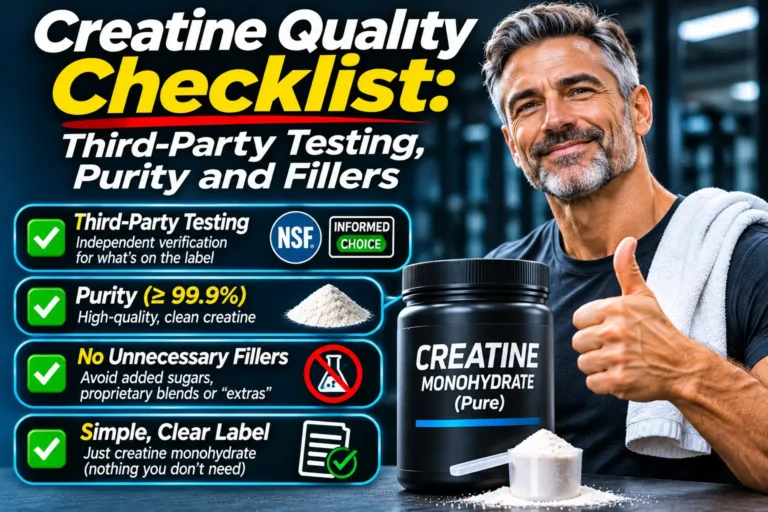
How can you tell a quality creatine monohydrate from a mediocre one? Start with the label. Choose a single-ingredient product that states creatine monohydrate clearly on the front and in the Supplement Facts panel. Flavors, blends and “proprietary” extras make quality harder to judge. Our guide on how to read a creatine label shows what to check.
Next, look for third-party certification such as NSF Certified for Sport or Informed Sport, and confirm the product in the certifier’s public database. Then prefer batch-specific Certificates of Analysis over vague “lab-tested” claims, and make sure the report matches the lot number on your container. Our creatine quality checklist walks through purity, impurities and heavy metals.
Finally, consider the source. Creapure is a German-made monohydrate that many brands use, and you can decide whether it’s worth the premium in our comparison of Creapure vs standard monohydrate. When you’re ready to buy, see our best creatine monohydrate supplements and our tested and ranked creatine supplements.
Frequently Asked Questions
What Is the Best Form of Creatine?
Creatine monohydrate. It has the most research behind it for strength, power and muscle, it’s usually the cheapest, and no other form has been shown to work better. Choose a plain product with third-party testing.
Is Creatine Monohydrate Better Than Creatine HCl?
For most people, yes, because HCl hasn’t shown better results and usually costs more. HCl is marketed for better solubility and smaller doses, but the evidence for those claims is limited.
Is Micronized Creatine Monohydrate Different?
It’s the same compound in finer particles. It dissolves more easily and feels smoother, but there’s no proof it builds more muscle than regular monohydrate. Choose it for texture, not for extra results.
Is Creapure Better Than Regular Creatine Monohydrate?
Creapure is a branded, high-purity monohydrate, and it works the same way as any other monohydrate. Its appeal is consistent quality control, not extra performance. A regular monohydrate with a verified seal and a matching lab report can be a good choice too.
Does Creatine Monohydrate Work the Same for Women?
Research suggests women respond much like men, with similar benefits for strength and lean mass when paired with resistance training. The same 3 to 5 gram dose applies. See our guide on the best creatine for women for picks.
What Happens to Your Muscles When You Stop Taking Creatine?
Your muscle creatine levels drift back toward baseline over about four to six weeks, and you may lose a little water weight. You won’t lose real muscle if you keep training, though high-intensity performance may dip slightly.
Conclusion
Creatine monohydrate has earned its reputation. You’re getting decades of research, proven gains in strength and muscle, and a strong safety record for healthy people, all at a low price. Newer forms haven’t beaten it, so you don’t need to chase trends. Take 3 to 5 grams daily, choose a third-party-tested product, and stay consistent. Not sure where to start? See our picks for the best creatine for men and the best creatine for women.





3 Comments